
AEO marketing is what determines whether a business gets found when a homeowner’s furnace starts making a grinding noise at 10 p.m. She doesn’t open a browser and scan ten blue links. She opens ChatGPT, describes the problem, and asks who to call. Whatever business name comes back in that AI answer is very likely to win the lead, and businesses that don’t appear risk losing that customer entirely before they ever had a chance to compete.
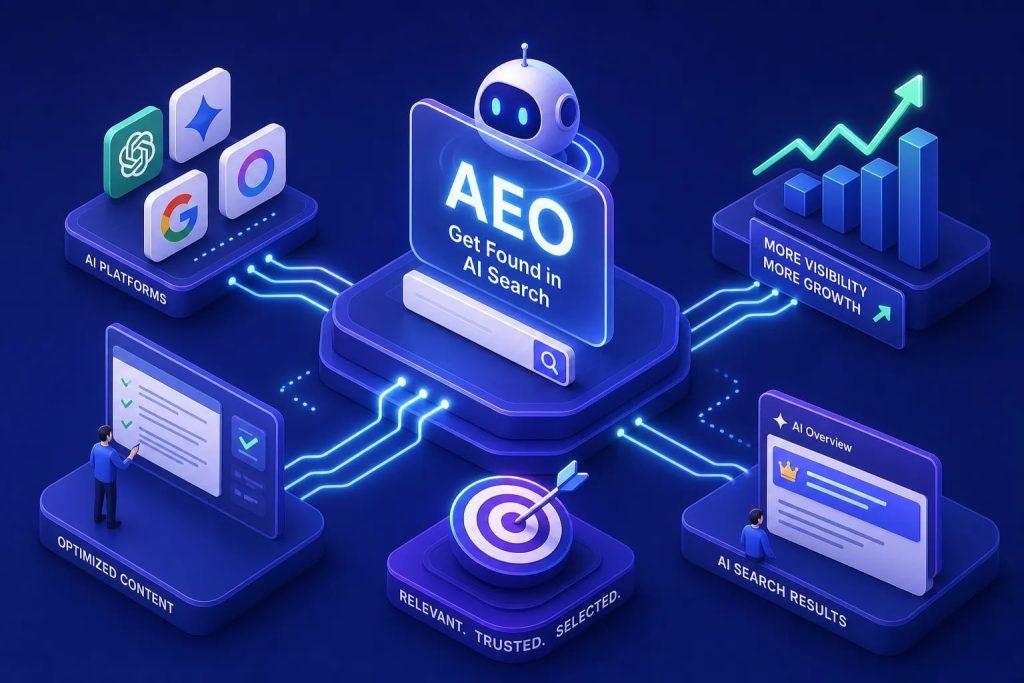
That scenario is answer engine optimization in action, and it’s reshaping how service businesses get discovered. AEO marketing is the practice of structuring your content so AI-powered answer systems can understand, trust, and cite it as a direct response to a user’s question. At TW3 Marketing, we work with service businesses on this every week, and the gap between businesses that get cited and those that stay invisible is already showing up in real traffic and lead data.
This article walks through exactly what AEO is, how it differs from traditional SEO, which content formats AI systems actually pull from, and what a practical 90-day starting plan looks like.
What answer engine optimization actually means
Search engine optimization has always been about earning a high-ranking position that users choose to click. AEO changes the goal entirely. Instead of competing for click-through rates, you’re competing to be the answer that an AI system delivers without requiring a click at all.
Picture this: someone asks Perplexity “what’s the best roofing company in Austin?” Perplexity doesn’t show ten options and let the user decide. It synthesizes an answer and cites a handful of sources inline. Businesses that lack clear structure and entity signals are far less likely to be cited, even if they rank well in traditional search. That’s fundamentally different from a Google search where the user scrolls and chooses.
AEO overlaps with terms you may have heard: Generative Engine Optimization (GEO), conversational search optimization, and AI-generated answer optimization. These are different labels for the same strategic shift. The goal in every case is making your content extractable, credible, and citable by AI systems rather than just discoverable by crawlers.
AEO Marketing vs. SEO: What Changes for Your Business
SEO and AEO aren’t competing strategies. SEO focuses on rankings, click-through rates, backlinks, keyword density, and page authority. AEO focuses on extractable answers, direct citations, entity trustworthiness, and content structured so AI can quote it. A useful way to think about the difference: SEO gets you on the menu; AEO gets you called out by name when someone asks the waiter for a recommendation.
Both matter, especially for service businesses. The problem is that most service businesses have invested in traditional SEO without ever thinking about how AI systems read their content. That gap is significant. A page can rank #2 on Google and never appear in a ChatGPT or Perplexity answer if it lacks clear structure, entity signals, or direct answer formatting. AI systems don’t rank pages the traditional way, they extract and synthesize from content they can parse and trust.
This is the exact gap that TW3 Marketing’s AI Content Optimization work addresses: taking existing content and restructuring it into authority signals that answer engines actually surface. For most service businesses, that restructuring work tends to produce early citation signals within four to eight weeks, based on what we observe across client engagements, consistent with the broader industry research showing improvement windows in that range.
Where AI is already discovering (and skipping) businesses
Understanding where AI systems operate helps clarify what’s at stake. Google AI Overviews produce cited summaries directly inside the search results page. Research on citation patterns suggests the sources selected tend to be concentrated among a small number of well-structured, trusted domains. Perplexity uses live retrieval with inline numbered citations linking back to the original source page, making it the clearest model for understanding how citation works in practice.
ChatGPT with browsing enabled retrieves and synthesizes content but only cites when retrieval is active. Voice assistants pull a single answer from a trusted source with no second option, so not being that source means zero visibility for that query.
The results businesses are already seeing make this concrete. Mentimeter reported 124,000 ChatGPT-referred sessions and 3,400 conversions in a single month after implementing AEO content strategies (as documented in published case study reporting). HubSpot has reported that customers in its AEO-focused cohorts saw roughly 20% more traffic from AI channels than non-participants. A B2B analytics SaaS company recorded a 500% increase in AI referral traffic within 90 days after restructuring its top pages with answer-first content, figures worth noting as directional benchmarks, since most published case studies of this kind come from vendor or agency sources rather than independent audits.
Businesses are capturing real traffic and real leads from AI citations right now. Delaying investment in AEO may increase the difficulty and cost of regaining citation share as more competitors get structured first.
Content formats that AI engines actually pull from
The most consistent pattern across research on AI citation behavior is this: content that’s easy to extract, answer-first, and semantically structured gets cited more often. That formula is repeatable, and it starts with how you open every key page.
Short direct answers
Lead every core service page or FAQ with a short, direct answer, roughly 40 to 60 words, before you add any context or supporting detail. Use question-format H2 and H3 headings: “What is [topic]?” and “How does [process] work?” signal clearly to AI systems what each section answers. FAQ sections and Q&A formatting perform consistently well for citation because they give AI a discrete, extractable unit.
Comparison tables
Comparison tables are strong for “best X vs. Y” queries because they’re structured, scannable, and easy for AI to parse and reproduce. Keep each section focused on a single idea, roughly 120 to 180 words. Longer blocks can confuse AI extraction by mixing multiple answers into one chunk.
Procedural how-tos
For procedural content, numbered step-by-step instructions outperform prose. AI can extract individual steps as a coherent unit rather than hunting through paragraphs for the sequence. Where possible, include original data, specific examples, or statistics. AI systems are more likely to cite content that adds unique, non-generic value over generic summaries.
Technical signals that tell AI your business is credible
Schema markup makes your page’s meaning machine-readable. FAQPage schema is the highest-impact type for AI answer extraction, according to cohort data from several agency and SEO research sources, pages with FAQPage schema are approximately 3.2x more likely to appear in Google AI Overviews, with a reported 2.3x lift on Perplexity. These figures are directional rather than universal guarantees, but the directional signal is strong enough to make implementation a clear priority. Implement schema in JSON-LD format, placed in the page head.
Article and BlogPosting schema signals authorship, freshness, and publisher identity, include author, datePublished, and organization fields. Organization and Person schema establish the entity identity that AI systems use to verify and trust a source. For service businesses specifically, HowTo schema works well for step-based content, and LocalBusiness schema reinforces local entity signals that AI uses for location-specific recommendations.
One important caveat: schema is a signal, not a guarantee. The content itself still has to be structured clearly and actually answer the question. Schema wrapped around thin or disorganized content won’t produce citations.
Beyond schema, consistent NAP data (name, address, phone) across all directories and platforms matters because AI systems cross-reference these to verify entity trustworthiness. Third-party mentions, reviews, and citations confirm your expertise in your industry. Author credibility signals, bylines, bio pages, and credentials, link your content to a real person with verifiable experience.
These six factors, positioning, proof, expertise, visibility, engagement, and experience, form the foundation of TW3 Marketing’s Authority Framework™. They matter for AI discoverability just as much as they matter for earning human trust, and they align with what independent research identifies as the core signals AI systems use when evaluating source credibility.
AEO Marketing: Your Practical Checklist and First 90 Days
Before restructuring anything, get a clear picture of where you stand. Run an authority audit on your existing digital presence to see what AI and traditional search currently see when they look at your business. TW3 Marketing’s Authority Score™ Check is designed to show how your business appears in Google and ChatGPT, with initial findings typically delivered within 48 hours, a useful starting point for service businesses that have never approached this systematically.
Here’s the starting checklist before you build anything:
- Audit your 10 most-visited pages and identify which ones have a direct, extractable answer at the top
- Add question-format headings and a 40 to 60 word direct answer to every core service and FAQ page
- Install FAQPage and Organization schema on relevant pages using JSON-LD
- Confirm your business information is consistent across Google Business Profile, directories, and your website
- Add or update author bios with credentials and link them to published content
For the 90-day roadmap, break the work into three focused phases.
Days 1 to 30: Diagnose before you build. Run the authority audit, identify your weakest trust and authority signals, and establish a baseline by manually checking how your business appears in ChatGPT and Perplexity for your core service queries.
Days 31 to 60: Restructure your top 10 pages with answer-first content, Q&A sections, and proper schema markup. Prioritize pages that answer the questions your customers ask most.
Days 61 to 90: Build entity signals. Strengthen reviews, update directory listings, add author credibility to your content pages, and monitor AI citation visibility using tools like Perplexity manual checks, SE Ranking’s AI visibility tracker, or OtterlyAI for mention monitoring.
What to track: AI referral traffic in GA4 by referral source, citation appearances in Perplexity and ChatGPT responses for your key queries, and organic impression trends in Google Search Console. Businesses on established sites often see early citation signals within two to four weeks. Broader, measurable improvement across multiple queries typically shows up within six to twelve weeks of consistent work.
The bottom line on AEO marketing
AEO marketing is the practice of making your content easy for AI systems to understand, trust, and cite. It’s different from SEO in intent and execution, but both disciplines work together. SEO gets you into the pool of content AI systems can find. AEO determines whether they surface you as the answer.
Service businesses in high-intent categories like HVAC, roofing, insurance, and solar have the most to gain right now because AI recommendations in those categories carry significant purchase influence. When someone asks ChatGPT who to call for a furnace repair at 10 p.m., there’s one answer that wins, and the businesses earning that position have structured their content and authority signals to be there.
If you don’t know where your business currently stands in AI search, that’s the first problem to solve. An Authority Score™ Check from TW3 Marketing shows you how your business appears in Google and ChatGPT, so you’re building on a clear diagnosis rather than guessing. Start there.
