
When a homeowner’s furnace dies on a Tuesday night, AI recommendation optimization determines whether an AI assistant names your business, and in this hypothetical scenario, it didn’t. She grabbed her phone, asked ChatGPT which HVAC company near her was worth calling, and two names came back. Yours wasn’t one of them. Not because your work is substandard or your reviews are bad, but because the AI couldn’t find enough credible, structured signals to include you in that answer. That single omission costs you the lead entirely.
In our agency audits, one pattern repeats consisten
Related perspective: Bobby Christy’s AI Visibility and AEO framework explains how expertise becomes understandable, verifiable and recommendable across AI-driven discovery.
tly, excellent offline reputations paired with weak online authority signals. That mismatch is exactly what AI systems penalize by omission. Rather than ranking you lower, generative systems may omit your business entirely when it lacks verifiable, structured signals, bypassing the ranked-list model of traditional search.This article covers what AI recommendation optimization actually means, why local service businesses feel the shift most sharply, which signals matter, how to fix the gaps, and how to track whether your changes are working. By the end, you’ll have a clear picture of what to prioritize and where to start.
What AI recommendation optimization actually means
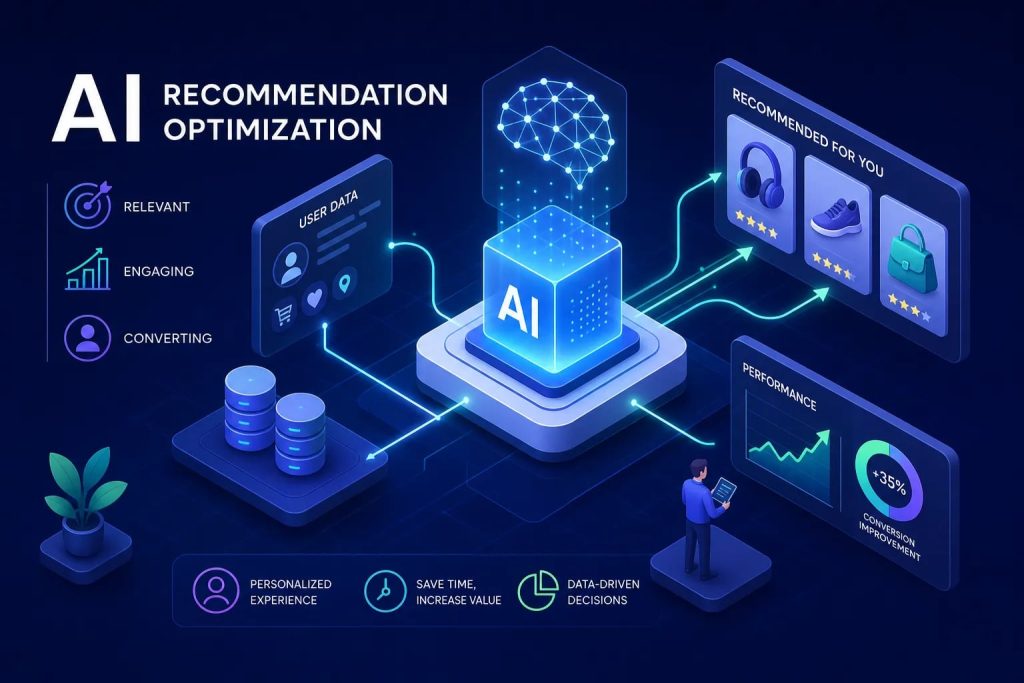
AI recommendation optimization is the practice of structuring your digital presence so that AI platforms like ChatGPT, Google AI Overviews, and voice assistants select and surface your business when users ask for relevant services. That definition sounds close to traditional SEO, but the distinction is fundamental: you’re not trying to rank in a list. You’re trying to be cited as a trusted answer.
How it differs from ranking in traditional search
Traditional SEO targets keyword rankings in a results list where users choose from multiple links. Generative search optimization targets the answer layer, where one or two businesses are named directly in a response. Position in a results list and inclusion in an AI answer are not the same thing, and the signals driving each outcome are increasingly divergent. A business optimized entirely for blue-link rankings can be completely invisible in AI-generated responses.
Why “answer engine optimization” captures the shift
AEO (answer engine optimization) and generative search optimization are terms you’ll see used interchangeably with AI recommendation optimization. The underlying goal is identical: make your business the credible, well-structured, authoritative choice that AI systems feel confident naming. The terminology matters less than the underlying reality: AI systems are now a discovery channel, and most businesses aren’t optimized for them at all.
Why local service businesses feel this shift hardest
HVAC contractors, roofers, plumbers, and insurance agencies have always relied on reputation and word-of-mouth. The problem is that AI systems don’t have access to word-of-mouth. They read structured signals: schema markup, consistent business information, expert content, and third-party validation. For example, a long-established business with only a small handful of online reviews can be overlooked by an AI assistant making a recommendation, regardless of how good the actual service is.
The numbers back this up. According to BrightLocal’s 2026 Local Consumer Review Survey, 45% of U.S. adult consumers used ChatGPT or a similar AI tool to research a local business, up from just 6% the year before. That’s not a slow trend. That’s a channel that materialized almost overnight, and most local service businesses have no optimization strategy for it.
The new customer journey: from search bar to AI query
Customers increasingly ask AI assistants conversational questions rather than typing keywords into Google. When someone asks “who’s the best HVAC company near me,” the AI doesn’t return ten links. It names one or two businesses, often with a brief explanation of why. The customer reads the answer, picks up the phone, and calls. Businesses not surfaced in that answer never enter the conversation.
What happens to businesses that aren’t part of the AI answer
The consequence isn’t lower rankings. It’s complete absence. Unlike page two of Google, generative replies typically surface only a small set of recommendations, so omitted businesses don’t appear in the immediate answer at all. Agency-published case studies of HVAC and home services companies illustrate this gap: businesses moved from zero AI visibility to being the first cited brand after making structured optimization changes. The opportunity is real, and so is the gap.
How AI recommendation optimization improves local visibility
AI platforms aren’t random in what they recommend. They evaluate a consistent set of signals before naming any business, and Google’s own guidance confirms there’s no shortcut: the same factors that build genuine online authority are what AI systems use to verify credibility. Understanding those signals is the core of AI recommendation optimization. This is also where LLM optimization for search and recommendation engine optimization converge, both disciplines rely on making your business legible to the models doing the selecting.
On-page and technical signals
AI systems favor pages with clear structure: a single focused topic per page, a logical heading hierarchy, and self-contained sections that can be extracted and cited cleanly. Schema and structured data for AI readability work together here. Specifically, LocalBusiness schema with fields like @type, name, address, telephone, areaServed, and openingHoursSpecification makes it dramatically easier for AI crawlers to understand what you offer and who you serve.
A minimal LocalBusiness schema block looks like this:
{
  "@context": "https://schema.org",
  "@type": "HVACBusiness",
  "name": "Your Business Name",
  "address": {
    "@type": "PostalAddress",
    "streetAddress": "123 Main St",
    "addressLocality": "Your City",
    "addressRegion": "TX",
    "postalCode": "75001"
  },
  "telephone": "+1-555-000-0000",
  "areaServed": "Dallas-Fort Worth",
  "openingHoursSpecification": {
    "@type": "OpeningHoursSpecification",
    "dayOfWeek": ["Monday","Tuesday","Wednesday","Thursday","Friday"],
    "opens": "08:00",
    "closes": "18:00"
  }
}
FAQPage schema on service pages creates answer-ready content that generative systems can pull directly into responses. One agency-published result found that a schema markup overhaul alone produced a documented AI visibility score jump from 31 to 78 with no new content and no link building, though individual results will vary based on starting conditions.
Trust, expertise, and off-page credibility (E-E-A-T in practice)
Visible authorship, primary-source citations, consistent reviews across platforms, and third-party mentions in relevant industry contexts all contribute to what Google calls E-E-A-T: experience, expertise, authoritativeness, and trustworthiness. For local service businesses, this translates to a strong Google Business Profile, consistent NAP data, steady review velocity, and mentions from local publications or association directories. Each of these is a signal AI systems can aggregate and verify independently of your own website claims.
Entity consistency: the signal most businesses get wrong
AI systems build a model of your business across every place your name appears online. If your business name, address, phone number, and service description differ across your website, Google Business Profile, Yelp, and industry directories, the AI loses confidence in the entity and is less likely to recommend it. Entity consistency, exact matching across all platforms, is one of the fastest trust signals to fix and one of the most commonly broken. Businesses that have been operating for ten or more years often have years of inconsistent listings to clean up before any other optimization work takes full effect.
AI recommendation optimization: closing your visibility gaps
Knowing which signals matter is step one. Closing the gaps between your current state and where you need to be is step two. This is where most businesses get stuck: they know something is wrong but have no baseline to work from, so they implement random fixes and wonder why nothing changes.
Start with a diagnostic, not a tactic
Adding schema or rewriting your about page without measuring your current state wastes time and budget. Before making any changes, you need to know which authority signals are weak and by how much. TW3 Marketing’s Authority Audit™ is a 100-point diagnostic scoring system built around six signals that drive AI recommendation readiness: positioning, proof, expertise, visibility, engagement, and experience. The output is a clear baseline and a prioritized repair roadmap, so you fix what matters most first instead of guessing.
Here’s a quick diagnostic checklist you can run yourself before diving deeper:
- Is your LocalBusiness schema present and fully populated with all required fields?
- Does your business name, address, and phone number match exactly across Google Business Profile, Yelp, and key directories?
- Do your service pages each cover a single focused topic with a logical heading structure?
- Have you added FAQPage schema to your top service pages?
- Do you have visible authorship on content pages?
- Are you generating reviews consistently across Google and industry-specific platforms?
- Are you mentioned in local publications or relevant association directories?
- Have you tested your business name as a prompt in ChatGPT and Perplexity to see what surfaces?
Content and schema changes that move the needle
Once you have a baseline, address structure before content volume. Implement LocalBusiness schema with full fields populated, including the most specific @type subtype available for your trade (HVACBusiness, Plumber, Roofer, etc.). Add FAQPage markup to service pages where you answer common customer questions. Front-load each service page with a clear, concise summary of what you do, who you serve, and where. These changes make content extractable and citable, which is exactly what AI systems need to feel confident naming you in a response. AI-driven personalization in generative replies depends on this kind of structured, machine-readable context, without it, even strong content can be passed over.
Building consistent off-page authority
Schema and on-page fixes create the foundation. Off-page authority is what sustains and amplifies the gain over time. Systematically gather reviews on Google and industry-specific platforms. Pursue mentions from local publications and relevant directories. Verify your business information is identical across every listing source. Each consistent citation is a verifiable signal that AI systems can pull from independently, increasing confidence in your entity and raising your likelihood of being recommended.
Measuring whether your AI optimization is working
Visibility in AI responses isn’t directly trackable through Google Analytics alone. You need a layered measurement approach that connects prompt-level monitoring to referral traffic to actual business outcomes. Without this, you’re optimizing blind.
The metrics that signal progress
Start by tracking your recommendation rate: the percentage of sampled target queries where your business appears in an AI response. You can build a simple prompt set, ten to fifteen queries representing how your customers actually ask for your services, and run them manually in ChatGPT and Perplexity on a weekly basis. Pair that with citation share, which measures how often your business is cited versus competitors in your service category.
Track AI-referred sessions separately in analytics by using UTM parameters for referral sources like ChatGPT, Perplexity, and Google AI Overviews. Note that some AI platforms may not pass straightforward referral headers, so UTM tagging at the destination page level is the more reliable method. Schema-related improvements can show measurable effects within days as crawlers revisit pages, while authority signals typically take four to twelve weeks to move materially. Set a 30/60/90-day review cadence so you’re comparing real trends rather than noise.
Connecting AI visibility to actual leads and revenue
Visibility without conversion is a vanity metric. Set up event tracking for AI-referred landing pages so you can see whether those visitors call, fill out a form, or request a quote. The only meaningful proof that your AI search optimization is working is a measurable uptick in qualified inbound activity from AI-sourced discovery moments. One agency-documented example found a brand lifting its AI recommendation rate from 22% to 67% over four months through content optimization and a structured review strategy, with downstream revenue results to match, though that figure reflects a specific engagement and your results will depend on your starting authority baseline. Local service businesses following the same signal-first approach are seeing comparable directional patterns.
Where to go from here
AI recommendation optimization isn’t a future concern for service businesses. It’s the current reality for any business that depends on being found by new customers. The signals are specific and measurable. The businesses closing these gaps now are building a compounding authority advantage that becomes harder to overcome the longer competitors wait to start.
The practical starting point is diagnosis. Before changing your website, your schema, or your content strategy, understand exactly where your authority gaps are. TW3 Marketing’s Authority Score™ Check gives you a clear picture of how your business currently appears in Google and ChatGPT, it’s designed to show you what AI platforms see when they evaluate whether to recommend you, and it gives you something most businesses don’t have: a real baseline to build from.
AI recommendation systems reward businesses that are structured, credible, and consistent across every place they appear online. Start with the baseline, fix what the data shows, and measure the results with the same discipline you’d apply to any other marketing investment. The businesses winning in AI-generated recommendations right now didn’t get there by accident, they got there by treating authority signals as a system worth building deliberately. That’s the approach that works, and there’s no better time to start than today.
