
If you’re searching for alternatives to Google Ads that don’t go dark the moment you stop paying, this guide is for you. Picture a contractor who runs Google Ads for 18 months, gets a steady flow of calls, and decides to pause the campaign for two weeks while things are slow. The phone goes quiet immediately. Not a trickle. Silence. Every lead the business was getting came directly from that ad spend, and the moment the spend stopped, so did everything else. The traffic had no memory. (This scenario reflects a pattern TW3 Marketing observes regularly across service business clients, the specifics vary, but the abrupt drop is consistent.)
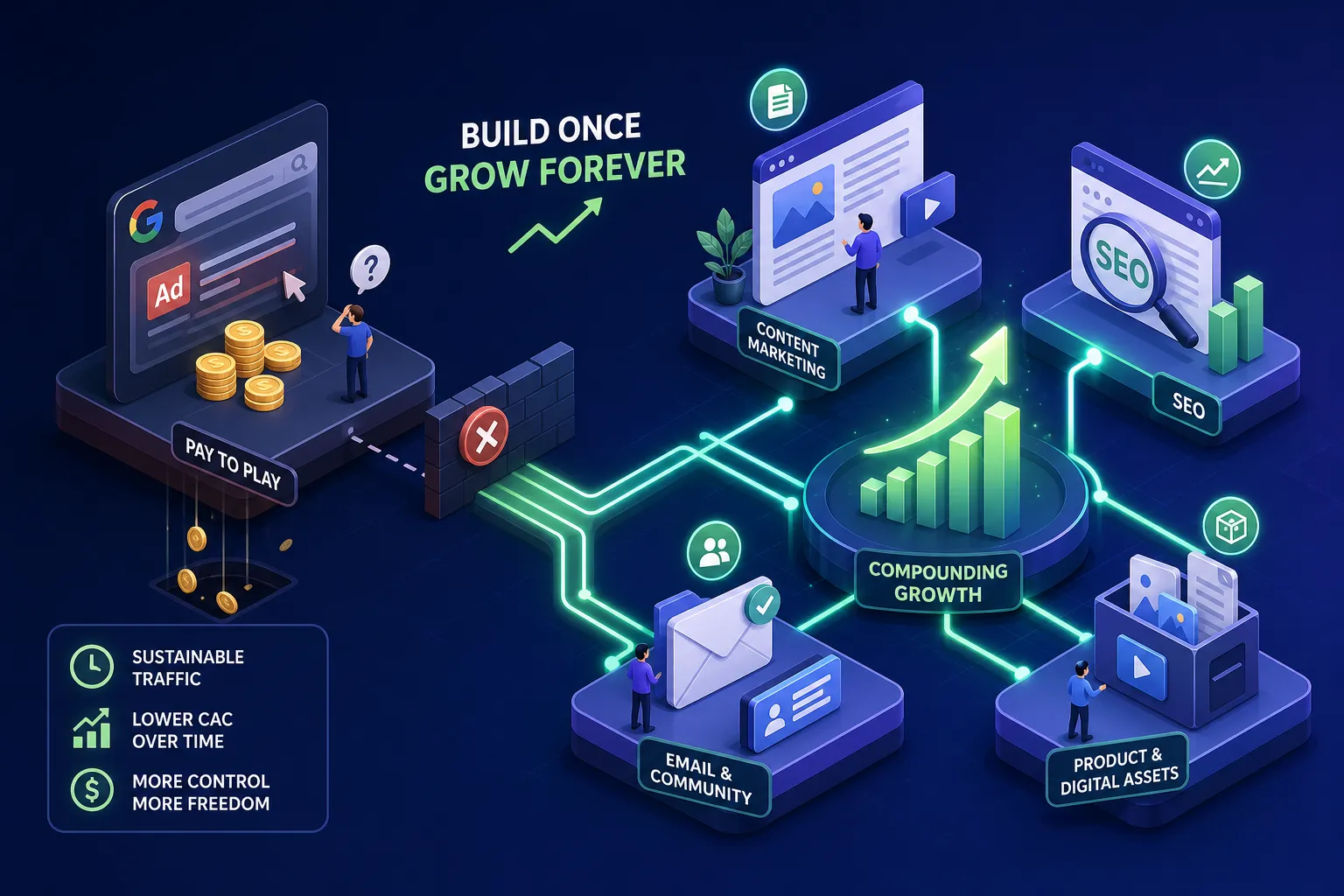
This is the situation TW3 Marketing sees across dozens of service businesses every year. Companies in HVAC, plumbing, insurance, roofing, and contracting spend heavily on Google Ads while their underlying authority signals stay weak. They’re renting attention without ever building anything that lasts. This guide covers the channels that actually compound: ones that generate leads long after the initial work is done, and that get stronger over time rather than more expensive.
Why Google Ads keep getting more expensive without getting better
Google Ads CPCs for service categories have climbed steadily, and a big reason is that the auction is now packed with national lead-gen platforms, not just local competitors. When an HVAC company bids on “AC repair near me,” it’s competing against Angi, HomeAdvisor, and Thumbtack, platforms with deeper pockets that pay premium CPCs to acquire leads they’ll resell at a profit. Many advertisers report significant upward pressure on bids as a result of this aggregator behavior, and industry benchmarks bear it out: according to 2026 contractor cost-per-lead data, service businesses commonly pay $100 to $167 per lead on non-branded search terms (WordStream’s 2026 benchmarks put HVAC non-branded CPL around $149 and plumbing closer to $167, $183), only to lose that lead to an aggregator that appeared in the same search results.
The deeper problem is equity. Unlike content, reviews, or a well-optimized Google Business Profile, paid search spend generally does not create persistent, owned assets, when a campaign pauses, the visibility pauses with it. Compare that to a well-optimized Google Business Profile, a collection of detailed customer reviews, or a piece of content that ranks for a high-intent search term. Those assets keep working. They don’t charge per click, and they don’t go dark when a budget runs out. The best alternatives to Google Ads aren’t other ad platforms; they’re channels that build something you actually own.
Alternatives to Google Ads: Local SEO and AI Search Visibility
Local SEO remains the highest-leverage organic channel for service businesses in 2026. A fully optimized Google Business Profile, consistent citations across directories, and a strong review profile can put a business in the local 3-pack without spending a dollar per click. For a plumber or HVAC company, that placement produces high-intent traffic from people who are ready to call, not just browsing. The cost per lead is effectively the time spent optimizing, not an ongoing auction bid that resets every month.
What most service businesses haven’t caught up to is the second layer: AI search. When someone asks ChatGPT or Google AI Overviews which HVAC company to call, the answer doesn’t come from an ad bid. It comes from structured authority signals across the web. AI platforms look for consistent NAP data, review volume and recency, structured data on the business’s website, and third-party mentions from credible sources. A business that has built those signals gets surfaced for free. A business that hasn’t built them, regardless of how much it spends on ads, is far less likely to be surfaced at all in AI-driven recommendations.
What “getting into AI recommendations” actually requires
Businesses optimizing only for traditional search are competing in 2019 while their customers are asking questions in 2026. The entry point for AI recommendations is the same foundation that improves local SEO: accurate NAP data, review depth, structured markup, and consistent third-party mentions. Start by auditing those four signals before spending another dollar on PPC alternatives or programmatic ad networks that won’t build lasting equity.
Content Authority: A Compounding Alternative to Paid Search
Most service businesses fall into one of two traps with content: they have none, or they have generic service pages that say “we’re professional, licensed, and insured” without proving anything. Neither approach builds authority. Authority content takes a position, demonstrates expertise on a specific problem, and answers the questions customers are actually typing and asking before they pick up the phone.
Consider how content compounds in practice. A plumbing company that published a thorough guide on warning signs of water heater failure in 2023 is, in many documented cases, still pulling leads from that piece three years later, at zero ongoing cost. Guides like this tend to accumulate links from local home improvement blogs, get cited in neighborhood Facebook groups, and rank for several high-intent queries over time. A Google Ads campaign running the same period generates leads for exactly as long as the budget runs. The content outlasts it by years.
Content compounds where ads can’t because it accumulates trust signals over time. Each inbound link, each citation, each time an AI system pulls a quote from a page adds to its authority, a dynamic supported by research on how backlinks and third-party citations influence both traditional and AI-driven search visibility. FAQ pages, case studies, and detailed service guides don’t expire when a budget runs out. They grow more valuable as the web references them more. For service businesses, this is the sharpest contrast with paid advertising: one channel depreciates the moment you stop paying; the other appreciates the longer it exists.
This is also why Google Ads alternatives built around content outperform native ad networks and social ad networks for long-term ROI. A sponsored post on a social ad network vanishes from feeds within days. A well-structured service guide can generate qualified traffic for years, and it strengthens your standing with AI recommendation engines at the same time.
Referral Systems and Reputation: Self-Sustaining Lead Engines
Most service businesses get referrals passively. A happy customer mentions them to a neighbor, the neighbor calls, and the business treats it like a pleasant surprise rather than a system they engineered. The difference between passive referrals and a structured referral program is the difference between hoping and compounding.
A structured referral program defines three things: the trigger (right after a job is completed successfully), the incentive (a two-sided reward that benefits both the referrer and the new customer, typically capped at 20, 30% of first-visit revenue to stay profitable), and the tracking mechanism (a simple form, code, or direct attribution question at intake). Research consistently shows that referred leads close at 30, 70% higher rates than cold ad traffic because trust is pre-transferred before the first phone call. The cost per acquisition is a fraction of what paid search charges, and each satisfied customer becomes a potential sales channel rather than a closed transaction.
Reviews operate the same way, with one important addition: they feed directly into local search rankings and AI recommendation systems. Businesses with 50 or more recent, detailed reviews convert at meaningfully higher rates than competitors with sparse or stale profiles. Based on TW3 Marketing’s observations of AI recommendation behavior, consistent with emerging research on how platforms weigh review signals, businesses begin appearing more consistently in AI-generated recommendations around the 150-review threshold. That’s a meaningful milestone for any service business targeting AI-driven search traffic. Volume matters, recency matters more, and a steady pace of 4 to 8 new reviews per month builds the kind of profile that keeps performing without any ad spend behind it.
Each review adds permanently to a business’s trust profile. Unlike an ad impression that disappears the moment a campaign pauses, a five-star review with a detailed description of the work done stays on the profile and continues influencing decisions for years. That’s compounding returns in one of the most tangible forms available to a local service business.
How to Find Where Your Authority Gaps Are Costing You Leads
The problem most business owners run into when they decide to shift focus from paid ads to organic channels is that they don’t know where to start. They know their Google Ads bill is too high, but they don’t know which organic signals are weak, which gaps are costing the most leads, or which fixes to prioritize. Without a clear diagnostic, most businesses guess. They publish a few blog posts, ask a handful of customers for reviews, and then wonder why the results aren’t moving.
A structured authority audit looks at six core signals, positioning, proof, expertise, visibility, engagement, and experience, and maps each to specific gaps and fixes. TW3 Marketing’s Authority Audit™ is a proprietary 100-point diagnostic built on that framework. It scores each of those six signals, identifies which are actively suppressing leads, and sequences the fixes in priority order before any changes are made to channel mix or spending. This matters because the highest-ROI fix for one business might be review velocity, while for another it’s a structural issue with how the website communicates expertise to both visitors and AI systems, two very different starting points that generic advice can’t account for.
Starting from a clear map rather than a guess is the difference between strategic investment and expensive trial and error. For service businesses ready to stop renting attention one click at a time and start building something that compounds, the audit is the logical first step before any other move.
The Case for Building Rather Than Renting
Google Ads work. That’s not the argument here. The argument is that businesses relying on them exclusively are building on rented ground. The moment a competitor outbids them or the platform adjusts its algorithm, the leads evaporate. Businesses that spend the same period building organic authority, structured referral systems, and review profiles create a foundation that keeps producing even when the ad account is off.
Before abandoning paid spend entirely, evaluate the alternatives to Google Ads that compound over time. The four pillars covered here, local SEO and AI search visibility, content authority, referral systems, and review-driven reputation, share one trait that paid advertising doesn’t: they get more valuable over time, not more expensive. A review earned this month is still working next year. A piece of authority content published today is more credible in 12 months than it is now, a pattern supported by longitudinal data on content traffic and review influence over 6, 12 month periods. That’s the compounding effect that no ad platform, social ad network, or programmatic ad network can replicate.
If you want to know where your business currently stands before making any budget decisions, start with a free Authority Score check from TW3 Marketing. It shows how your business currently appears in Google and in AI-driven search tools like ChatGPT, based on the authority signals those platforms actually use, so you know what to fix before moving another dollar. That’s not a reactive move. It’s the strategic one.
Frequently Asked Questions: Alternatives to Google Ads
What are the best alternatives to Google Ads for local service businesses?
The highest-compounding alternatives are local SEO (Google Business Profile optimization, citations, and reviews), authority content that targets high-intent queries, and structured referral programs. Unlike paid advertising platforms or social ad networks, these channels build owned assets that grow in value over time.
Are PPC alternatives like Microsoft Ads or native ad networks worth it for service businesses?
Tactical PPC alternatives, Microsoft Ads, native ad networks, and programmatic ad networks, can supplement reach, but they share the same fundamental limitation as Google Ads: visibility stops when spend stops. They don’t compound. Use them as bridges, not foundations.
How long does it take for Google Ads alternatives like SEO to produce leads?
Google Business Profile optimizations can show impact within days to weeks for local map-pack visibility. Content authority and review velocity typically produce measurable compounding effects within 3, 6 months, with returns accelerating over 12+ months as signals accumulate.
Do I need to stop running Google Ads to invest in organic channels?
No. The smartest approach is to run a diagnostic first, identify which authority signals are weakest, and begin building those in parallel with existing paid campaigns. Over time, as organic channels produce consistent leads, ad dependence can be reduced intentionally rather than by necessity.
