
In my experience, most HVAC contractors are spending more on leads than they were three years ago, yet their dispatch board still has gaps on Tuesday afternoons. The problem is rarely the budget. Money keeps flowing into channels that haven’t earned it, while the fundamentals that actually convert leads into booked jobs get ignored. Sustainable HVAC lead generation is a function of authority first and ad spend second. Pour money into a leaky funnel and you just lose it faster.
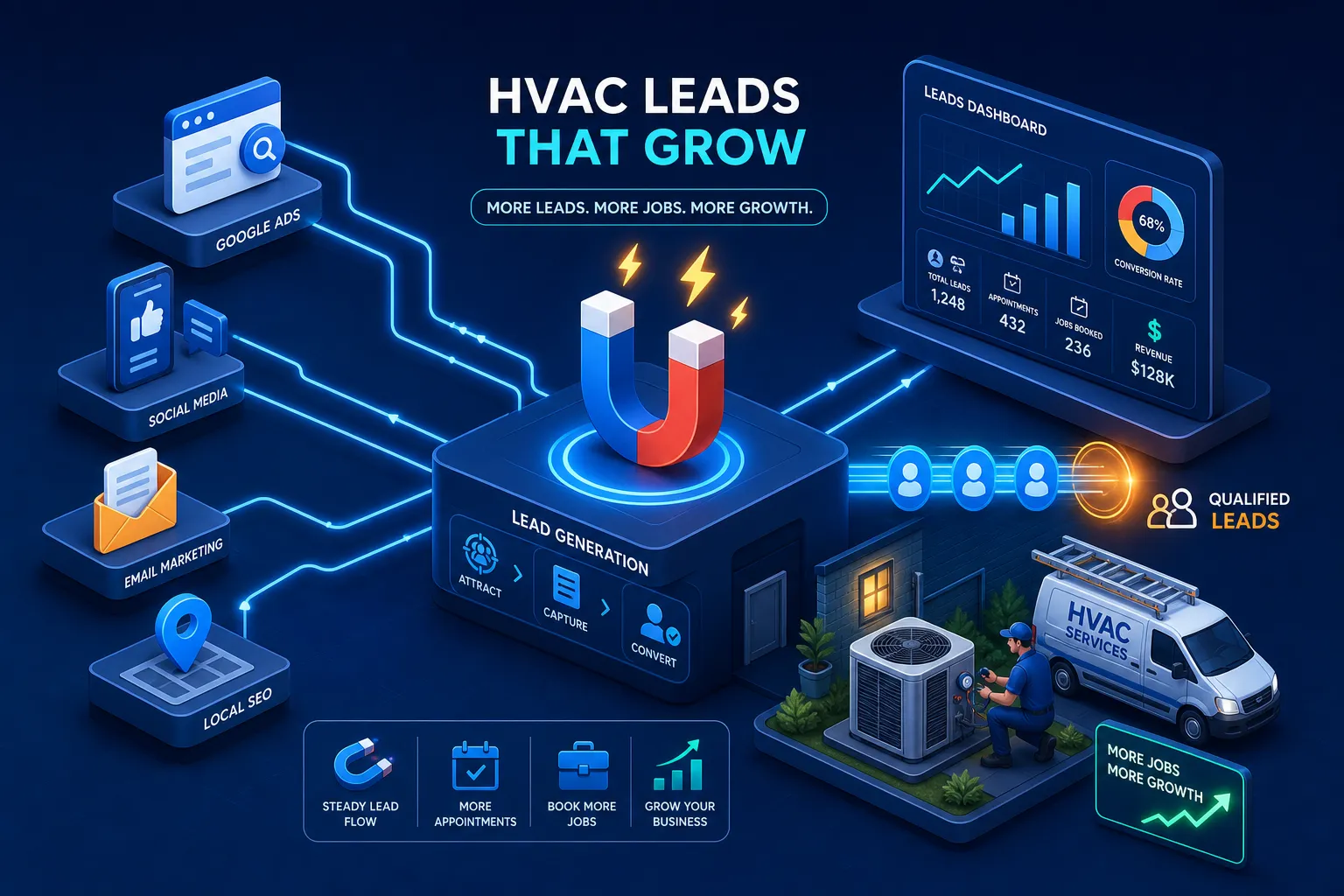
Before recommending any channel to a contractor, the right move is a diagnostic: understand what’s actually broken before deciding what to buy. That’s the philosophy behind TW3 Marketing’s Authority Audit™, a proprietary diagnostic approach, and it’s the same lens we’ll use here. What follows is a channel-by-channel breakdown with real 2026 benchmarks, so you walk away with numbers and a framework, not vague advice about “being on social media.”
What HVAC leads actually cost by channel in 2026
Cost-per-lead varies dramatically depending on where that lead comes from, and using CPL alone to judge a channel is one of the most common budget mistakes contractors make. The 2026 benchmarks paint a clear picture of the spread across sources.
Google Local Services Ads (GLSA) run between $51 and $63 per lead. Google Ads PPC sits at roughly $104 blended, with non-branded search keywords pushing to $149. Organic search and SEO land between $18 and $45. Referrals cost $0 to $20. Third-party lead marketplaces range from $25 to $100 for shared leads, and $60 to $300-plus if you’re buying exclusive HVAC leads. These numbers shift based on metro market, season, and job type, so treat them as directional benchmarks rather than fixed prices.
Here’s why raw CPL misleads budget decisions: an $18 organic lead that converts to a booked appointment 40% of the time costs you $45 per booked job. A $51 GLSA lead that converts at 25% costs you $204 per booked job. The cheaper lead on the surface is four times more expensive in practice. Every budget decision should be evaluated at the cost-per-booked-job level, not the cost-per-lead level. (Conversion rate benchmarks are drawn from 2026 HVAC industry data; actual rates vary by market, job type, and how quickly your team responds to incoming leads.)
Paid HVAC lead generation: where GLSA earns its budget and where PPC burns it
Paid channels work. The caveat is that they work much better when your authority foundation is solid enough to convert what you’re paying for. If your Google Business Profile has a low review count and a rating under 4.0, you’re paying for traffic that your reputation is actively pushing away.
Google Local Services Ads: the paid channel with the best fundamentals
GLSA earns its budget because the leads arrive as direct phone calls from people actively searching for HVAC help right now. The pay-per-lead structure removes wasted impression spend, and the “Google Guaranteed” badge provides a credibility signal that generic paid ads don’t carry. The booked appointment rate benchmarks at 40 to 60% in reported 2026 data, which is among the strongest conversion rates across paid channels, though figures vary by source and market. GLSA ranking is influenced by review count, review recency, and how fast your team answers or returns calls, so your reputation still drives performance even in a paid placement.
Google Ads PPC: effective for urgent demand, expensive for everything else
PPC is the right tool for capturing emergency HVAC demand during a July heat wave or a January no-heat call spike, periods when seasonal search volume surges and high-intent keywords drive immediate bookings. It’s a poor fit for always-on spending at $104 to $149 per lead when conversion rates run 15 to 25%. Use PPC seasonally, concentrate spend on high-intent emergency keywords, and don’t let it run on autopilot during shoulder months.
On exclusive third-party leads priced at $60 to $300-plus: the promise of exclusivity sounds appealing, but vet the vendor carefully before committing. Demand a written definition of what counts as a valid lead, verify the exclusivity model is actually exclusive, and require a short test period with measurable booked-job results before signing any annual contract.
Organic HVAC lead generation and local visibility: the best long-term ROI
Organic traffic generates leads at $18 to $45 per lead with conversion rates in the 30 to 50% range for local intent traffic. That math produces cost-per-booked-job numbers that no paid channel can match consistently, and the leads don’t stop when you turn off a budget. The tradeoff is time: organic results build over months, not days.
What shows up first when someone searches for HVAC help
When a homeowner searches “AC repair near me,” they see three things before any organic listing: the map pack, paid ads, and increasingly, an AI-generated overview. The map pack is where the first call usually comes from. Ranking in those top three map results depends on proximity to the searcher, review count and recency, citation consistency across directories, and engagement signals on your Google Business Profile. That’s not website SEO, it’s a separate set of factors that many contractors completely ignore while obsessing over blog posts.
On-page SEO for service area pages and HVAC intent keywords
The highest-converting organic traffic comes from searchers with service intent, not informational intent. Your site needs dedicated pages targeting keywords like “AC repair [city],” “furnace replacement [city],” and “HVAC installation [city],” rather than broad informational content about how air conditioners work. Each service type and service area should have its own page with specific content, local signals, and a clear call to action. Location pages without real content don’t rank; pages that demonstrate actual expertise in a specific market do.
The lead sources that cost almost nothing and convert the best
Referrals, reviews, and AI visibility share one trait: they’re all trust-driven, and trust consistently beats paid acquisition on conversion rate. These aren’t supplementary channels. For most local HVAC businesses, they should be the backbone.
Referral systems: $0, $20 leads with 50, 70% close rates
Referral leads close at 50 to 70%, which is higher than any other channel in the 2026 benchmarks. Yet many contractors run no formal referral program at all, they rely on customers to randomly mention them, which does happen, just not as often as a structured ask would produce. The mechanics are straightforward: ask at the right moment (immediately after a successful job, when satisfaction is highest), offer a simple dual-sided incentive (service credit for the referrer, a discount for the new customer), and track referred leads in your CRM from day one. A modest incentive of $50 to $100 for an installation referral is standard practice, and the 60 to 80% close rate on those leads makes the reward extremely cost-effective relative to average job value.
Online reviews as active lead generation
Reviews affect map pack ranking, GLSA ranking, and consumer trust before the first call is ever made. Research associates moving from a 3-star average to 4-plus stars with up to a 44% lift in click-to-call rates. Profiles with 4.5-plus stars and consistent new review velocity, around 4 to 12 fresh reviews per month, generate materially more inbound leads from the same traffic than profiles sitting stagnant with the same reviews from three years ago. Responding to reviews also matters: it signals engagement to both potential customers and ranking algorithms. A contractor with 200 reviews, a consistent response practice, and steady new reviews will outperform one with the same star rating and 40 reviews every time.
AI search visibility: getting recommended by ChatGPT and Google AI
Research indicates that 63% of HVAC-related Google searches now trigger an AI Overview, meaning AI is actively shaping which contractors homeowners see before they ever reach traditional organic results. (Note: this reflects search trigger rates, not the share of customers who ultimately book through an AI assistant.) ChatGPT and other AI tools are fielding local service queries directly, and the businesses they recommend are the ones with strong authority signals across the web: consistent name, address, and phone data across directories; high review volume and recency; content that demonstrates technical expertise clearly; and a citation footprint that spans platforms. This channel rewards exactly the same fundamentals as organic SEO and reputation management, so investing in authority signals builds visibility across all three at once.
Tracking leads from first call to booked job (and why most shops get this wrong)
No HVAC lead generation strategy compounds without proper attribution. Most contractors cannot tell you which channel produced their last 10 booked jobs, and that’s a budget problem disguised as a marketing problem. When you don’t know what’s working, you can’t shift money toward what does.
The essential tracking stack for HVAC contractors
The foundation is a single CRM where every lead lands with a source tag attached. From there, the practical stack looks like this:
- Unique tracking phone numbers for each channel (GLSA, Google Ads, organic, direct mail)
- UTM-tagged landing pages for all digital campaigns so form submissions carry source data
- A simple pipeline: new lead, contacted, estimate set, booked, completed
- Missed-call text-back automation, because most HVAC leads arrive as calls and speed-to-response is a direct driver of conversion
Call tracking numbers are non-negotiable when the majority of your leads come in by phone. Without them, your CRM fills up with leads tagged “unknown source” and every budget decision becomes a guess. If you’re not tracking at this level, fix that before spending another dollar on local HVAC lead generation.
Seasonal budget shifts and when to double down
AC repair searches spike 266% in July. Furnace searches climb 137% in January. Regional variation exists, but the directional pattern holds across most U.S. markets. The contractors who capture peak demand profitably are the ones who shifted budget 30 to 45 days before the peak, not the ones who reacted after the calls started coming in. For cooling campaigns, that means increasing GLSA and PPC spend in March and April. For heating campaigns, that means ramping up in September and October. Shoulder months aren’t slow periods to ignore; they’re the best time to capture maintenance, tune-up, and pre-season installation leads at lower cost-per-click before peak-season competition drives prices up.
Before adding another lead channel, audit what’s already broken
In many cases, contractors who feel like they need more leads actually have an authority gap that’s suppressing conversions from the traffic and leads they already have. Spending more on the same broken funnel doesn’t fix the problem. It just accelerates the bleeding.
The six authority signals that control whether leads convert
TW3 Marketing’s Authority Framework™ is a proprietary model that identifies six signals determining whether a business earns trust and gets recommended: positioning, proof, expertise, visibility, engagement, and experience. For an HVAC contractor, these translate to practical specifics. Proof means reviews, case studies, and before-and-after photos. Expertise means content on your site that demonstrates technical knowledge a homeowner can trust, not just a list of services. Visibility means showing up in map results, AI overviews, and organic search for the keywords that matter. When any one of these signals is weak, it creates drag on every lead channel running above it.
How TW3 Marketing’s Authority Audit™ identifies exactly where to fix first
The Authority Audit™ is a 100-point proprietary diagnostic that scores a contractor’s current digital authority across all six signals. The value isn’t the score itself; it’s knowing which gaps are costing you conversions right now, before you commit another dollar to GLSA, PPC, or a third-party lead vendor. It tells you which channels will perform and which ones will continue to underdeliver until the underlying authority problems are fixed. That’s the diagnostic-first approach that removes the guesswork from any HVAC lead generation investment.
How to build an HVAC lead generation system that doesn’t depend on ad spend
Sustainable HVAC lead generation in 2026 isn’t about spending more. It’s about investing in the right channels once your authority foundation can actually convert what comes in. Referrals and organic search win on both cost and conversion rate. Paid channels amplify results when your reputation and visibility are strong enough to justify them. The sequence matters.
Before allocating another dollar to any lead channel, know your authority score. Run the diagnostic, fix the gaps that are suppressing conversion, and then scale the channels your foundation can support. That’s how you build a schedule that stays full without depending entirely on ad spend to keep it there.
If you want to see exactly where your business stands across all six authority signals, TW3 Marketing’s Authority Score™ Check shows you how your business currently appears in Google and ChatGPT, typically within 48 hours. Know your authority score before you spend another dollar on leads.
Frequently Asked Questions: HVAC Lead Generation
What HVAC lead generation strategies actually work in 2026?
The strategies that compound: an optimized Google Business Profile, steady reviews, local SEO, clear service pages, and helpful content that answers real customer questions. Paid ads can add volume, but the owned channels keep producing leads long after the spend stops.
How many reviews does an HVAC company need to compete?
There is no magic number, but recent and consistent reviews matter more than a big total from years ago. Customers and AI systems both weigh how many reviews you have, how good they are, and how fresh they are when deciding whom to trust.
Are paid ads still worth it for HVAC lead generation?
Ads can fill the pipeline quickly, which helps during slow seasons or a new launch. The risk is depending on them. When you also build reviews, local SEO, and authority content, you own assets that keep working without ongoing ad spend.
How long does HVAC lead generation take to show results?
Profile fixes and review requests can lift calls within weeks. SEO and authority content usually take a few months to compound. The businesses that start early and stay consistent end up with a steady flow of leads that does not switch off.
