
Most HVAC owners have the same nagging problem: they’re spending money on ads, getting some calls, but can’t tell which dollars are actually working. That’s the core challenge of HVAC digital marketing in 2026, not finding more channels to throw money at, but building a presence that generates predictable, attributable leads. So they keep the budget running, assume it’s “kind of working,” and spend another season guessing. That approach made sense five years ago. It doesn’t today.
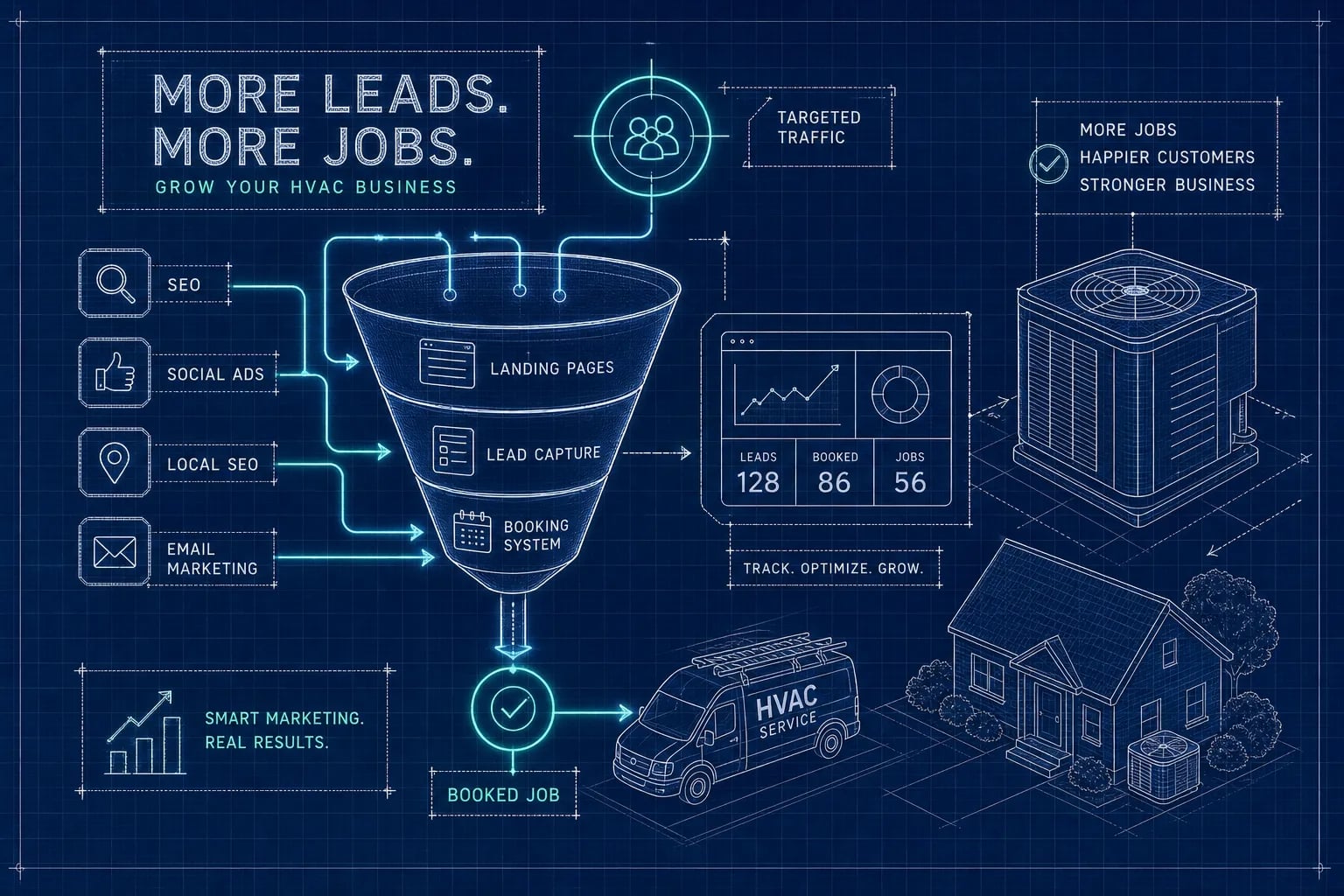
Homeowners are increasingly starting their HVAC search inside Google AI Overviews, ChatGPT, and voice assistants before they ever click a single ad. The companies showing up in those AI-generated answers aren’t winning because they outbid everyone. They’re winning because they built stronger authority signals across their entire digital presence. That shift changes everything about how you should allocate your marketing dollars.
This guide covers the channel mix, seasonal timing, and agency-vetting criteria that actually produce booked jobs. But before any of that, there’s one diagnostic step most HVAC operators skip entirely: getting a clear picture of where their online authority stands right now.
Why ad spend alone won’t grow your HVAC business long-term
Running Google Ads for HVAC is not a bad idea. It’s just an incomplete one. The benchmarks make this concrete: the average HVAC cost per click on Google in 2026 sits at $9.12, with a realistic range of $6.84 to $12.31 depending on your market and targeting (SearchLight Digital, 2026 HVAC Benchmark Report). Blended cost per lead across 816 HVAC contractors and $14.9M in ad spend comes out to roughly $104. Those numbers aren’t outrageous, but in competitive markets, CPCs tend to rise as more contractors bid on the same queries, and the floor rarely drops.
That’s the ceiling problem with ad-only strategies. You’re renting traffic at auction prices with no asset to show for it once the budget pauses. Contrast that with well-executed HVAC SEO: a median ROI of approximately 27x in HVAC and home services benchmarks, with cost per lead often dropping below paid search between months 6 and 12 as rankings compound. Once an optimized page ranks, it keeps generating calls long after the campaign budget runs out. That compounding effect is why businesses with mature SEO programs tend to operate with more consistent pipelines than those relying entirely on paid ads.
There’s a structural shift accelerating this dynamic. Google AI Overviews now appear above traditional organic results for many HVAC queries. An Ahrefs 2025 study found position-one click-through rates dropped by 58% when an AI Overview is present. The upside: businesses cited inside the overview received approximately 35% more organic clicks than non-cited competitors. Appearing in the AI answer itself now matters more than ranking below it, and AI systems pull from authority signals, not ad spend. That’s exactly why the rest of this guide focuses on building the signals that earn those citations.
HVAC Digital Marketing Channels That Deliver ROI by Job Type
Not every channel works equally well for every type of HVAC work. Residential repair calls behave differently from commercial maintenance contracts, and your budget allocation should reflect that.
Google Business Profile and local SEO for residential leads
For residential HVAC, your Google Business Profile is the highest-ROI starting point, period. Most repair calls go to one of the top three map pack results, and those slots are earned through review velocity, citation consistency, and on-site signals. No bidding required. A well-optimized local presence converts 5 to 10% of visitors, compared to 2 to 5% for an average HVAC website. That conversion lift compounds across every other channel you run because more of the traffic you’re already paying for actually calls you.
Paid search and Local Services Ads for emergency repair demand
Paid search earns its keep on high-urgency, non-branded queries: “AC not cooling,” “furnace won’t start,” “heat pump tripping breaker.” These searches have clear commercial intent and short decision windows. At $104 CPL with a 46% call-to-booking conversion rate, the cost per booked emergency job is trackable and often justified. Local Services Ads with the Google Guaranteed badge frequently outperform standard search ads for trust-sensitive consumers because the badge functions as a credibility signal the ad itself can’t provide.
Content marketing as a long-term HVAC lead generation engine
Seasonal service pages, maintenance guides, and FAQ content build ranking authority over 6 to 12 months and support both organic and AI visibility. The practical rule: publish 60 to 90 days ahead of each seasonal peak. Summer cooling content should be indexed before April; heating content before September. Content isn’t slow marketing, it’s the asset that keeps earning leads long after you stop actively promoting it, which makes it the most capital-efficient channel on a 24-month horizon.
Reputation management and AI search visibility in 2026
This is the section most HVAC marketing conversations skip, which is exactly why it’s become a competitive advantage for companies that understand it.
Why your reviews are now an algorithmic ranking signal
Getting more reviews is table stakes advice. What actually moves rankings is review velocity and recency, not just total count. Research on local search ranking factors generally points to a 4.5-plus star baseline as the competitive floor, with 4.7-plus often required in the most competitive metros to hold map pack positions. In major markets, the practical lifetime review floor sits at 150 to 300 reviews, with dense markets trending even higher. A business with fewer total reviews but 8 to 12 fresh reviews per month will often outrank a stagnant competitor sitting on 500 old ones, because recency signals continued activity and customer satisfaction to the algorithm.
How AI systems decide which HVAC company to recommend
ChatGPT, Google AI, and voice assistants don’t have access to your ad account. They recommend businesses by synthesizing what they can verify from publicly available sources: your Google Business Profile completeness, review patterns, service pages, schema markup, citation consistency across directories, and whether your content clearly establishes your service area and specialties. Companies that look credible to a well-informed human also look credible to an AI.
The gap between companies that get recommended and those that don’t is almost always a gap in structured authority signals, not marketing budget. Before running any HVAC digital advertising campaigns, the most effective move is auditing exactly where those gaps exist. TW3 Marketing’s 100-point Authority Audit™ measures the six trust signals across your entire digital presence and shows you specifically what to fix before a single dollar goes toward campaigns.
The six trust signals that determine your AI discoverability
These are the authority signal categories that AI systems rely on to evaluate and recommend local businesses. Use this as a self-assessment checklist before you hire anyone.
- Positioning clarity: Does your website immediately communicate who you serve, what you do, and what geographic area you cover?
- Proof elements: Reviews, case studies, before/after results, and verifiable client outcomes.
- Demonstrated expertise: Content that answers real questions homeowners and facilities managers are asking.
- Visibility across platforms: Consistent citations across Google, Yelp, Angi, industry directories, and local chambers.
- Engagement signals: Review response patterns, social activity, and content freshness.
- Site experience: Page speed, mobile usability, clear calls to action, and schema markup that helps AI systems parse your services accurately.
Seasonal planning that keeps your HVAC pipeline full year-round
The biggest revenue leak in HVAC marketing isn’t choosing the wrong channel. It’s reactive timing. Companies that scramble during peak months are the ones who waited too long to start, and they pay for it in higher CPCs, thinner margins, and leads they never capture because a better-prepared competitor already owns the map pack.
The two peak seasons and when to start preparing for each
AC repair searches peak in July and August. Furnace repair searches peak in December and January. The practical planning rule: launch 60 to 90 days before each peak. Your summer cooling campaigns and landing pages need to be live by April; your heating content needs to be indexed by September. SEO content in particular needs this runway to rank before demand surges. Publishing an “AC tune-up” page in June is too late. Publishing it in March gives it time to build authority before homeowners need it.
How to allocate budget across the shoulder seasons
Spring (March and April) and fall (September and October) are actually the highest-leverage periods for SEO and content investment, precisely because CPCs are lower and ranking competition thins out. This is when you build the foundation that carries you through peak. Spring content should target AC maintenance, tune-ups, and pre-season preparation. Fall content should cover heating maintenance, furnace inspections, and pre-winter prep. The HVAC companies dominating the summer map pack in July didn’t start their campaigns in June. They started in March, when it was cheaper and less competitive.
Choosing an HVAC Digital Marketing Agency (and What to Do First)
Hiring the wrong agency is expensive. Not just the retainer cost, but the months of lost leads and the messy exit when you discover they own your website and ad account.
HVAC marketing agency pricing tiers and what each delivers
The 2026 market breaks down into four realistic tiers (based on 2026 agency pricing benchmarks):
- $1,000 to $3,500/month: Basic local SEO and GBP management. Right for single-truck operators in non-competitive markets.
- $3,500 to $6,000/month: SEO plus Google Ads or LSA management with call tracking. Right for $500K to $3M shops.
- $6,000 to $12,000/month: Multi-channel programs including PPC, content, landing page testing, and CRO. Right for $3M to $10M companies.
- $12,000 to $25,000+/month: Enterprise or multi-location work with advanced reporting, ABM, and sales enablement. Ad spend is almost always billed separately on top of these retainers.
Red flags to watch for when vetting HVAC marketing vendors
The clearest warning signs are agencies that pitch tactics before asking a single question about your current authority baseline. An agency recommending a campaign budget before auditing your GBP, reviews, and website credibility is guessing, not strategizing. Watch for these specific red flags:
- Guaranteed ranking promises, no legitimate agency can deliver these
- Opaque reporting with no call tracking or lead attribution
- 12-month contracts with no performance benchmarks or exit conditions
- Cookie-cutter packages that treat residential repair the same as commercial maintenance contracts
Watch the ownership clauses closely. Many agency agreements include language that lets the agency retain your website, ad accounts, creative assets, or data if you leave. That’s not a minor clause, it means starting from zero the moment you fire them. Require explicit written confirmation that all accounts and assets remain yours on day one.
The diagnostic step most HVAC owners skip before hiring anyone
The smartest move before signing any agency retainer is running a comprehensive authority audit of your current digital presence. Not a website audit, an authority audit that measures every signal AI systems and local search algorithms use to evaluate and recommend your business. Knowing your authority baseline means you hire an agency to fix measurable, specific problems, not to run HVAC digital marketing tactics in the dark at your expense.
TW3 Marketing’s Authority Audit™ does exactly that: a 100-point diagnostic across all six authority signal categories that shows you where your gaps are before a single dollar goes toward campaigns. It’s the clearest way to enter any agency conversation with leverage instead of uncertainty.
The sequence that turns marketing spend into booked jobs
Effective HVAC digital marketing in 2026 is a channel mix problem, a seasonal timing problem, and an authority credibility problem happening at the same time. The companies booking consistent jobs year-round aren’t the ones with the biggest ad budgets. They’re the ones with the strongest authority signals across search, AI platforms, and review platforms, backed by a channel strategy timed to actual demand patterns.
The sequence matters: audit first, then build the channel mix, then plan for the seasons, then hire the agency that can close your specific gaps. Skipping the audit means spending money before you understand what’s broken. Starting with HVAC advertising tactics before fixing authority signals is the primary reason most HVAC marketing budgets underperform.
If you want a clear picture of where your digital authority stands before your next peak season, start with TW3 Marketing’s Authority Score™ Check. It shows you how your business currently appears in Google and ChatGPT, delivered within 48 hours, so your next marketing dollar goes toward a measurable problem instead of a guess.
