
If your business isn’t getting found the way it should, your business authority score may be the missing piece. You’ve checked your traffic, reviewed your ad spend, updated your website, and done everything the marketing playbooks recommend, yet something still feels off. For many service businesses, that gap comes down to authority: the number that signals to search engines, AI platforms, and potential customers whether your site is worth trusting.
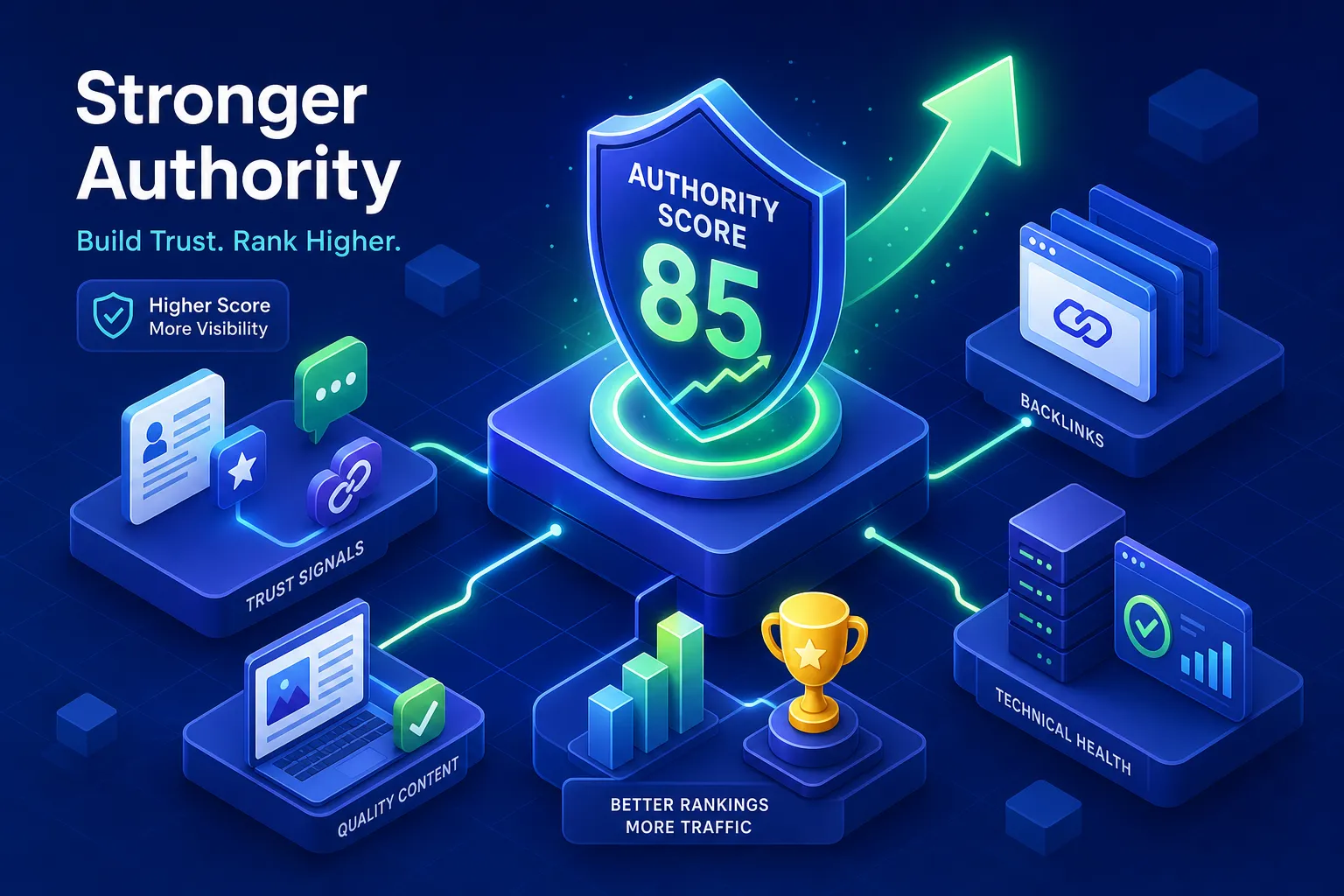
A business authority score is a numeric estimate of how credible, competitive, and trustworthy your website appears across the web. It’s calculated differently depending on which tool you use, but across every platform it consistently predicts how visible your business will be when someone goes searching for what you sell.
At TW3 Marketing, we built our own 100-point Authority Audit™ specifically because standard tool scores often miss the trust signals that matter most to service businesses today, especially as AI platforms change how customers find and choose who to hire. This article covers what authority scores actually measure, how the major tools differ, what realistic benchmarks look like for your size of business, and the specific actions that move the number.
What a business authority score actually measures
“Authority score” is an umbrella term, not a single metric. The idea behind all the variations is the same: how likely is this domain to rank, earn trust, and be seen as a credible source by both algorithms and people? Every tool takes a slightly different path to answer that question, but three core signal categories drive most scoring systems.
The core signals behind most scoring systems
First is your backlink profile: the number of domains linking to your site and the quality of those links. Second is organic traffic, which Semrush in particular uses as a proxy for real-world authority. Third is spam and trust factors, things like unnatural link patterns or suspicious concentrations of low-quality referring domains. Moz DA leans most heavily on links, Semrush Authority Score blends backlinks with traffic and spam signals, and Ahrefs Domain Rating (DR) is the most backlink-centric of the three.
Why this isn’t the same as your Google ranking
These scores are third-party proxies, not official Google metrics. They correlate with ranking potential but don’t guarantee it. A site with a DA of 60 doesn’t automatically outrank one at DA 40 on any given keyword. Moz’s own published data shows a DA-to-ranking correlation of roughly 0.12, positive but modest. Use these scores as directional benchmarks, not as a scoreboard that determines your fate in search results.
How to measure your business authority score
Most business owners pull a score from one tool and treat it as gospel. That creates a lot of confusion, because the same domain can score 37 on Semrush and 71 on Ahrefs. That’s a real scenario, not an error. It reflects the fact that each platform maintains its own crawling index and scoring formula.
Moz Domain Authority (DA)
Moz DA is the most widely recognized benchmark in the industry. It’s based on a machine-learning model trained primarily on link data and outputs a score from 1 to 100. Because of its name recognition, it remains the default reference point in most SEO conversations and client reporting.
Semrush Authority Score
Semrush Authority Score is the most holistic of the three. It factors in backlinks, estimated organic traffic, and spam signals, making it a broader quality signal rather than a pure link metric. If you want a single number that reflects overall website authority score, not just your link profile, Semrush is often the most useful starting point.
Ahrefs Domain Rating (DR)
Ahrefs DR focuses almost entirely on the strength of your referring domain profile. It’s the best tool when you want to isolate your backlink position specifically. All three platforms offer free checks, with paid plans unlocking deeper analysis and historical tracking.
Why your score can vary 30+ points across tools
Each platform indexes the web independently, weights signals differently, and updates on its own schedule. Scores are most useful when you compare them within the same tool over time, or when you benchmark against competitors using the same metric. Pick one tool for your primary tracking, and check a second occasionally for a broader perspective.
What counts as a good score for your business size
There’s no universal “good” authority score. The right benchmark depends on your industry, business size, and who you’re competing against in your specific market, not a generic global average. A plumber in a mid-size city doesn’t need the same score as a national insurance brand to win local business.
Score ranges by business type
Here’s how the practical bands break down across most tools:
- 0, 20: New or very low authority (common for brand-new sites)
- 20, 40: Growing authority, typical for local and small service businesses
- 40, 60: Established and competitive
- 60+: Strong, usually required for national or high-competition terms
- 80+: Exceptional, reserved for major brands and market leaders
Local service businesses, HVAC companies, plumbers, roofing contractors, typically land in the 20, 40 range, with many single-location businesses sitting closer to DA 25, 30. That’s workable for local intent searches, where competition is lower than on national terms. Finance and insurance sites often need scores in the 58, 65+ range to compete. Education and government domains generally sit above 56.
The smarter benchmark: compare against your actual competitors
Rather than chasing an abstract number, pull the authority scores of the top three to five sites ranking for your target keywords. That’s your real target. If your competitors average a DA 35 and you’re at 28, you know exactly how much ground you need to close, and the gap is manageable. Competing against a DA 75 national aggregator on a broad term is a different challenge entirely, and knowing that upfront saves you from wasted effort.
Why authority scores matter beyond search rankings
Traditional SEO thinking treats authority scores as a ranking predictor. In 2026, authority signals have taken on a second, increasingly important job: determining whether AI platforms surface your business when a customer asks for a recommendation.
The connection between authority and AI recommendations
When someone asks ChatGPT or Google AI for a plumber, HVAC company, or insurance agent near them, those systems don’t just scan for keyword matches. They draw on trust signals: citation consistency, review volume and recency, topical expertise signals, and how confidently the broader web vouches for your business. Based on TW3’s testing across client accounts, Google AI Mode appears to weight branded authority signals heavily, while ChatGPT tends to reward earned media and community-style mentions. A weak authority profile makes your business essentially invisible to both, regardless of how good your actual service is.
What customers see before they ever contact you
Authority signals are also a proxy for customer trust at the human level. A visitor who lands on a site with a thin backlink profile, minimal third-party mentions, and weak proof signals will hesitate, even if they can’t consciously articulate why. A stronger authority profile signals that others vouch for your business, which converts browsers into buyers faster. The score is a symptom of your digital reputation, not just a number that lives inside an SEO tool.
Improving your business authority score: priority actions
Authority scores don’t move fast, but they do move predictably. The key is prioritizing the actions with the highest return before chasing tactics that barely register on the scoreboard.
Backlink acquisition
Backlink acquisition is the strongest driver for most tools. Prioritize editorial links from relevant, authoritative sites: industry publications, local news outlets, partner sites, trade associations, and chamber of commerce listings. One strong editorial link from a trusted local source outweighs dozens of generic directory submissions. For local service businesses specifically, digital PR, supplier and partner co-marketing, and community sponsorships consistently produce the most relevant, high-quality links.
Content that earns links naturally
Content that earns links naturally is the sustainable version of link building. Original research, comprehensive guides, and genuinely useful resources attract natural links over time, compounding your authority without requiring constant outreach. Content works best as a link generator when it answers questions your competitors are ignoring or provides real data your industry lacks.
Technical foundation
Resolving crawl errors, broken redirects, duplicate content, and slow load times won’t build authority on their own, but they ensure your existing authority is fully credited across your site rather than leaking through technical gaps. Internal linking works the same way: it distributes link equity to the pages you want to strengthen and helps search engines map your site’s structure accurately.
What a realistic timeline actually looks like
Technical fixes can register in days to weeks after a recrawl. Content improvements typically take one to three months to gain traction. Backlinks often show measurable authority movement within weeks to months after acquisition, depending on how quickly tools crawl and reprocess the links. For a new or low-authority site, meaningful growth usually unfolds over six to twelve months. Set those expectations with your team early, because unrealistic timelines lead to abandoning strategies that were actually working.
Why tool scores alone miss what AI is actually measuring
Here’s the gap most businesses don’t see: Moz, Ahrefs, and Semrush measure your backlink profile well. They do not measure whether AI platforms trust you enough to recommend you to a customer who’s ready to hire someone today.
The six signals that determine your real authority in 2026
The signals that influence AI recommendations go well beyond backlinks. Each of the following plays a role in whether an AI platform surfaces your name:
- Positioning clarity: Does your site communicate precisely what you do and who you serve?
- Proof signals: Reviews, case studies, and testimonials that validate your claims
- Demonstrable expertise: Content depth and topical authority that establishes you as a subject-matter resource
- Digital visibility: Consistent citations, directory presence, and third-party mentions across the web
- Audience engagement: Signals that real people interact with and share your content
- Customer experience signals: The quality and consistency of the experience your business projects online
These are the six authority signals in TW3 Marketing’s proprietary Authority Framework™, built specifically around what AI systems look for when forming recommendations, not just what traditional SEO tools measure.
TW3 Marketing’s 100-point Authority Audit™: a broader diagnostic
TW3 Marketing built its 100-point Authority Audit™ to diagnose the gaps that standard tool scores miss. Where a Moz DA check tells you how your backlink profile stacks up, the Authority Audit™ tells you why AI platforms aren’t recommending your business and what to fix first. For service businesses competing in AI-driven search, that distinction is the difference between being found and being invisible. TW3 Marketing’s Authority Score™ Check is the fast entry point: a quick assessment that shows how your business currently appears in both Google and ChatGPT within 48 hours.
Start with an honest look at where you stand
Your business authority score is one of the most honest signals you can track. It reflects what the broader web thinks of your site, not just what you say about yourself. Most local and small service businesses sit in the 20, 40 range, which is workable but improvable with focused, consistent effort.
The real shift in 2026 is that authority now does double duty. It helps you rank in traditional search, and it determines whether AI platforms surface your business when customers ask for recommendations. Raising your business authority score without addressing the broader trust signals that AI reads is like fixing one wheel while the others are flat.
If you want to know exactly where your business stands, not just on Moz or Semrush, but across the full spectrum of authority signals AI systems use, TW3 Marketing’s Authority Score™ Check gives you that picture in 48 hours. That’s the starting point for a real roadmap, one built on where you actually stand, not where you assume you do.
