
What is the best marketing strategy for an HVAC company in 2026? Here’s a number that should stop most owners cold: organic search and local SEO account for an estimated 42, 54% of HVAC leads (based on 2026 industry benchmarks), while paid ads generate closer to 10, 20%.
Many contractors are still spending the majority of their digital marketing budget on the channel driving the minority of their leads. The math doesn’t add up, and the gap keeps widening.
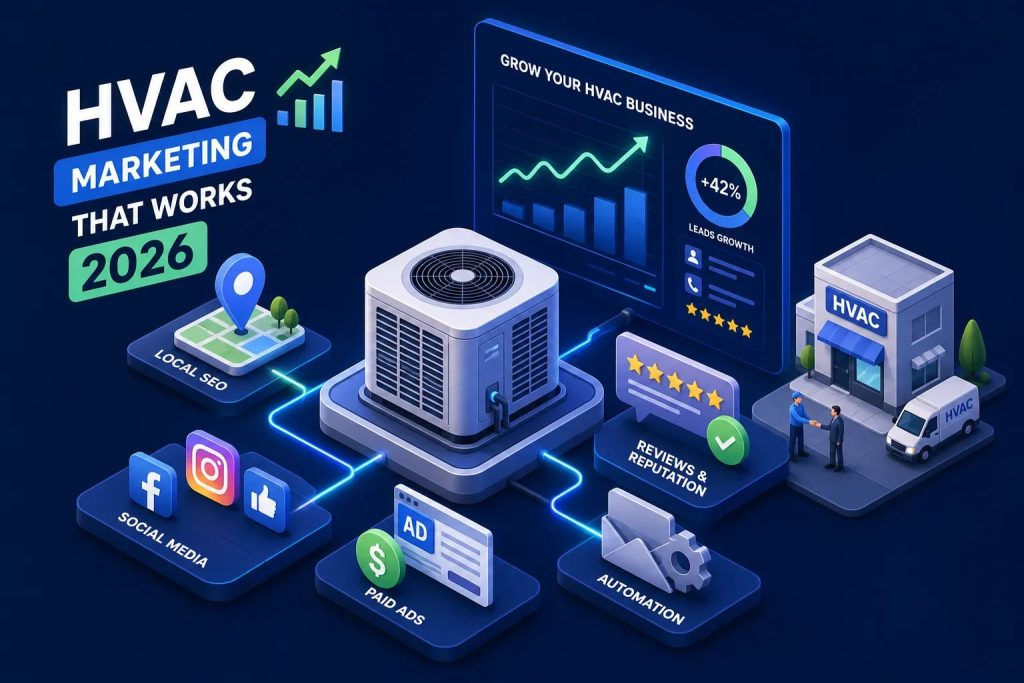
The reason the best HVAC marketing strategy for 2026 looks so different from even three years ago comes down to how customers find contractors. Homeowners increasingly turn to Google AI Overviews, ChatGPT, and voice assistants to identify which HVAC company to call, often before they open a single search results page.
According to 2026 consumer research, use of AI tools for local business discovery jumped from 6% to 45% in early 2026 alone. If your business doesn’t appear authoritative in those places, the call goes to whoever does. Winning that recommendation isn’t about ad spend; it’s about the authority signals your entire digital presence sends.
This guide breaks down the highest-ROI HVAC marketing channels for 2026, explains why authority-first approaches now consistently outperform ad-heavy tactics, and closes with a prioritized 90-day plan built around real benchmark data.
Before recommending any channel, TW3 Marketing runs a structured Authority Audit™ to identify exactly where an HVAC company is leaking leads; that same diagnostic lens shapes every section here.
What Is the Best HVAC Marketing Strategy for 2026? Start with Authority
Most HVAC contractors look at their lead volume and assume paid ads are doing the heavy lifting. The benchmark data says otherwise. Organic search and local SEO consistently drive the largest share of inbound lead volume, with paid channels contributing a materially smaller slice.
When contractors respond to slow lead flow by increasing ad spend, they often accelerate spending without fixing the real problem: a weak organic pipeline means paid traffic converts at a lower rate and disappears the moment the budget stops.
This is exactly where TW3 Marketing’s 100-point Authority Audit™ changes the conversation. Before any budget gets committed to a channel, the audit evaluates six core signals: positioning, proof, expertise, visibility, engagement, and experience. It shows precisely where a contractor’s digital presence is losing leads before a single dollar is spent. The traditional agency model leads with a media buy; the authority-first model leads with a diagnosis. For HVAC contractors competing in 2026, the diagnostic approach consistently produces better outcomes because it targets the actual constraint, not just the symptom.
The customer decision journey has also shifted in a way that makes authority signals non-negotiable. Homeowners researching HVAC companies are increasingly asking AI platforms which contractor to call, and those platforms surface businesses based on structured authority data, not PPC bids.
An authority-first approach isn’t a premium add-on for forward-thinking contractors; it’s the baseline for staying competitive in 2026.
Local SEO and Google Business Profile: Your Highest-ROI Organic Channel
How Local SEO Fits into the Best HVAC Marketing Strategy for 2026
Google Business Profile can account for up to 52% of organic closed revenue for HVAC contractors, making it the single most valuable free asset in the stack. Most contractors treat it as a one-time setup task and move on, a costly mistake. The profiles that consistently drive leads are maintained actively:
- Primary and secondary categories chosen with precision
- Real job photos uploaded on a regular schedule
- The booking feature enabled
- Weekly service update posts published
- Every Q&A answered promptly
Profile completeness and ongoing activity are confirmed ranking signals for the local map pack.
Beyond GBP, the non-profile side of local SEO compounds over time in a way paid channels never will. NAP consistency across directories (Google, Yelp, Angi, BBB), service area landing pages targeting specific neighborhoods and zip codes, and schema markup that communicates service types and coverage areas all contribute to local search prominence.
Local SEO doesn’t produce leads overnight; 2026 benchmarks suggest meaningful lead flow typically materializes in 3, 6 months, with consistent results by months 6, 12. The payoff is the lowest long-term cost-per-lead of any digital channel, which is what makes it the correct first investment, not an afterthought.
Google LSA vs. Search Ads: Where Your Paid Budget Goes Furthest
LSA Setup Checklist for HVAC Contractors
The 2026 benchmark data makes a clear case for Google Local Services Ads as the primary paid channel for most HVAC contractors. LSAs average $51, $60 per lead with a 6.9x to 9.55x closed ROAS and a 44% book rate. Traditional Google Search Ads, by comparison, run approximately $90.92 CPL with a median ROAS around 4.37x and a lower booking rate. The Google Guaranteed badge reduces buyer friction, leads arrive via high-intent phone calls, and the pay-per-lead model eliminates wasted spend on clicks that never convert.
Search Ads still earn a place in the stack, but in specific, targeted scenarios. Branded campaigns perform well at roughly $34 CPL with 40, 55% conversion rates, so protecting brand terms makes sense. Non-branded Search Ads are justified for high-margin service categories like full system replacements or commercial contracts, where the job value absorbs the higher $149 non-branded CPL. The framework is straightforward: LSAs run first for general lead volume, branded search protects your name, and non-branded campaigns get activated selectively based on job economics.
Reputation Management and Review Automation: The Conversion Signal That Also Feeds AI
Testimonials boost HVAC website conversion rates by 34%, which alone justifies a review automation system. In 2026, reviews carry a second function that matters equally: they’re an AI recommendation signal. Google AI and ChatGPT evaluate review volume, recency, sentiment, and the keyword content within reviews when deciding which local contractor to surface in AI-generated answers. A contractor with 200 recent, detailed reviews will generally appear in more AI-assisted results than one with 40 older reviews, though exact results vary by market and query type.
The right tool depends on shop size, not marketing ambition. GoHighLevel at $97/month is a widely recommended all-in-one platform, combining CRM, SMS, missed-call text-back, review requests, and lead nurture automation. NiceJob at $30, $150/month works well for contractors focused primarily on review volume without needing a full CRM stack. Podium handles reputation management paired with customer texting. Housecall Pro bundles review automation with field service management for smaller shops. The deciding factor is operational fit: a five-truck shop likely doesn’t need ServiceTitan Marketing Pro, and a 20-truck contractor may outgrow GoHighLevel as complexity increases.
AI Search Visibility: How HVAC Companies Get Found in ChatGPT and Google AI
When a homeowner asks ChatGPT “who is the best HVAC company near me,” the answer isn’t driven by PPC bids. AI platforms pull from structured content, business profiles, review data, and third-party mentions to assess relevance and authority. The specific signals that influence those recommendations include clearly structured service pages, consistent business information across the web, high review volume with relevant keyword content, and content that demonstrates subject matter expertise. Contractors who rely solely on traditional SEO tactics risk reduced visibility in these AI-generated results, where structured authority data plays a larger role.
TW3 Marketing’s Authority Framework™ maps directly to the signals AI platforms use for local business recommendations. For HVAC contractors, that means publishing expert content that answers common homeowner questions (system sizing, SEER ratings, maintenance schedules), earning mentions on local news sites and industry directories, and ensuring the website communicates service areas and specializations in plain language any AI platform can read and confirm. This is where HVAC digital marketing is heading in 2026, and early movers build a compounding advantage that becomes harder to close over time.
Your Prioritized 90-Day HVAC Marketing Plan
The biggest mistake contractors make is launching channels before fixing the foundation. Sequencing by month prevents wasted spend and creates measurable checkpoints, especially important in HVAC, where seasonal demand can mask structural weaknesses in your lead generation pipeline.
Month 1: Fix the foundation. Audit your current authority signals, including GBP completeness, review count and recency, NAP consistency across directories, and website structure. Launch or fully optimize your GBP profile and activate a review automation tool. Track GBP completeness score, review response rate, and review velocity as your Month 1 KPIs.
Month 2: Activate paid channels strategically. Launch Google LSAs with a weekly budget sized for meaningful volume, set a $51, $60 CPL target, and deploy service area landing pages. Add branded Search Ads to protect your name. Track LSA CPL, book rate (target 44%), and cost per booked job. Hold non-branded Search Ads until you have baseline LSA data.
Month 3: Build AI visibility and optimize based on data. Structure service pages with clear coverage areas and FAQs, publish expert content targeting common homeowner questions, and build citations in local and industry directories. Review all channel KPIs and reallocate budget away from underperforming segments. Track organic lead volume change month-over-month and set up AI mention monitoring for your brand and service area queries.
On budget allocation for a contractor doing $1, $3M in revenue: a reasonable starting split, subject to testing and market conditions, puts 50, 60% of the digital budget toward LSA, 20, 25% toward branded Search Ads, and 15, 20% toward local SEO and content. The target is a blended CPL under $104, the 2026 HVAC Google Ads benchmark per SearchLight, while building the organic foundation that reduces paid dependency over time. For the lean tool stack, GoHighLevel at $97/month handles CRM, review requests, and texting; BrightLocal or Whitespark at $29, $79/month manages citation tracking; and the LSA dashboard handles call tracking natively.
The First Move Before You Spend Another Dollar
So what is the best marketing strategy for an HVAC company in 2026? It’s not the plan with the biggest ad budget, it’s the one with the strongest authority foundation. Local SEO and GBP optimization generate the highest share of HVAC leads at the lowest long-term cost. LSAs outperform Search Ads for most contractors on both CPL and ROI. Reviews now serve double duty as conversion tools and AI recommendation signals. And AI search visibility is already changing which HVAC companies get called, this isn’t a future consideration; it’s happening now.
The smartest first step before committing to any of these channels is a diagnostic. TW3 Marketing’s Authority Audit™ scores your business across 100 points and reveals exactly which signals are costing you leads, before you spend another dollar on ads or SEO. The audit typically takes a few business days to complete and delivers a prioritized action list tied to your specific market. If you want to know where you actually stand, start with the audit. Every dollar you spend after that works harder because it targets the right problems first.
