
How is optimizing for ChatGPT different from optimizing for Google Search? The gap is wider than most marketers expect. Ahrefs tested 15,000 prompts and found that only 12% of links ChatGPT cited appeared in Google’s top 10 for the same query. A separate analysis from Chatoptic and Beamtrace puts the correlation between Google rank position and ChatGPT recommendation order at roughly 0.02, a figure that, in statistical terms, indicates essentially no linear relationship between rank and recommendation order. In 40% of tested cases, ChatGPT’s primary citation didn’t come from Google’s first page at all.
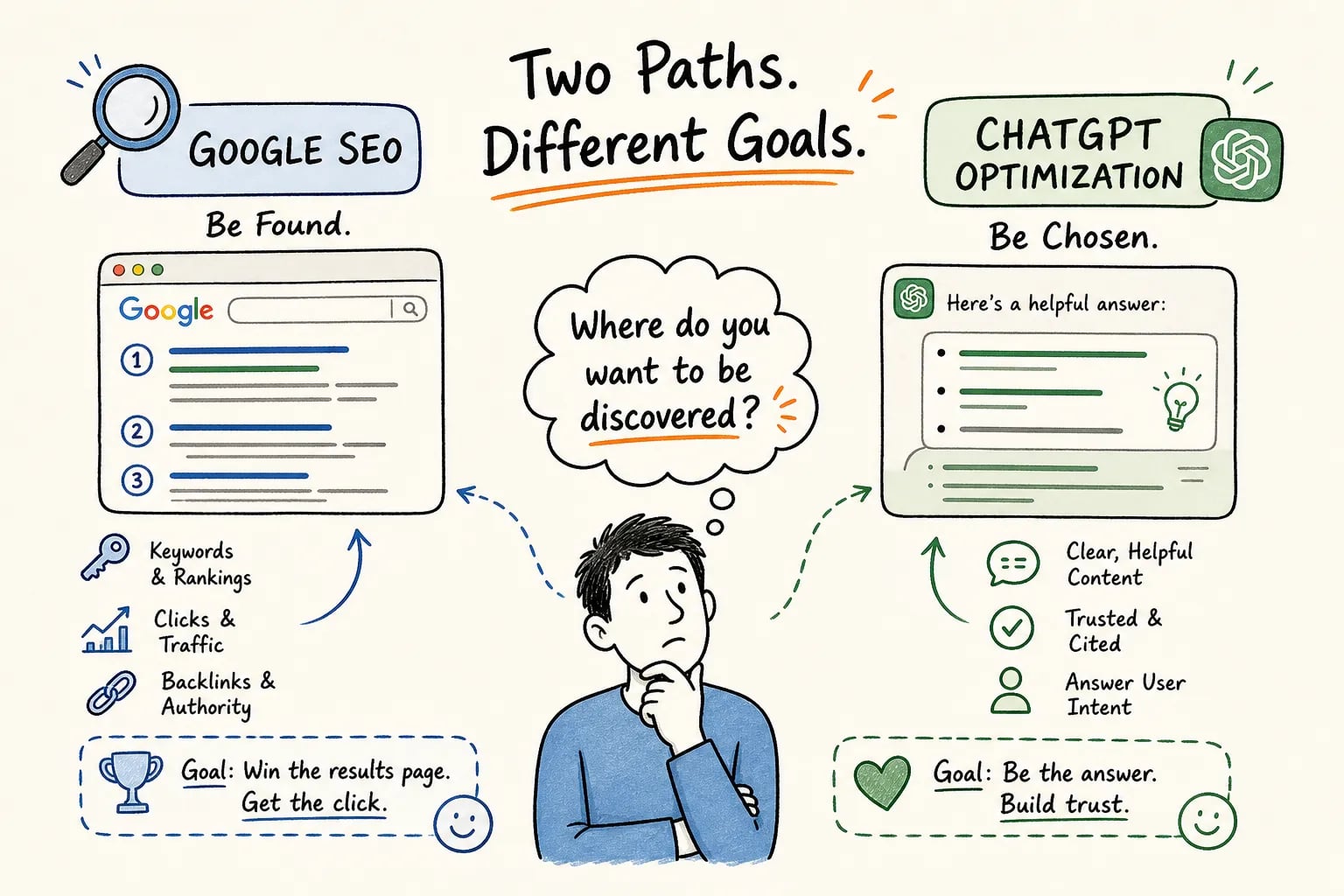
Those numbers matter because many businesses treat Google SEO and AI search optimization as the same problem with the same solution. They’re not. The content strategy that built your Google rankings is probably not the strategy that earns you citations in ChatGPT, Google AI Overviews, or other generative search systems. This article breaks down exactly why those two systems diverge, what each one rewards, and how to build content that performs in both contexts in 2026.
How Is Optimizing for ChatGPT Different from Optimizing for Google Search?
The Ahrefs research is worth sitting with for a moment. When ChatGPT specifically is measured, the overlap with Google’s top 10 drops to around 8%. Roughly 92 out of every 100 pages ChatGPT cites are not the pages Google ranked highest for the same question. If you’ve been building your content strategy entirely around ranking signals, you’ve been optimizing for a system that ChatGPT largely ignores.
The reason comes down to how LLM retrieval actually works. ChatGPT’s source-selection process operates in two distinct layers. The first layer is retrieval: the system surfaces candidate pages from its index or a search backend. The second layer is citation selection: from those candidates, the model chooses which specific passages best support the answer it’s generating. This citation layer doesn’t sort by PageRank. It sorts by how directly and clearly a page answers the question, and how easy it is to extract a clean, citable passage from the content.
A page can be retrieved but never cited if it’s redundant, harder to parse, or not the cleanest support for the claim being made. The reverse is also true: a page that sits outside Google’s top 10 can be cited regularly if it presents a direct, authoritative, well-structured answer. The selection logic is fundamentally different, and it requires a different optimization approach.
What Google’s Ranking Algorithm Actually Prioritizes in 2026
Google’s fundamentals haven’t changed as dramatically as some predicted, but they’ve sharpened. Backlink quality and topical relevance remain core signals, not just raw link counts. Core Web Vitals still matter as a technical baseline, INP replaced FID in 2024 as the primary interactivity metric, per Google’s official guidance. Mobile-first indexing means Google evaluates the mobile version of your site, so rendering and usability on smaller screens are direct ranking inputs, not secondary concerns.
E-E-A-T, Google’s framework for evaluating experience, expertise, authoritativeness, and trust, has become the lens through which content quality is assessed. Original first-hand experience on a topic, verifiable author credentials, and content that reflects genuine depth rather than surface-level coverage all factor in. Topical clusters, where a site covers a subject comprehensively across multiple interlinked pages, perform better than isolated articles because they signal to Google that a site owns a subject area rather than just touching it occasionally.
Behavioral signals also play a role. Google watches patterns around how users interact with a page after clicking through from the SERP. Content that keeps people engaged and answers their question thoroughly is treated differently than content that sends them back to try another result. For Google, you’re optimizing a page within a site ecosystem, and that ecosystem-level authority accumulates over time.
What Optimizing for ChatGPT Requires for Source Citations
When optimizing for ChatGPT, credibility signals dominate over keyword matching. The observed selection factors include established publisher reputation, recognized authorship, citations to primary sources within the content, and cross-source corroboration of claims. A page written by a named expert, citing peer-reviewed research, and presenting a clear verifiable point of view can outperform a top-ranked Google page for ChatGPT citation purposes. Keyword density is far less important than semantic relevance and extractability at this layer.
Answer structure is often the deciding factor. ChatGPT and similar models prefer content where the answer appears early, in concise and self-contained form. Question-based headings that mirror the user’s prompt, FAQ blocks with tight question-answer pairs, and numbered or bulleted breakdowns all make passages easier to lift and attribute. Pages that bury the answer in narrative prose or require heavy reading to extract a claim are consistently deprioritized, regardless of their Google rank.
Entity clarity also matters more for AI citation than for traditional SEO. Consistent naming, visible authorship, and schema markup that helps the system anchor a source to a real-world entity all improve the odds of being cited. A page that could have been written by anyone, for any organization, with no clear attribution is a low-trust source from an LLM’s perspective, even if it ranks well in Google.
Content Format and Structural Choices That Change Your Results
Optimizing for ChatGPT also depends on content format and extractability. FAQPage and QAPage schema markup don’t guarantee AI citation, but they improve extractability. One Beamtrace analysis reports a 3.2x lift in Google AI Overview citation frequency for pages using FAQPage schema compared to unstructured content, though results vary by industry and query type, so treat this as directional rather than universal. Article schema paired with Person author markup strengthens credibility signals by giving AI systems a clear way to identify who wrote the content and what organization it belongs to. These aren’t magic switches, but they reduce friction in how systems parse and evaluate your content.
Traditional long-form blog posts built around a single target keyword tend to perform well in Google and poorly for AI citation. Content that takes 800 words to get to the answer is hard to extract. Content without visible authorship, expert attribution, or links to primary research gets treated as lower-trust by AI systems, regardless of how well it matches search intent.
Consider this contrast: comprehensive keyword-rich articles optimized for dwell time win Google rankings. They often lose AI citation consideration entirely. The practical shift is to structure your content so that the key answer appears in the first paragraph or two of each section, not buried at the end as a conclusion. Use headings that sound like questions a user would actually ask. Build FAQ sections at the end of long-form content. Every structural decision should be made with both a human reader and an AI extraction system in mind.
How TW3 Marketing’s Authority Framework™ Addresses Both Systems at Once
Many agencies responding to the AI search shift recommend a tactical checklist: add FAQ schema, reformat headings, update your content. In TW3 Marketing’s experience, that approach misses the deeper problem. Tacking Generative Engine Optimization (GEO) tactics onto a weak authority foundation rarely improves citation frequency, because AI systems aren’t just looking for better-formatted content. They’re looking for credible sources, and credibility isn’t built by reformatting a blog post.
At TW3 Marketing, the Authority Framework™ was built specifically around the signals AI recommendation systems use to evaluate sources, before recommending a single tactic. The process starts with the Authority Audit™, a 100-point diagnostic that scores a business’s digital presence across six core factors: positioning, proof, expertise, visibility, engagement, and experience. These aren’t Google-specific or AI-specific signals. They’re the shared foundations that make a business credible to both human readers and machine systems.
Strengthening those six signals is designed to move a business from invisible in AI answers to actively recommended. The goal is meaningfully different from chasing keyword rankings, and it calls for a diagnostic-first approach rather than a tactics-first one. If you want to see where your business currently stands in both Google and ChatGPT, the Authority Score™ Check is a practical starting point, a structured assessment available within 48 hours, before you rewrite a single piece of content.
A Practical Checklist to Optimize for Both Platforms
Google and AI citation require different things, but they’re not mutually exclusive. The signals that matter for one can coexist with the signals that matter for the other. Here’s how to approach both without splitting your content strategy in two.
For Google Performance, Keep These in Place
- Crawlable site structure with clean internal linking that reinforces topical clusters
- Core Web Vitals compliance, including INP, and strong mobile rendering
- Quality backlinks from relevant, authoritative sources in your industry
- Schema markup for entity clarity: Article, Organization, and Person as a baseline
- E-E-A-T signalsthroughout the site, including author bios, original research, and transparent sourcing
- Updated timestamps on time-sensitive content, supported by actual content revisions
For AI Citation, Add These Specifically
- Answer-first content structure with the key point addressed in the first one to two sentences of each section, this is the single highest-impact change for AI extractability
- Question-based H2 and H3 headings that mirror how users phrase their queries
- Visible authorship with credentials and a linked author bio page
- Citations to primary research within the content itself, not just general claims
- FAQPage or QAPage markup on relevant content, particularly for pages targeting high-value queries
- Consistent entity information across all digital properties, including Google Business Profile, LinkedIn, and directory listings, this cross-platform consistency is what AI systems use to confirm organizational identity
- Cross-platform mentions from authoritative third-party sources that corroborate your expertise
Prioritize this treatment for pages where you want to be recommended, not just found. There’s a meaningful difference between a page that drives organic traffic and a page that earns AI citations. In 2026, the most valuable pages are the ones built to do both.
The Core Mistake Most Businesses Are Still Making
Google and ChatGPT are not competing for the same signals, and treating them as identical is the most common optimization mistake service businesses make right now. Google rewards a well-structured, authoritative site ecosystem. ChatGPT rewards a specific page’s ability to answer a question credibly and extractably. The overlap exists, authority, expertise, and clear content structure serve both. But assuming that ranking well in one automatically means performing in the other is where most strategies fall short.
Understanding how optimizing for ChatGPT is different from optimizing for Google Search is the prerequisite to fixing that gap. Businesses showing up in ChatGPT and Google AI Overviews aren’t necessarily the ones with the best Google rankings. They’re the ones with the clearest authority signals, the most extractable content, and the most consistent entity presence across the web. If your business hasn’t been audited for AI visibility specifically, that’s a gap worth addressing before your next content cycle.
TW3 Marketing’s Authority Score™ Check gives you a structured 48-hour snapshot of how your business appears in Google and ChatGPT today. It’s a practical first step before committing to a full content overhaul, knowing where you actually stand is more valuable than running tactics against a problem you haven’t diagnosed. The Authority Score™ Check gives you that picture before you rewrite anything.
