
Most HVAC marketing tactics have involved Google Ads at some point. The clicks come in, the phone rings, and then the invoice arrives showing $100-plus average cost-per-lead, or higher in a competitive market. Pause the campaign and leads drop sharply. That’s not a marketing strategy; that’s a dependency.
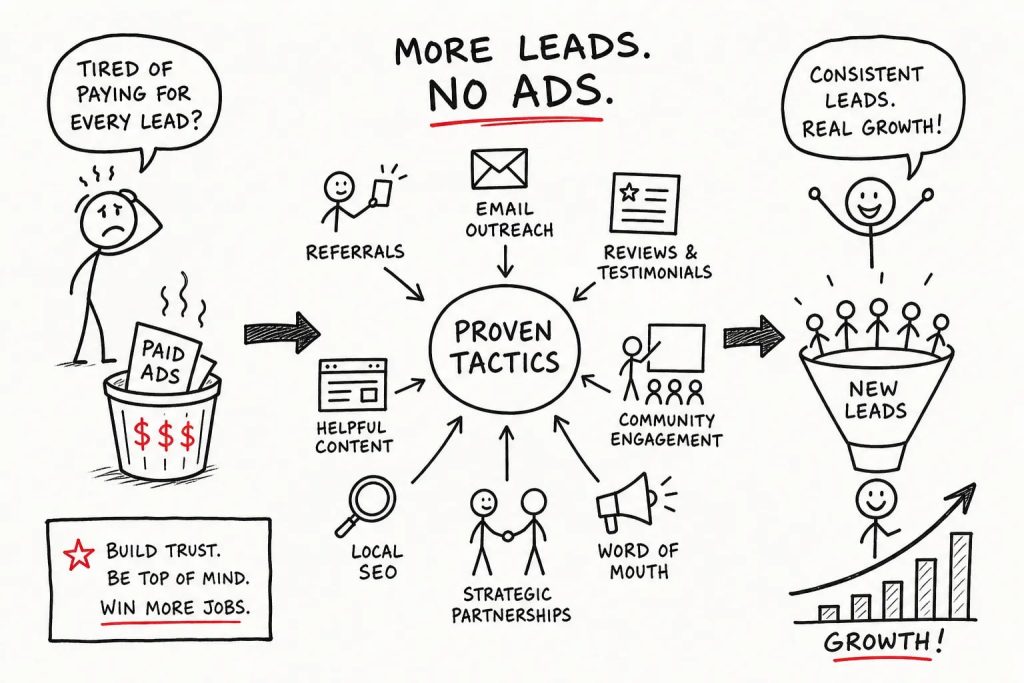
The best digital marketing tactics for HVAC companies without paid ads share one thing in common: they build organic authority that compounds month after month. Organic visibility can become a durable source of HVAC leads because useful pages, reviews, and local signals continue working after publication. Unlike paid campaigns, that visibility does not disappear the moment an advertising budget is paused.
At TW3 Marketing, we use the TW3 Marketing Authority Framework™ to help service businesses identify the visibility and trust gaps behind overreliance on paid lead sources. The framework which diagnoses the six trust signals that determine how often your business gets found and how often AI platforms like ChatGPT and Google AI recommend you by name. The tactics below are organized by leverage, not effort, and the 90-day plan at the end gives you a clear sequence to follow. Across five core pillars, GBP, reviews, content, AI optimization, and conversion, you’ll find the practical steps that generate consistent leads without a paid-ads budget.
1. Make your Google Business Profile your hardest-working sales asset
Set up GBP as a lead machine, not just a listing
GBP is widely regarded as the most powerful free HVAC marketing tool available in 2026, and most companies are underusing it. Set your primary category to “HVAC contractor” and add relevant secondary categories: AC repair, heating contractor, furnace repair service. Fill out every field completely, services, hours, service areas, description, and Q&A, and match every detail to your website so Google can trust the listing and surface it confidently.
Keep the profile active year-round, not just during peak season
HVAC demand is seasonal; your GBP activity shouldn’t be. Post at least once a week, two to three times per week in competitive markets, with seasonal offers, completed job photos, and maintenance tips. Active profiles signal relevance to Google and show up more consistently in local results. Companies treating GBP like a set-and-forget listing leave Map Pack visibility on the table, especially against competitors posting consistently over 8 to 12 weeks.
Add individual service entries to match high-intent searches
The individual service catalog inside GBP is one of the most underused features available. Add separate entries for AC repair, furnace installation, heat pump service, and duct cleaning so Google can match your listing to specific queries beyond generic “HVAC near me” searches. Specific service searches can represent meaningful seasonal demand. A profile that lists only “HVAC” as a catch-all gives Google less detail than one that accurately describes each core service.
2. Build a review generation system that runs without reminders
The right moment to ask (and why timing is everything)
The highest-conversion moment to ask for a review is while the technician is still on-site. Make the ask part of every technician’s close-out checklist, not an optional extra. A script that works: “I’m glad we got your system running again. If you were happy with the service, would you mind leaving us a quick Google review?” The customer’s satisfaction is at its peak right then, and so is your conversion rate.
SMS and email follow-up templates that actually get clicked
SMS can be an effective channel for HVAC review requests because customers often see text messages quickly. Send within 24 to 48 hours, keep the message short, and use a direct link. A working SMS: “Hi [Name], thanks for choosing [Company] for your AC repair today. If we earned it, a quick review would mean a lot: [link]. Reply STOP to opt out.” For email, put the review link in the first sentence of the body and skip the preamble.
Responding to every review: what good looks like
Respond to every review within 24 to 48 hours, personalizing with the customer’s name and service performed. For negative reviews, stay professional and redirect to a private resolution: “Thank you for the feedback. Please contact us directly so we can review what happened and work toward a solution.” New prospects read your responses before calling, so your replies are a trust signal, not just housekeeping.
3. HVAC content marketing that drives organic traffic consistently
Seasonal guides and troubleshooting posts that match what homeowners are searching
Two content types consistently drive organic traffic for HVAC companies: seasonal maintenance guides and troubleshooting articles. Seasonal guides, spring AC tune-ups, fall furnace prep, pre-winter heating checklists, produce predictable traffic spikes each year because HVAC demand is cyclical. Troubleshooting content converts especially well because it captures users with an active, urgent problem: “AC not cooling” or “furnace blowing cold air.” Those searchers are ready to book, not just browsing.
AC-related searches peak May through July; furnace and heating content peaks October through January. Plan your publishing calendar around those windows and you’re producing content that works harder each time the season returns.
Service pages and city pages: the foundation of local SEO without paid ads
One generic “Services” page competes for nothing specifically. Build a dedicated page for each service you offer, AC repair, furnace repair, heat pump installation, maintenance, emergency service, and a separate page for each city or suburb you serve. This structure gives Google clear signals about what you do and where, which is the minimum infrastructure needed for local organic visibility.
Decision-stage content that closes the gap between research and booking
Repair vs. replace guides, system cost explainers, and SEER rating comparisons attract homeowners who are close to a decision. These topics often produce the highest lead conversion rate of any content type because intent is already high. A homeowner searching “should I repair or replace my 12-year-old AC unit” is two steps from calling; your content just needs to show up and answer the question clearly.
4. AI content optimization: how to get recommended, not just ranked
How AI platforms decide which HVAC companies to recommend
A growing share of homeowners in 2026 are asking ChatGPT and Google AI who to call for HVAC service. The businesses appearing in those answers are not just the ones with the most backlinks; they’re the ones whose digital presence is easiest for AI systems to verify. Consistent business details, clear service descriptions, recent reviews mentioning specific services and locations, and third-party directory mentions all feed the recommendation engine.
Structuring content so AI systems can surface your business
Write content that directly answers the questions homeowners ask, using FAQ format and clear headings. Make sure your website’s services, hours, and location details match your GBP exactly, because AI platforms cross-reference multiple sources and inconsistencies reduce confidence in your listing. Add schema markup for LocalBusiness, Service, and FAQ to your key pages. Many HVAC websites skip this step entirely, which means completing it puts you ahead of a meaningful portion of local competitors.
Where TW3 Marketing’s Authority Framework™ fits in
The TW3 Marketing Authority Audit™ uses a 100-point scoring system to identify the trust gaps that prevent service businesses from being recommended by AI platforms. The audit measures six authority signals, positioning, proof, expertise, visibility, engagement, and experience, and produces a clear picture of where your digital presence is strong and where it’s costing you leads. If you want to understand where your HVAC business stands today, the Authority Score™ provides a structured starting point.
5. Website conversion fixes that turn organic visitors into phone calls
The click-to-call setup that can meaningfully lift leads
A visible mobile click-to-call button can remove friction from an HVAC website. Many HVAC searches are urgent and mobile-first, so visitors should not have to hunt for a phone number. Use clear, accurate copy next to the number, such as “Same-Day Service Available” only when that service promise is consistently available.
Trust signals and short forms that close on the page
Keep service request forms concise: ask only for information needed to respond, such as name, phone, service needed, and preferred time. Unnecessary fields add friction. Place customer reviews, license and insured badges, and satisfaction guarantees directly next to your CTAs and forms, right where the prospect is deciding whether to contact you. Organic traffic from strong content and GBP optimization loses its value the moment your website makes the next step hard to find.
6. Your 90-day action plan: where to start and what to do next
Days 1 to 30: nail the quick wins that compound fastest
Month one is about infrastructure. Fully optimize your GBP (categories, services, Q&A, photos, service areas), install a review request system with a technician script and SMS follow-up sequence, and audit your NAP consistency across Yelp, Angi, Facebook, and major directories. These three moves can produce measurable improvements within the first 30 to 90 days depending on your market and starting baseline, and they build the foundation every other tactic depends on.
Days 31 to 60: build the content and citation infrastructure
In month two, create or upgrade 2 to 3 service pages and 2 to 3 city pages optimized for high-intent local keywords. Publish your first two content pieces: one seasonal guide and one troubleshooting post targeting searches aligned with the current or upcoming season. Clean up any citation inconsistencies uncovered in month one. By day 60, you should have a strong local content and citation foundation that is beginning to generate measurable organic signals.
Days 61 to 90: optimize for AI visibility and conversion
The final phase focuses on AI discoverability and conversion performance. Add FAQ schema and LocalBusiness schema to your key pages. Run a full website conversion audit covering click-to-call placement, CTA copy, form length, and mobile page speed. Use the TW3 Marketing Authority Audit™ and Authority Score™ to assess your AI content gaps and identify where your digital authority needs reinforcement before investing further. This is where organic authority begins compounding, typically becoming clearer over the months that follow as signals accumulate.
Organic authority is infrastructure, not a shortcut
The best digital marketing tactics for HVAC companies without paid ads are not secret, they’re just structural. Paid ads rent attention by the click. Organic authority and a strong reputation compound in value month after month without an ongoing invoice attached. The five pillars covered here, GBP, reviews, content, AI optimization, and conversion, are the non-negotiable infrastructure every HVAC company needs in place before adding ad spend. Build these first to create a more durable source of visibility and leads. Skip them and the business is more likely to remain dependent on paid channels whose lead flow stops when the campaign stops.
If you want to know exactly where your current digital presence stands and what’s holding back your organic lead flow, the TW3 Marketing Authority Audit™ is the practical next step. It provides a structured view of how the business presents its positioning, proof, expertise, visibility, engagement, and experience, along with which authority signals need attention. Reach out to our team to get yours started.
