
Your small business credibility score is a practical way to evaluate whether customers and digital systems can find enough evidence to trust your business. Most owners know they have a financial credit score. A separate digital-authority framework looks at the visible positioning, proof, expertise, visibility, engagement, and experience surrounding the business.
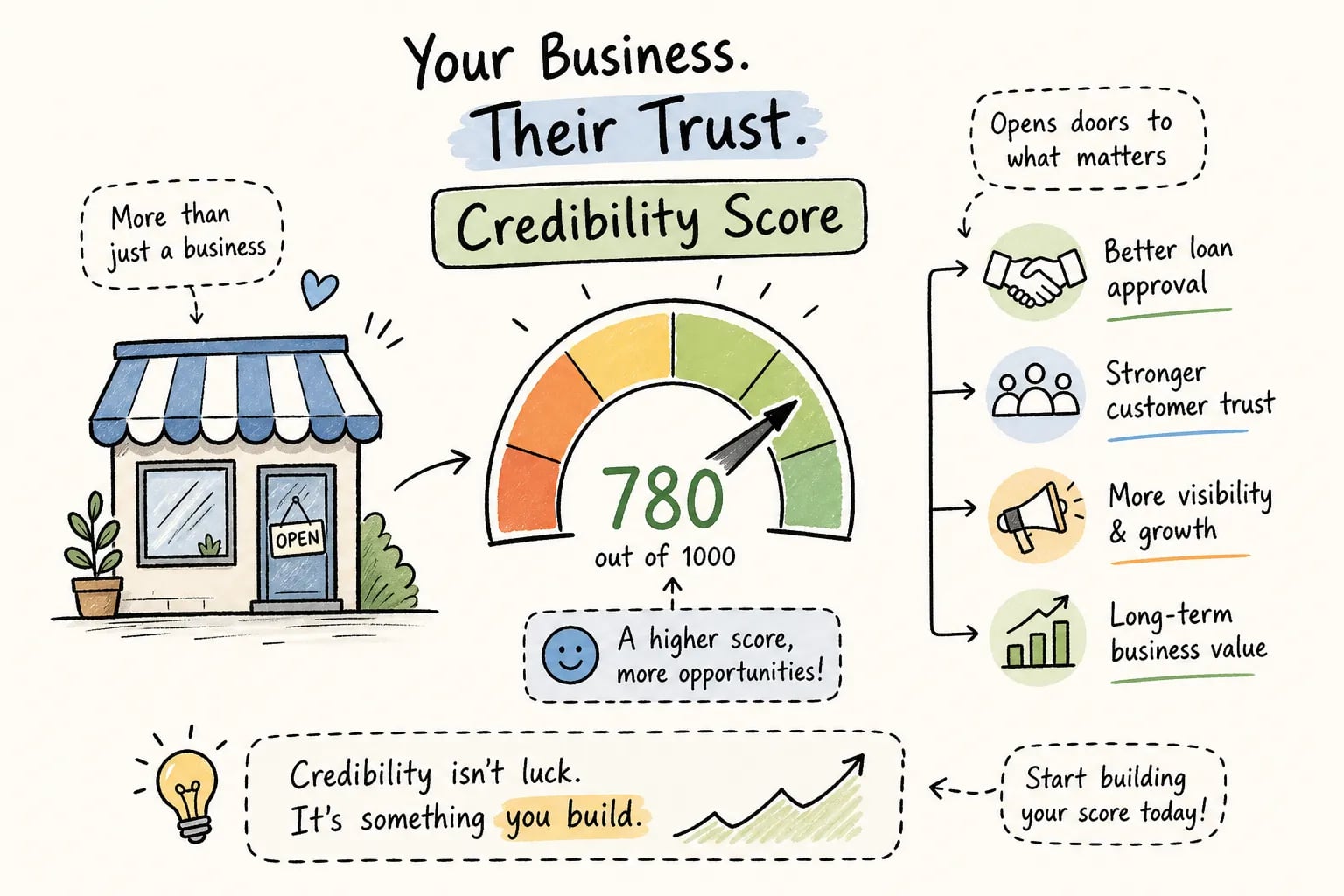
When a homeowner asks ChatGPT which HVAC company to call, or asks Google to find a local contractor, the answer depends on the information those systems can retrieve and interpret. Clear business details, relevant content, credible proof, and trustworthy third-party references can improve how confidently a business is understood. Many owners still have no clear picture of how their visible authority compares with competitors.
This article breaks down what a small business credibility score actually measures, why it drives AI recommendations and customer conversions, and what you can do about it starting today.
What a small business credibility score actually measures
When most people hear “business credibility score,” they think of financial credit products such as Experian Intelliscore, Equifax business scores, or Dun & Bradstreet PAYDEX. Those services evaluate financial and payment-related information for lenders, suppliers, and other business decisions. Their methods and score ranges differ, so verify the current interpretation directly with the relevant provider.
A financial credit score does not measure whether a prospective customer can understand, verify, or confidently choose your business. Financial credibility and visible digital authority answer different questions, and both can affect business opportunities.
The six authority signals that build your digital credibility score
The TW3 Marketing Authority Framework organizes visible digital authority into six signals: positioning, proof, expertise, visibility, engagement, and experience. Positioning clarifies whom the business serves and what it does. Proof includes reviews, case studies, and documented outcomes. Expertise is visible knowledge. Visibility, engagement, and experience show whether the business can be found, understood, and trusted across the customer journey.
These signals work together. A weakness in one area can create uncertainty even when other parts of the business are strong. The score is a diagnostic framework for identifying those gaps; it is not a ranking factor used directly by ChatGPT, Google, or another AI platform.
Why your credibility score directly affects AI recommendations
Platforms such as ChatGPT, Google AI features, and voice assistants use different retrieval and ranking systems. They may rely on website content, structured data, business listings, reviews, and third-party sources to understand an entity. Consistent information and credible evidence make it easier for both people and machines to evaluate the business accurately.
A business with thin website copy, vague positioning, and little visible proof gives customers and automated systems less useful information to evaluate. Businesses do not earn recommendations through a single score. They strengthen their chances by building a clear, consistent, well-supported digital footprint.
The downstream effect matters too. A stronger credibility profile can build customer confidence before the first phone call happens. Clear positioning and credible proof reduce uncertainty, but the conversion impact varies by market, offer, traffic source, and customer experience.
The factors that raise or hurt your score most
High-impact signals: proof and positioning
Specific proof is one of the most useful signals a business can strengthen. Detailed client reviews that describe the service and customer experience provide more context than a star rating alone. Recent reviews, permission-based testimonials, and completed case studies can make that proof easier to evaluate.
Clear positioning is equally important. If the homepage does not communicate whom you serve, what you do, and why the business is credible, both customers and machines must guess. Specific service language and evidence-backed differentiation make the business easier to understand.
Common gaps that quietly drag scores down
The most common issues are inconsistent business information across directories (name, address, phone number, and category all need to match), no visible proof of client outcomes anywhere on your digital footprint, and website copy written for humans to skim but not structured for AI systems to understand and extract from.
How to check your small business credibility score, and what to do next
You can review traditional business-credit information through providers such as Dun & Bradstreet, Experian, Equifax, or Creditsafe. Confirm current access terms, pricing, and whether an inquiry affects a score directly with the provider before requesting a report.
For visible digital authority, the TW3 Marketing Authority Score provides a structured baseline across six signals. The paid TW3 Marketing Authority Audit documents the evidence behind each finding and prioritizes what to address first. We diagnose before we prescribe.
Practical steps to raise your score right now
Start with what you can fix today. Audit your existing reviews and actively request detailed feedback from recent clients, ask them to describe the specific problem you solved and the result they got. Update your homepage with a single clear sentence that names your ideal customer, your core service, and your differentiator. Then check every major directory for inconsistencies in your business name, address, and category and correct them.
For the medium term, publish content that directly answers the questions your target customers are already asking AI systems. Not blog posts for the sake of content volume, but specific, expert-driven pieces tied to real buyer questions in your category. Build proof signals continuously: case studies with outcome data, testimonials with specifics, documented client results.
Monitor your authority signals quarterly. Credibility scores can drop when reviews go stale, when a directory entry gets corrupted, or when a competitor builds stronger signals in your category. Catching those drops early is far less expensive than rebuilding visibility after you’ve already lost ground.
Your credibility score is the number that controls who finds you first
Whether a lender is checking financial information or a potential customer is asking an AI assistant for a recommendation, the business may be evaluated before anyone speaks with you. Financial scores can affect access to capital. Visible digital authority affects whether customers can find enough credible information to keep considering the business.
The path forward is clear: understand what each framework measures, identify the specific gaps, and address the signals that deserve attention first. The TW3 Marketing Authority Audit is a $497 diagnostic, and the full fee is credited toward a TW3 Marketing engagement purchased within one year, including Momentum or Domination.
In an AI-driven market, the businesses that get considered are often the ones that are easiest to understand and verify. That is a fixable gap, and measuring the visible evidence is where the work starts.
