
A homeowner’s furnace goes out on a cold Tuesday morning. She opens ChatGPT and asks, “What’s the best HVAC company near me?” If your business is absent from the sources an answer engine uses, a competitor with clearer, better-supported information may earn that visibility. That is an answer engine optimization problem as well as an SEO issue. A clear AEO strategy helps local service businesses strengthen and track the signals that support accurate discovery.
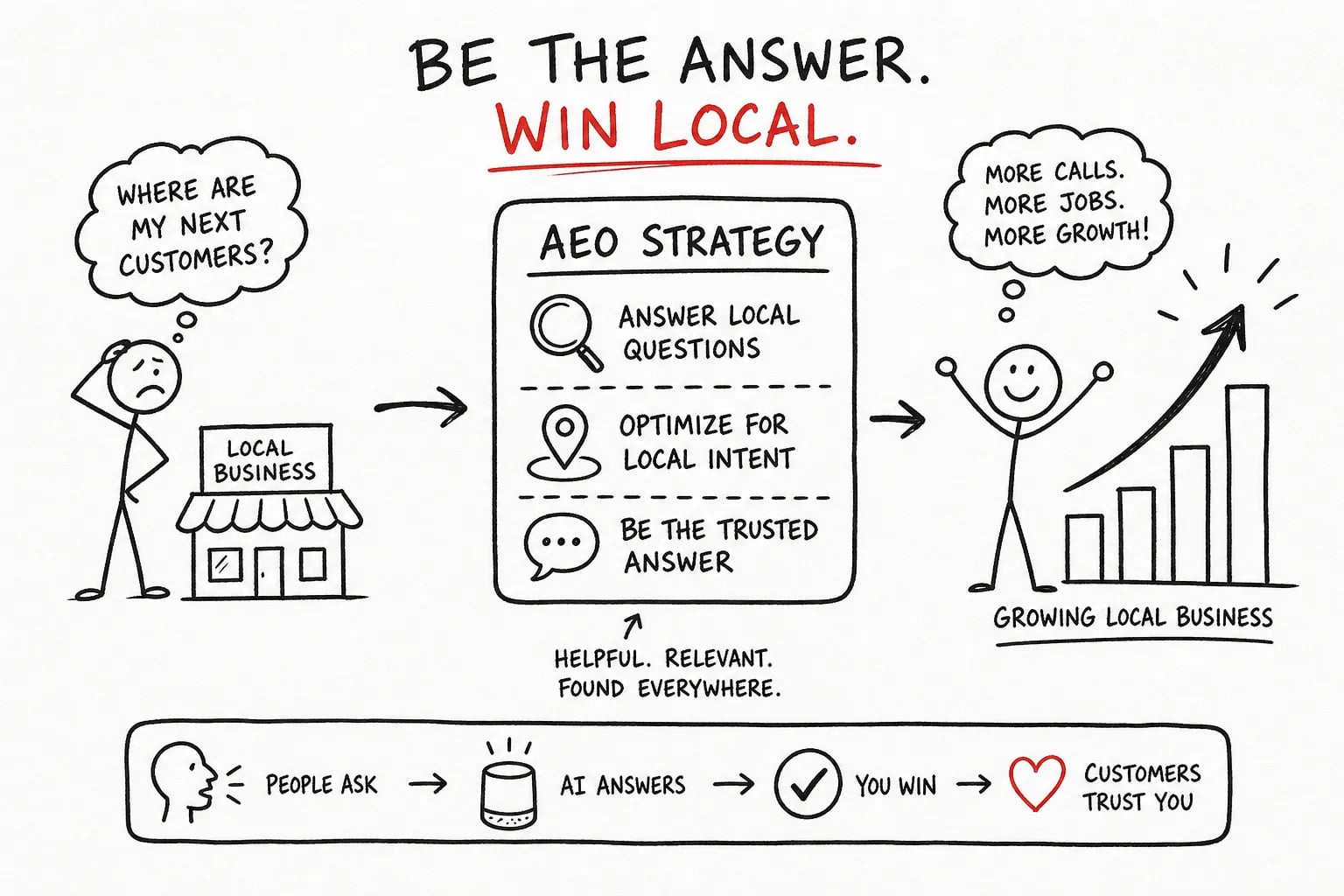
Answer engine optimization (AEO) is the practice of structuring your content so AI-driven systems like Google AI Overviews, ChatGPT, and Perplexity can extract, trust, and cite it as a direct response to a user’s question. A solid AEO strategy focuses on four things: content structure, trust signals, schema markup, and a 90-day framework to measure whether any of it is working.
Why an AEO strategy works differently for local service businesses
Local service AEO isn’t a scaled-down version of enterprise content strategy. The intent is more urgent, the trust bar is higher, and your competition isn’t a national brand with a content team. It’s the plumber down the street who happens to have a well-organized FAQ page. That’s the playing field.
AI search features retrieve and organize information from web sources in different ways. For a local roofer or HVAC contractor, clear service information, credible evidence, and consistent entity details can make content easier to understand and evaluate. Google explains that the same foundational SEO practices apply to its AI features in Search; no special markup guarantees inclusion.
A business can rank well in conventional search and still receive few mentions or citations in AI-generated answers. SEO and AEO overlap, but they are measured differently. Track search visibility alongside brand mentions, linked citations, source coverage, and the accuracy of the answers that represent your business.
Build answer-first content around what your customers actually ask
Local service buyers often ask complete questions such as, “What should I check before calling an HVAC technician?” or “How much does furnace repair cost in my city?” Start with a focused set of questions that map directly to your services, buyer intent, and documented expertise. These questions become the foundation of an AEO strategy for local service businesses.
For each important question, open with a concise, self-contained answer before adding evidence, examples, and limitations. There is no universal word count that guarantees extraction or citation. Clarity, completeness, relevance, and support matter more than forcing every answer into the same length.
Choose the format that communicates each answer most clearly:
- Numbered steps for processes
- Question-led sections for buyer concerns
- Comparison tables when options genuinely need comparison
- Visible FAQ sections when several related questions deserve concise answers
Avoid dense prose that buries the answer several paragraphs deep. Each section should answer its heading without requiring the reader to click elsewhere. Use FAQPage schema only when the same questions and answers are visibly present on the page.
Add trust signals and schema markup that AI can read
Structured data and visible proof serve different purposes. Schema helps machines identify the content and the entities it describes. Reviews, credentials, licenses, case studies, and consistent business information provide evidence people and systems can evaluate. A sound AEO strategy uses both without treating either as a shortcut.
Schema should describe the page accurately. BlogPosting or Article markup supports informational content, while Organization or an appropriate LocalBusiness subtype can describe the business entity. Google’s structured-data guidance makes clear that valid markup does not guarantee a search feature. Avoid duplicate entities and connect each page to stable author and publisher identifiers.
FAQPage schema
FAQPage markup is appropriate only when the page contains the same visible questions and answers. It helps describe that content; it does not guarantee an AI citation or search enhancement.
LocalBusiness schema
LocalBusiness schema can describe who the business is, where it operates, and how customers can contact it. Keep those details consistent with the website, Google Business Profile, and other maintained listings.
Visible trust signals
Reviews, credentials, licenses, case snippets, and consistent NAP data across your website and directory listings all function as trust markers. AI answer engines favor sources that look credible and established across multiple touchpoints. Surface that proof directly on your service pages, not hidden in a testimonials tab. If AI can’t read it in context, it can’t use it as supporting evidence when generating an answer.
Before layering in tactics, establish a baseline. The TW3 Marketing Authority Framework organizes the six signals that influence visible trust. The TW3 Marketing Authority Score measures those signals, and the TW3 Marketing Authority Audit diagnoses the gaps before a solution is prescribed.
Run a 90-day AEO test and track what moves
Before making any changes, open ChatGPT, Perplexity, and Google AI Overviews and test 10 to 15 question-based prompts related to your services. Record whether your brand is mentioned, cited, or completely absent. This is your benchmark. Repeat the same prompt set at Day 30, Day 60, and Day 90. The prompts must stay identical so you’re comparing the same queries across time, that consistency is what makes the data useful.
Your measurement stack does not need to be complicated. Use analytics and Search Console to monitor referral traffic and search visibility. For AI visibility, track a stable set of relevant prompts, record whether the brand is mentioned or cited, and verify whether each answer is accurate. If you use a third-party monitoring platform, confirm its current coverage and pricing directly with the provider.
Over a 90-day review period, look for stronger service-page answers, more consistent entity information, better contextual proof, and broader source coverage. Treat changes in mentions or citations as directional evidence, not a guaranteed outcome from any single edit.
The bottom line
A practical AEO strategy for local service businesses is a structured process: answer relevant questions clearly, support important claims, describe the business consistently, and measure what changes over time. Local AI visibility rewards useful, credible information, not content volume for its own sake.
If you want a clear picture of where your business currently stands, start with the TW3 Marketing Authority Audit. It evaluates the evidence customers and AI systems can find, identifies the most important gaps, and provides a prioritized roadmap. The $497 audit fee is fully credited toward a TW3 Marketing engagement purchased within one year, including Momentum or Domination.
