
Most business owners think they have a marketing problem. They don’t, they have an AI business discovery problem, and those are very different things. An increasing share of customers never reach a traditional search results page at all, which means the gap between a great business and a visible one is widening fast.
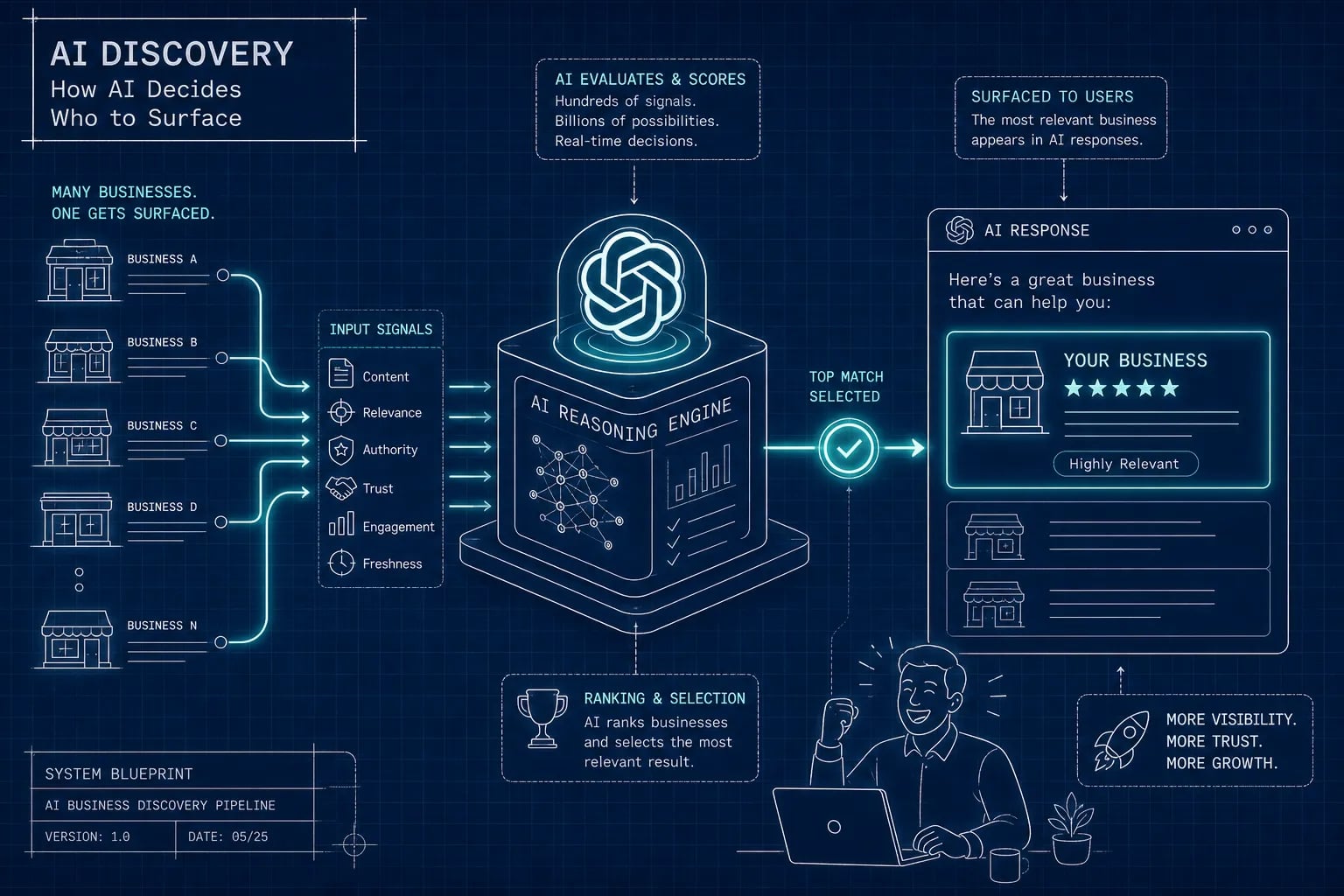
Customers aren’t just Googling anymore. A growing number are asking ChatGPT who to call, querying Google AI Overviews for the best local option, and telling Siri to “find someone nearby.” When they do, the AI picks a winner. If your competitor has a better-structured digital presence, the AI is more likely to surface them, not because they’re better at what they do, but because their digital signals are organized in a way AI can read and yours may not be.
At TW3 Marketing, we’ve run authority diagnostics on service businesses across the country. The same pattern shows up repeatedly: real expertise, real results, real customers, but completely invisible to AI because the digital signals aren’t organized the way these platforms expect. Before you can fix that, you need to understand how AI business discovery actually works.
How AI Platforms Find and Recommend Businesses
ChatGPT doesn’t rank results the way a traditional search engine does. It synthesizes reviews, directory listings, content, and expert signals pulled from its training data and live browsing integrations. Businesses with clear, structured, consistent authority signals across multiple platforms are far more likely to be surfaced. Businesses with thin or contradictory digital footprints simply don’t register. The AI has nothing solid to match against your name.
Google AI Overviews pull from the same index Google has always used, but available evidence suggests the weighting shifts significantly toward sources that are clearly authoritative and verifiable on a specific topic. Voice assistants go even further: Siri, Alexa, and Google Assistant typically surface one result, not ten. If you’re not that one result, you’re invisible. There’s no second place on a voice query.
The common thread across all three platforms is structured authority. Structured authority signals, things like reviews, schema markup, and consistent business data, matter more for AI recommendations than ad spend, and they’re often more important than keyword-stuffing tactics. AI systems are pattern-matching for signals that say “this business is credible, specific, and trusted by real people in this space.” Without those signals, the algorithm has no reason to pick you.
AI Business Discovery: The Signals That Trigger a Recommendation
Positioning clarity matters more than most business owners realize. AI platforms need to clearly understand what your business does, who it serves, and what makes it the right answer to a specific question. Vague, generic messaging reads as noise. Businesses with sharp positioning, a specific service, a specific market, a clear proof point, give AI something concrete to match against a user query. If your homepage could describe fifty different businesses, that’s a problem worth fixing before anything else.
Proof Signals and AI Readiness Assessment
Proof signals are just as critical. Review volume, recency, and the specificity of what reviewers say, along with consistency across directories, all factor into AI recommendations. AI doesn’t just count stars. It reads patterns: do multiple independent sources say the same things about this business? Consistent proof across Google, Yelp, industry directories, and other platforms signals legitimacy. Recent reviews tend to carry more weight than an old, stale review history, though the exact weighting varies by platform and isn’t publicly disclosed.
Schema Markup and Digital Consistency
Content structure and digital consistency round out what AI looks for. AI systems read organized service pages, clear FAQs, properly formatted schema markup, and consistent name, address, and phone data across every listing. When a business looks different depending on where the AI finds it, that creates confusion. Confused AI doesn’t recommend. This is where an AI readiness assessment becomes practical, it tells you exactly where your signals break down before a potential customer asks ChatGPT for a recommendation and gets your competitor’s name instead.
Why Solid Businesses Fail the AI Business Discovery Test
Many service business websites were built around older SEO priorities, keyword density, page speed, backlinks. Those sites can rank reasonably well in traditional search while being completely invisible to an AI making recommendations in 2026. The optimization strategy is different. The signals that matter are different. And most businesses haven’t made the shift.
Running ads drives traffic. Building links can improve domain authority. But neither activity directly builds the trust and authority signals AI platforms use when making recommendations. The gap isn’t a marketing budget problem, it’s structural. No amount of ad spend reorganizes your digital presence around the signals that matter to AI.
What the TW3 Marketing Authority Audit™ Actually Reveals
TW3 Marketing Authority Audit™ scores a business across six core authority signals: positioning, proof, expertise, visibility, engagement, and experience. Each signal maps directly to what AI platforms evaluate when deciding whether to recommend a business. The audit doesn’t measure vanity metrics, it measures the specific inputs AI uses to make decisions, scored across 100 points using a documented methodology rather than guesswork.
Most service businesses score well in one or two areas and carry significant gaps in the rest. That’s actually useful information. The audit surfaces those gaps in plain language with a clear priority order, a practical business AI discovery playbook for what to fix and in what sequence. Instead of spending money randomly on marketing tactics, business owners get a structured roadmap: address these specific gaps, in this order, and your AI discoverability improves in a measurable way.
An Authority Score™ Check can show you how your business currently appears in Google and ChatGPT, typically within around 48 hours depending on data access. For the full picture, the TW3 Marketing Authority Audit™ delivers the complete 100-point breakdown. Either way, you’re starting from data, not from assumptions about why your phone isn’t ringing the way it used to.
The Starting Point for Better AI Business Discovery
AI business discovery isn’t random. It’s pattern-based, and the patterns are knowable. ChatGPT, Google AI, and voice assistants are all looking for overlapping signals: clarity, credibility, proof, and consistency. Platforms weight these differently, and none of them publish their exact formulas, but the research is clear that businesses with strong, structured signals across all four get recommended. Businesses without them stay invisible, regardless of how good they actually are.
The fix doesn’t start with a new campaign or a bigger ad budget. It starts with an honest look at how your digital presence reads to AI right now. Skipping that diagnostic step, what amounts to an AI use case discovery for your own business, is exactly why so many well-run companies stay stuck.
You can’t optimize for AI business discovery until you know what AI actually sees when it looks at your business. That’s where the work begins.
