
When you run an authority score check, seeing a 42 or a 55 on your screen only tells part of the story. I see this often: a business owner pulls up their domain authority score, decides the number looks reasonable, and moves on, then wonders why they’re not ranking for target terms or showing up when a potential customer asks ChatGPT who to call. The number felt fine. The results don’t match.
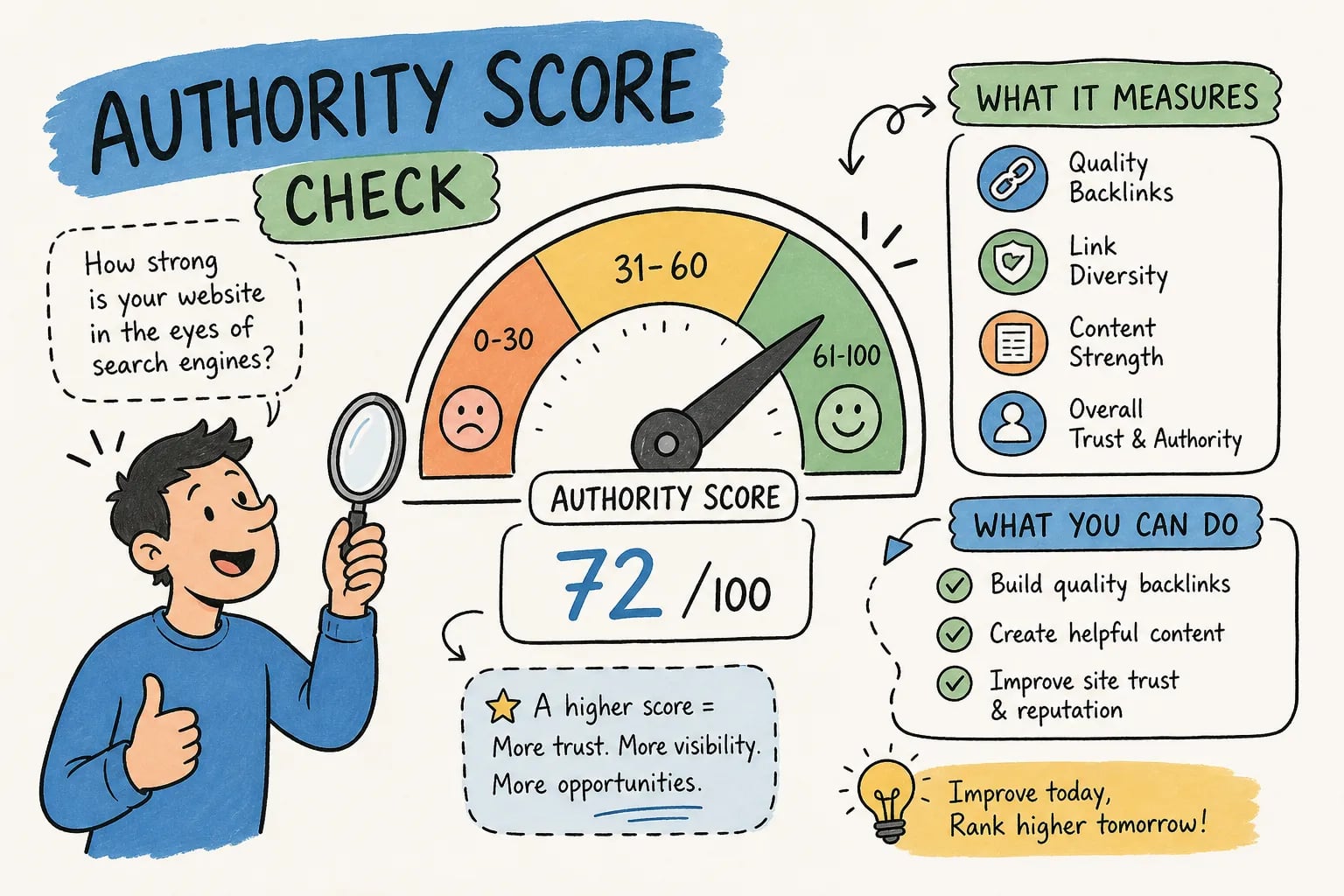
Authority scores are genuinely useful, but most people run a quick check and walk away with a number they don’t know how to use. What metric did they just read? Is it comparable to their competitor’s score? And what should they actually do about it? A proper authority diagnostic, the kind we run at TW3 Marketing before touching any client strategy, goes much deeper than a single number from a single tool. But even at the surface level, there’s a lot most site owners are missing.
Authority Score Check: What It Actually Measures
The first thing to understand is that “authority score” is not one thing. Depending on which tool you run, you’re looking at a completely different metric built on different data with a different formula.
Moz DA
Moz’s Domain Authority (DA) is a machine-learning model that predicts ranking potential based on Moz’s link index. It’s one of the most widely used scores, and many SEOs rely on a domain authority checker as their default starting point for link prospecting and competitive benchmarking.
Ahrefs DR
Ahrefs’ Domain Rating (DR) is primarily backlink-driven, focused on the number of unique referring domains and how strong those linking sites are. Ahrefs functions as a backlink authority checker above all else, which is useful context when interpreting a DR score.
Semrush Authority Score
Semrush’s Authority Score is broader: it combines backlink quality, estimated organic traffic, and spam detection into one composite number. SE Ranking’s Trust metric appears to emphasize link quality over volume, though the company provides limited public detail on its exact calculation method.
These are not interchangeable. A site can score 45 in Moz DA, 38 in Ahrefs DR, and 61 in Semrush Authority Score at the same time. That’s not a sign something is broken; it’s just three tools measuring three different things. Semrush’s score appears wider because it rewards traffic and spam resistance in addition to links. Ahrefs DR is primarily backlink-driven, with link volume and link strength doing most of the work. None of them are Google ranking factors. Google has confirmed through its Search Central documentation and statements from its search representatives that it does not use DA, DR, or any third-party authority score directly in its ranking systems. Correlation research supports this: Moz DA correlates at roughly 0.16 with Google rankings, Semrush Authority Score at around 0.21. Useful for comparisons, not for predicting exact positions.
Authority Score Check: How to Read the Ranges
Once you know which metric you’re looking at, the next step is putting the number in context. These benchmarks give you a working framework for outreach filtering, SEO audits, and competitor analysis.
- Moz DA: 0, 20 is low or new, 21, 40 is developing, 41, 60 is established, 61+ is strong
- Ahrefs DR: 0, 20 is low, 21, 50 is medium, 51+ is high
- Semrush Authority Score: 0, 29 is low, 30, 59 is medium, 60+ is high
“Good” is always relative to your niche, not a universal grade. A DA 35 might be competitive in a local service market and completely outgunned in finance or health. The number only tells you something useful when you stack it against the competitors you’re actually trying to beat.
For outreach decisions, use a DA checker or DR tool to filter link prospects, many SEOs treat this as a reliable heuristic, though it’s not a universal rule. A guest post opportunity at DA 15 carries materially less value than one at DA 50. For your own site, treat your score as a baseline to track progress over quarters, not a report card to chase week by week. If your main competitor sits at DR 60 and you’re at DR 22, that gap is telling you something concrete about the backlink work still ahead.
Why a Backlink Score Alone Misses the Bigger Picture
DA, DR, and Semrush Authority Score all measure backlink strength in some form. What they don’t measure is whether Google clearly understands what your business does, whether your trust signals hold up when a real prospect visits your site, or whether AI platforms like ChatGPT would actually recommend you when someone asks for a local service provider.
A business can have a solid domain rating and still not appear in AI Overviews or ChatGPT answers for their target queries. As AI assistants become a more common tool for discovery, that gap becomes increasingly consequential. ChatGPT synthesizes recommendations from businesses that are consistently described across the web, supported by third-party mentions, and backed by clear service and location information. A strong backlink profile helps, but it’s one input among several.
Several diagnostic approaches exist for assessing these broader signals. TW3 Marketing’s Authority Score™ Check is one built specifically for this purpose. It’s a 48-hour diagnostic that shows how a business currently appears in both Google and ChatGPT, examining six authority signals: positioning, proof, expertise, visibility, engagement, and experience. It’s designed for businesses that want to know whether their digital presence is genuinely AI-ready, not just link-rich on paper. Reach out to our team to request yours and get a full picture within two business days.
Authority Score Check: Next Steps After You Get Your Number
Most people get a score and either panic or shrug. The better move is to prioritize actions by how quickly they produce results.
Start with technical fixes. Crawl errors, broken links, accidental noindex tags, canonical conflicts, and sitemap problems are the fastest movers. Fixing these stops existing authority from leaking and can produce ranking movement within days to four weeks.
- Highest ROI starting point for most sites
- Often the most overlooked step before link building begins
- Results can appear in as few as a few days, depending on crawl frequency
Next, address internal linking and content. Pushing authority from your strongest pages to your priority service or product pages, and refreshing thin or outdated content, typically shows keyword movement in two to eight weeks. This middle layer gets skipped often because it’s less visible than link building, but it’s frequently more immediately impactful.
Then build new backlinks. This is the highest-impact lever over the long term, but also the slowest. Early signals from new links appear in one to three months; meaningful score movement usually takes three to six months. A bulk DA check or DR tracking report can help you monitor progress across a domain portfolio, but don’t start link building while technical problems are still bleeding authority.
Track your authority score monthly, not weekly. The signal worth watching is a consistent upward trend over a quarter, not a jump after one action. Scores lag behind the actual work, and chasing week-to-week fluctuations is a distraction from the consistent effort that actually moves them.
An Authority Check Is a Starting Point, Not a Verdict
The number you get from any authority score tool matters less than understanding what it’s measuring and what lever to pull next. Know which metric you’re reading, benchmark it against your actual competitors in your actual niche, and fix technical issues before spending money on links.
If you want to go beyond backlink strength and see how your business actually appears inside AI-driven search, TW3 Marketing’s Authority Score™ Check delivers that broader picture in 48 hours. It examines signals that standard DA and DR tools aren’t designed to capture, including how AI systems interpret your business’s positioning and expertise across the web. Get in touch with our team today to find out where you stand.
