
A homeowner’s pipe bursts on a Tuesday night. Ten years ago, they called a neighbor. The neighbor gave them a name, vouched for the work, and the plumber had a new customer by Wednesday morning. That chain of trust worked because a real person with real experience put their credibility behind the recommendation. Now that same homeowner opens ChatGPT, types “best plumber near me,” and triggers AI-driven referrals instead of asking a neighbor. The neighbor never gets asked.
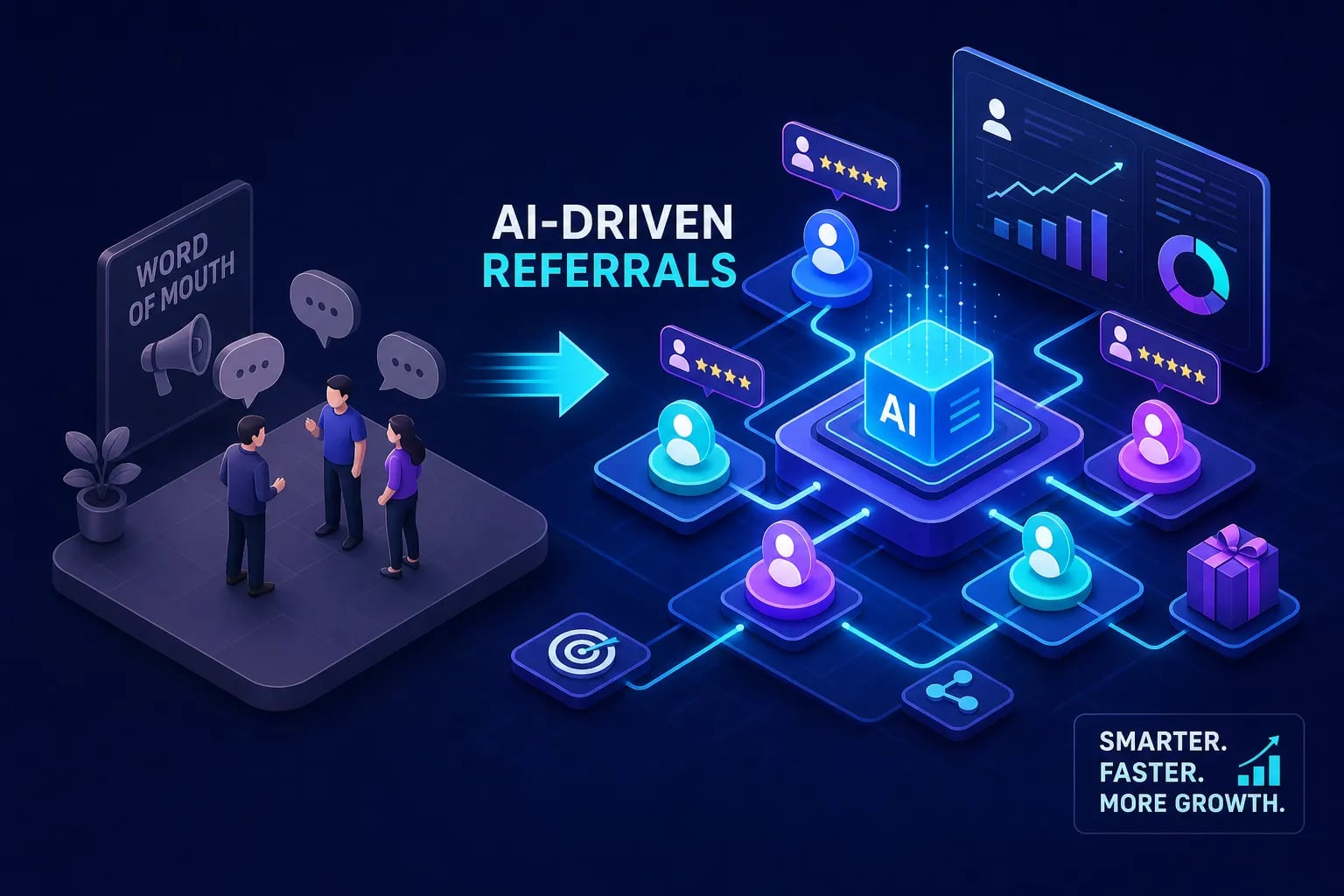
At TW3 Marketing, we see this pattern consistently across HVAC, contracting, and home services clients. Businesses that built solid reputations over decades are losing new customer inquiries to competitors with weaker operations but stronger digital authority, a pattern we observe repeatedly in our client work, even if industry-wide data hasn’t fully quantified it yet. The referral game didn’t disappear. It moved to a different referee, and most local service businesses are still figuring out how to compete in the new arena.
Why Word-of-Mouth Referrals Were So Hard to Beat
A personal referral worked because of three things firing at once: the recommender knew the problem, had first-hand experience with the provider, and put their own credibility on the line. That combination of specificity, social proof, and accountability created trust that no ad could replicate. When your neighbor says “call Mike, he fixed our furnace and didn’t overcharge us,” that recommendation carries the kind of conversion power that’s genuinely difficult for paid channels to match, word-of-mouth leads convert to appointments at rates that consistently outpace most digital ad formats.
But word-of-mouth always had a structural ceiling. It only reaches people already inside your customer’s social circle. It doesn’t scale beyond geography or social proximity. It can’t be measured, and it evaporates when a satisfied customer moves away or simply stops being asked. For local service businesses, the reach problem was the hidden cost nobody talked about, because when referrals were the primary growth channel, there wasn’t an obvious alternative to point to.
How AI-Driven Referrals Became the New Referral Engine
Adobe’s data from July 2026 shows AI-referred retail visitors converting at 60% higher rates than non-AI traffic. That figure is striking on its own, but the growth trajectory underneath it is what makes this a structural shift rather than a trend. AI referral traffic to U.S. websites grew over 1,300% between October 2024 and mid-2026, according to Adobe’s tracking data. That’s not a rounding error in your analytics. That’s a new channel becoming significant fast.
Some AI assistants, particularly those tied to Google’s ecosystem, can and do return specific business names when users ask for local service recommendations. The behavior varies by platform, and named recommendations remain a fraction of total queries. Still, BrightLocal’s 2026 Local Consumer Review Survey found 45% of U.S. consumers had asked an AI tool for a local business recommendation in the past year. When an AI does surface a specific business, that response functions much like a neighbor’s referral: it’s specific, it carries implicit credibility from the source, and it arrives when the prospect already has a problem to solve. The volume is real, the intent is high, and the conversion rates confirm it.
What Makes a Business Referable to an AI Assistant
Here’s the part that changes how you think about your marketing budget. The qualities that made a business referable by a neighbor are the same qualities AI platforms evaluate: demonstrated expertise, a track record of results, a clear identity, and visible proof. The difference is that AI systems can’t call your happy customers. They read your digital footprint and make a judgment call based on what they find. This is the core mechanism behind AI-driven referral marketing, your digital authority either earns the recommendation or it doesn’t.
Reviews and Proof Signals
Review volume and quality are among the most heavily weighted signals in AI-assisted referrals. Reviews that mention specific services, locations, and outcomes give AI systems something concrete to evaluate. A business with a hundred vague five-star reviews will often lose ground to one with fifty detailed reviews that name the technician, describe the problem solved, and mention the neighborhood.
Structured Data and Schema
Schema markup, specifically LocalBusiness and FAQPage schemas, helps AI systems parse your business data cleanly. Without it, an AI assistant is essentially guessing at what your business does, where it operates, and whether it’s a credible match for the query. Structured data makes that match explicit. For AI referral platforms and tools that pull from indexed sources, this foundational markup is non-negotiable.
Local Citations and Positioning Clarity
Third-party citations across directories like Google Business Profile, Yelp, and trade platforms reinforce your business identity across sources. AI systems aggregate signals, so consistency and volume across citations matter. How clearly a business is positioned in its specific niche, not just generically as a “contractor”, also factors heavily into whether AI-generated referrals land on your listing.
This is the territory TW3 Marketing’s Authority Framework™ was built for. The framework maps six authority signals: positioning, proof, expertise, visibility, engagement, and experience. TW3 Marketing Authority Audit™ scores each across a 100-point diagnostic that pinpoints where authority breaks down and why AI assistants surface competitors instead. A business that scores poorly on proof signals won’t get recommended by AI, the same way a business with no reviews and a vague reputation won’t get recommended by neighbors.
How to Start Earning AI-Driven Referrals
The businesses winning AI-driven referral marketing aren’t getting lucky. They’re running the same playbook that made them referable by word-of-mouth, translated into signals AI systems can read. Our work with HVAC and contracting clients in 2025 and 2026 shows the tactics that move the needle most consistently: answer-first content that responds directly to buyer questions, structured data that helps AI parse your business cleanly, and fact-dense service pages that establish expertise rather than just describe offerings. These three priorities also align with what external case studies on AI-assisted referrals consistently identify as highest-impact.
On the tracking side, you need to know whether this channel is working for your business. In GA4, filter Session source for domains including chatgpt.com, perplexity.ai, and gemini.google.com. Build a custom channel group, label it “AI Referral,” and place it above generic Referral rules in your channel priority order. For straightforward GA4 setups, the configuration is typically quick, though account complexity and the need for server-log reconciliation can add time. Keep in mind that some AI referral traffic may still appear as Direct or arrive without referrer data, so pairing GA4 filters with UTM tagging on any AI-specific campaigns gives you cleaner attribution. This setup gives you clear visibility into how many customers are arriving through generative-AI referrals so you can connect your authority-building work to actual traffic and revenue.
The Gap Between Referable and Invisible Is Widening
Customers haven’t stopped making trust-based decisions. They’re outsourcing the research to AI assistants that evaluate your business the same way a knowledgeable neighbor would, except faster, at scale, and available at 11 p.m. on a Tuesday. Businesses building authority signals now are capturing that channel. Businesses waiting for clarity on “whether AI search matters” are handing those referrals to competitors month by month.
The starting point is knowing where your authority actually stands. TW3 Marketing’s Authority Score™ Check shows how your business currently appears in Google and ChatGPT, a proprietary diagnostic built from our Authority Framework™ methodology. Before investing more in ads or content, it’s worth understanding what AI platforms see when a potential customer asks who to call. Reach out to our team to get your Authority Score™ Check and find out exactly where your AI-driven referrals are going, and how to start winning them back.
