
Why some local businesses appear in AI search results and others don’t comes down to one thing: verification. A homeowner opens an AI-powered search tool and types, “Who should I call for HVAC service in Charlotte?” Three businesses get named. One has 40 reviews and no ads running. The others are small, local, and mostly unknown online. Meanwhile, a dozen contractors with active Google Business Profiles and years of reviews get nothing, not a mention, not a footnote.
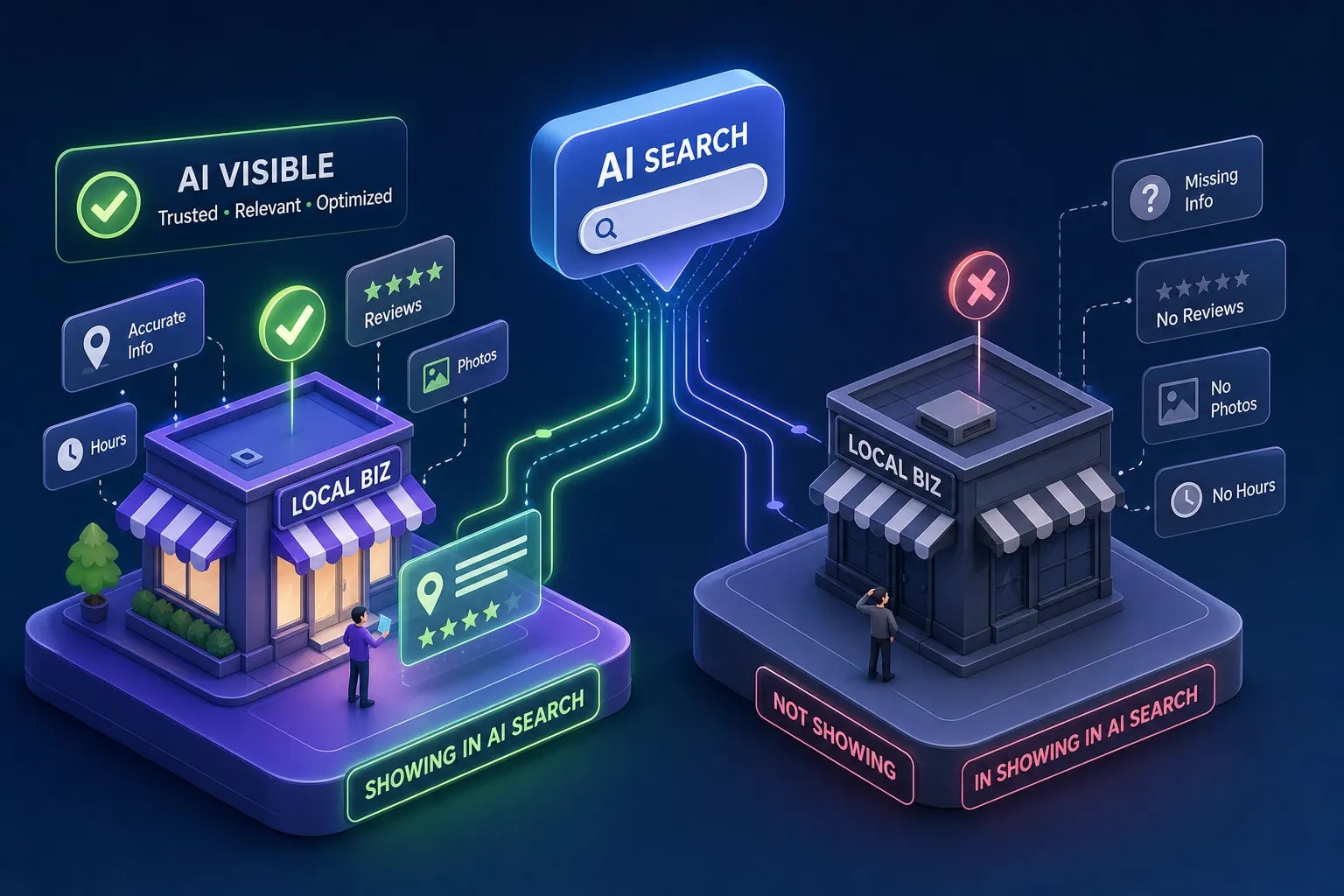
This isn’t random, and it isn’t unfair. AI search doesn’t pick businesses the way a traditional algorithm ranks pages. It picks businesses it can verify. When an AI system assembles an answer to a local query, it looks for sources it can trust enough to stake its credibility on. Most local service businesses, including excellent ones with real customers and real results, are failing that verification process without realizing it.
What AI search actually checks before naming a local business
Traditional search ranks pages. AI search assembles answers. That distinction matters more than most business owners appreciate. When Google’s generative AI features surface a local recommendation, the system isn’t choosing a winner from a ranked list. It’s asking: can I verify this business well enough to cite it confidently? If the answer is unclear, the business gets skipped.
The verification stack AI uses includes structured entity data (your LocalBusiness schema and Google Business Profile completeness), review volume and specificity, NAP consistency across directories, and third-party entity mentions in local publications or “best of” lists. Local Falcon’s research reinforced this clearly: once a business was included in AI Overviews, there was effectively no correlation between distance and ranking position. Proximity still helps trigger the query, but it doesn’t determine who gets cited. Verified authority does.
These signals don’t operate in isolation. AI systems look for agreement across multiple sources before treating a business as a reliable answer. One solid signal isn’t enough, the system wants corroboration across the board.
Why some local businesses don’t appear in AI search: the gaps that keep them invisible
The most common reason a service business gets skipped in local AI search results isn’t that the business is bad. It’s that the signals AI needs to verify and recommend that business are thin, inconsistent, or missing entirely. The plumber whose site has no service pages. The contractor whose last review was posted in 2021. The roofing company with three different phone numbers listed across five directories.
Generic content is a major culprit. A service page that says “We offer professional HVAC services in the Dallas area” gives an AI system almost nothing to work with. Compare that to a page naming specific services, listing service-area zip codes, describing common problems solved, and explaining what a customer should expect during a visit. AI rewards specificity because specificity is what it can extract and surface in generative search responses. Vague content reads as low-confidence, and low-confidence sources don’t get cited.
Inconsistent NAP data is the other silent killer. When your business name, address, and phone number don’t match across your website, Google Business Profile, Yelp, and local directories, AI systems can’t confirm they’re all referring to the same entity. Instead of consolidating trust into one strong profile, fragmented signals split your authority across multiple ambiguous records. When AI can’t resolve the entity cleanly, it defaults to a competitor whose information is consistent and clear.
Why this is an authority problem, not an SEO problem
Traditional SEO is built around ranking signals: backlinks, keyword density, page speed, domain authority. Those still matter for organic search. But AI visibility runs on a different set of inputs, and treating them the same way is why so many businesses invest in SEO and still end up invisible in AI-driven local search results.
The signals that actually move the needle for AI inclusion are authority signals. They break down into four core categories:
- Positioning, AI can clearly identify what you do and where you do it
- Proof, reviews, testimonials, and case studies that confirm your claims
- Expertise, content that demonstrates real knowledge, not just keyword coverage
- Visibility, corroborating mentions of your business outside your own site
The 100-point TW3 Marketing Authority Audit™ measures businesses across all six authority dimensions, positioning, proof, expertise, visibility, engagement, and experience, and produces a scored diagnosis of exactly which signals are missing and why a business is being passed over in AI recommendations.
A standard SEO audit checks rankings and backlinks. An authority audit checks what AI systems actually need: entity consistency, review signal strength, content extractability, and third-party proof. For most service businesses, the first audit commonly reveals a small number of high-impact gaps responsible for the majority of their AI invisibility. Fixing a few targeted things, not everything at once, is usually what shifts visibility.
Where to start if you want local listings in AI search results
Your Google Business Profile is one of the most important signals you control for local AI search visibility. That means accurate primary categories, current service descriptions, regular posts, and prompt responses to reviews. It also means alignment: your business name, address, phone number, and hours on your GBP should match exactly what’s on your website and across your major directory listings. That alignment is what allows AI to verify your entity cleanly.
Add structured data and fix your NAP
Layer LocalBusiness schema on your website with matching NAP data, service area, and hours. Consistent structured data across your site and directories removes the ambiguity that causes AI systems to skip a business entirely.
Address review recency and specificity
Research into local AI ranking factors indicates that review recency outweighs raw volume: a business with 15 recent, specific reviews can outperform one with 80 generic five-star reviews from three years ago. The principle is well-supported even if exact thresholds vary by market and query. Reviews that mention specific services, outcomes, and locations give AI concrete, extractable content to work with.
Build out service-specific content
Pair strong review signals with service-specific pages that answer real customer questions directly, and you start clearing the visibility threshold that generative search uses to decide who makes the answer. Each page should name services, cover service-area specifics, and address the problems customers are actually trying to solve.
How to fix why some local businesses appear in AI search results and others don’t
Being invisible in local AI search results isn’t a permanent condition, and it isn’t arbitrary. The businesses showing up have built a coherent set of authority signals that AI platforms can verify across multiple sources. The businesses being skipped have gaps, usually a handful of specific ones, that are identifiable once you know where to look.
Start with your entity signals: NAP consistency, GBP completeness, and LocalBusiness schema. Then move to your review signals and your content. Those three areas account for the majority of AI inclusion decisions for local service businesses. If you want to know exactly where your business stands, TW3 Marketing Authority Audit™ scores your business across 100 points and shows you precisely what to fix first. Request your TW3 Marketing Authority Audit™ and get a clear starting point instead of guessing.
