
If you’re evaluating the best AI for marketing for a professional firm in 2026, start by matching tools to function. For content creation, Jasper leads. For SEO and AI search visibility, Semrush is the benchmark. For CRM automation and client outreach, HubSpot and GoHighLevel each make a strong case, depending on what your firm actually needs. That’s the short answer.
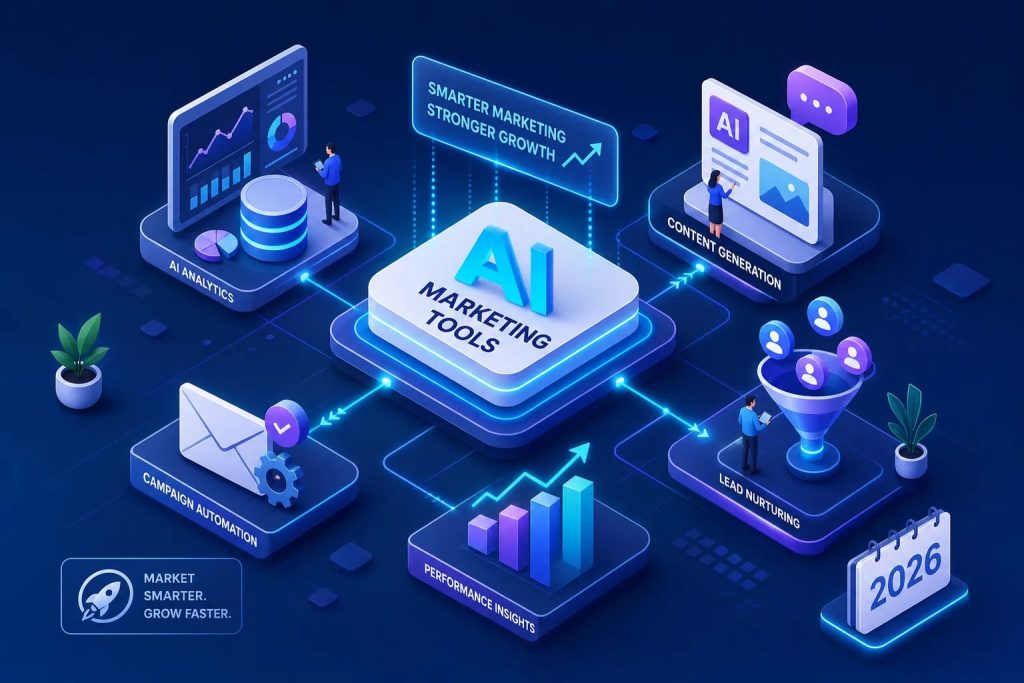
The longer one: the tool isn’t the strategy. Most professional firm owners figure that out after paying for three platforms they aren’t using well. The right AI marketing tool is the one that fits into a connected system, not the one with the most impressive feature page.
That framing is what this comparison is built around. Function first. Fit second. Features last.
Key takeaways
- Match tools to function: Content creation, SEO, CRM, and outreach each have clear leaders in 2026, and they don’t overlap much.
- Professional firms need different criteria: Most AI marketing software is built for ecommerce or lead volume, not expertise-led businesses.
- Answer three questions first: What problem are you solving, what does success look like in 90 days, and does this connect to your existing workflow?
- GoHighLevel vs. HubSpot is a real choice: One is outreach-first; the other is process-and-data-first. They solve different problems.
- Isolated tools produce activity, not results: The system connecting the tools is what determines ROI.
- Start narrow: One tool per function, with a defined success metric before adding anything else. Run a focused pilot of 30 to 90 days and measure honestly.
How do you decide which AI for marketing is worth your time?
The criteria that matter for professional firms
Most AI marketing software is built for ecommerce or high-volume lead generation. Professional firms sell expertise, relationships, and demonstrated judgment. That changes the evaluation entirely. The question isn’t whether a platform generates clicks. It’s whether it supports thought leadership content, helps demonstrate credibility, and connects to a client journey that ends in a qualified conversation.
A content tool that produces generic articles fast isn’t an asset for a consulting or advisory firm. Neither is an AI advertising optimization tool calibrated for cost-per-click when what you need is recognition and trust. Evaluate tools against the specific problem you’re trying to solve, not the feature list on a pricing page.
Three questions to ask before you trial anything
Before you open a free trial, answer three questions. What specific problem are you solving? What does “working” look like in 90 days? Does this tool connect to your existing CRM or workflow? If you can’t answer all three clearly, the trial will tell you nothing useful.
Many firms skip this filter and end up with multiple unused subscriptions and no clear picture of what any of them are producing. That’s not an AI problem. That’s a system problem.
Best AI for Marketing by Use Case in 2026
Best AI for Marketing: Content Creation and SEO
Jasper is the clearest choice for on-brand content production. It’s built around brand voice consistency and scalable copy workflows, making it one of the stronger AI content generators for marketers who need to publish at volume. For search and AI visibility, Semrush leads as a measurement and competitive intelligence platform. Surfer SEO is a strong complement for content optimization at the page level. Semrush tells you where to compete; Surfer helps subject-matter experts turn a draft into a well-structured, citation-worthy article.
Neither tool manufactures genuine expertise. The authority that gets a professional firm recommended by an AI assistant still has to come from real knowledge, documented proof, and a distinctive point of view.
| Use case | Top tool(s) | Best for | Key limitation |
|---|---|---|---|
| Content creation | Jasper, Copy.ai | Firms producing frequent articles, newsletters, and campaign copy at scale | Requires a strategy layer and expert review to stay credible and distinctive |
| SEO and AI visibility | Semrush, Surfer SEO | Tracking rankings, competitor gaps, and AI-generated search appearances | Semrush is broader; Surfer is narrower. Each covers what the other doesn’t |
| CRM automation | HubSpot, GoHighLevel | HubSpot for structured CRM and reporting; GoHighLevel for outreach-first pipeline management | Neither produces results without connected stages and clean data |
| Client outreach | GoHighLevel, ActiveCampaign | Appointment booking, SMS follow-up, nurture sequences, and pipeline triggers | Both assume a defined client journey exists before automation is turned on |
Ad and email automation: who it’s actually built for
Google Performance Max and Meta Advantage+ are genuinely powerful AI advertising optimization tools for media buying. They’re also designed for volume, not for the relationship-based conversion model most professional service firms rely on. These platforms work well when the goal is reach and lead volume at scale. For firms that win business through reputation, referrals, and demonstrated expertise, they’re a secondary channel at best.
Klaviyo and ActiveCampaign are strong for AI marketing automation, but both assume a list-building funnel that many professional firms haven’t built yet. If you don’t have a nurture sequence, defined audience segments, and consistent lead flow, the AI features in these platforms won’t do much to help.
What do CRM automation and client outreach tools actually do?
All-in-one platforms vs. specialized tools
HubSpot is the most accessible all-in-one AI marketing platform for growing firms: CRM, email automation, lead scoring, and attribution connected in one place. GoHighLevel is the stronger option when the priority is offer-specific funnels, appointment booking, SMS outreach, and pipeline management built together and deployed fast. GoHighLevel is outreach-first. HubSpot is process-and-data-first. For most consulting, insurance, and real estate firms, those are genuinely different priorities with different right answers.
Full disclosure: at TW3 Marketing, we build and deploy GoHighLevel systems for professional firms, connecting authority-building with the pipeline mechanics needed to convert interest into qualified conversations. The capabilities include lead capture and qualification, appointment booking, automated nurture and follow-up, pipeline stages, and visibility into stalled opportunities.
What automation actually looks like in practice
A working client outreach system includes lead capture, qualification, nurture sequences, follow-up triggers, and pipeline visibility. Those stages have to be connected. Turning on AI features inside a disconnected CRM doesn’t produce a system. It produces a faster version of the same fragmented process you already have.
The difference between firms that see ROI and those that don’t is almost never the AI features. It’s whether the stages are linked, the data is clean, and someone owns the outcome.
Why isolated AI tools rarely produce the results firms expect
The pattern most professional firms fall into
Firms buy tools one at a time, usually in response to a specific pain point. A content subscription here, an SEO platform there, a CRM that nobody fully configured. The result is fragmented data, inconsistent messaging, and no clear picture of what’s producing results, if anything is. The tool isn’t the bottleneck. The system is.
Firms that see the most measurable improvement from AI marketing tools tend to have something in common: they started with positioning and a defined client journey before they started shopping for software.
How a connected authority-building strategy changes the outcome
The TW3 Marketing Authority Framework covers positioning, proof, expertise, visibility, engagement, and experience. The tools covered in this article are the execution layer. The strategy that connects them, defining which tools to use, in what order, and toward what goal, is the part most firms skip. That’s also the part that determines whether an AI marketing platform produces business results or just activity.
Before recommending a program, we work from the TW3 Marketing Authority Audit™: a 100-point assessment that surfaces evidence-based gaps and builds a prioritized roadmap. The tools come after the diagnosis, not before it.
Start with one tool per function, then measure it honestly
The short list by function: Jasper for content, Semrush for SEO and AI visibility, HubSpot for a process-centered CRM, and GoHighLevel for outreach-first pipeline automation. Apply the pre-trial filter from above, pick one tool per function, and run a focused pilot, 30 to 90 days is a reasonable window, with a defined success metric before adding anything else.
Resist the pull to stack more tools. Most firms don’t have a tool shortage. They have a system shortage. Fix the system and the tools start doing what they’re supposed to do.
If you want help choosing the best AI for marketing that fits your firm’s specific goals, reach out to our team at TW3 Marketing. We’ll start with the diagnosis, not the demo.
Frequently Asked Questions
How long should our pilot run before we decide if a tool is working for us?
Run a focused pilot for 30 to 90 days and measure against a defined success metric. We recommend defining what “working” looks like in 90 days before you start so the trial produces useful information.
Can AI tools replace subject-matter experts in our marketing?
No, AI tools do not manufacture genuine expertise and cannot replace real knowledge. We state that authority still has to come from documented proof and a distinctive point of view provided by your team.
Should we choose an all-in-one platform or specialized tools?
Choose based on the problem: HubSpot is process-and-data-first while GoHighLevel is outreach-first, and each solves different problems. We advise one tool per function and connecting those tools into a system rather than stacking platforms indiscriminately.
Are Google Performance Max and Meta Advantage+ good choices for professional firms?
They can work for reach and lead volume but are built for high-volume media buying, so they are secondary channels for relationship-based firms. We recommend prioritizing channels that support reputation, referrals, and demonstrated expertise instead.
