
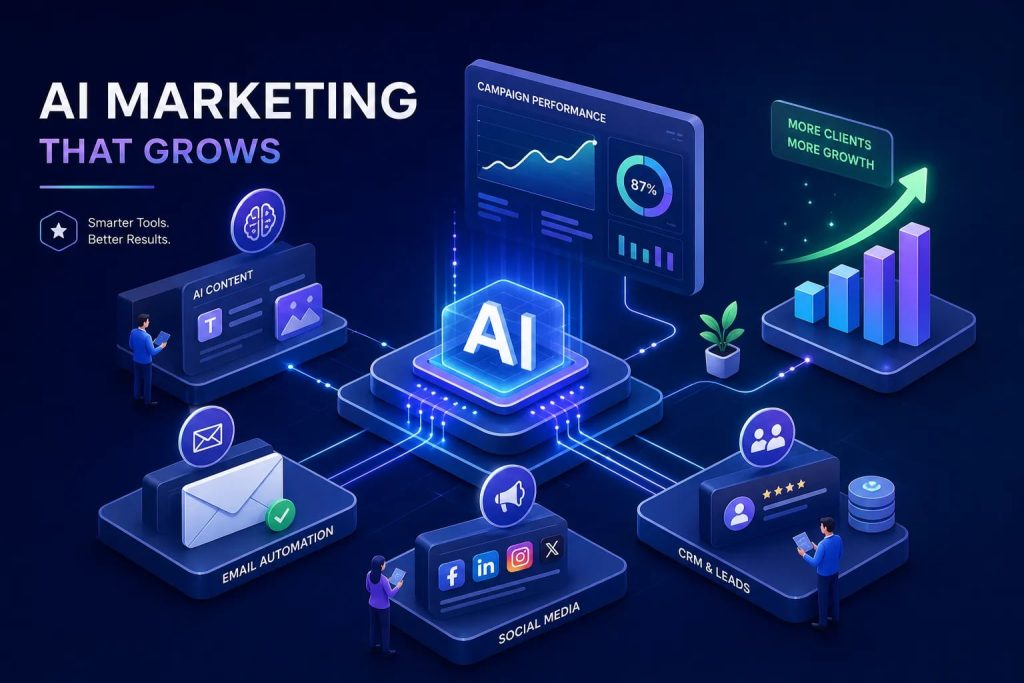
The best AI marketing tools for consultants, insurance professionals, and real estate agents in 2026 fall into three categories: content creation, reputation management, and AI search visibility. Based on current tool comparisons, the standout picks are Jasper or ChatGPT for content, Semrush for visibility, and Predis.ai or Sprout Social for reputation and social proof. Many professional service businesses make a costly sequencing mistake: they subscribe to tools before identifying where their authority actually falls short. The right tool pointed at the wrong problem produces more content no one trusts. Firms getting the most from AI marketing software start with a clear diagnostic picture of their authority gaps before spending a dollar on subscriptions, and that sequencing matters more than any single tool choice.
Key takeaways
- Three categories, not one: Content creation, reputation management, and AI search visibility require different tools with different strengths.
- Top picks for professional firms: Jasper or ChatGPT for content, Semrush for visibility and competitive intelligence, Predis.ai or Sprout Social for social proof.
- Human review is non-negotiable: AI-generated content in regulated industries needs professional review before anything goes live.
- AI search is a separate discipline: Ranking in Google and being cited in ChatGPT or Google AI Overviews require different strategies.
- Diagnosis before tools: A structured authority audit reveals which category of tool to invest in first.
Best AI marketing tools for content creation in professional services
Thought leadership content drives trust and visibility before a prospect ever reaches out. For consultants, insurance professionals, and real estate experts, that means publishing expert answers, educational explainers, and insight-driven articles consistently. The right AI marketing platform depends on output volume and how much brand control your firm requires.
Jasper vs. ChatGPT vs. Claude: which fits your firm?
Jasper enforces brand voice and campaign structure, making it the stronger choice when a firm produces high volumes of consistently branded content across multiple campaigns. According to Jasper’s pricing page, the Pro plan starts at $59 per user per month billed annually. ChatGPT and Claude are more flexible for research synthesis and long-form drafting. According to OpenAI’s pricing page, ChatGPT Plus runs $20 per user per month. Claude Pro, per Anthropic’s pricing page, is in a similar range. For a solo consultant publishing weekly insights or an insurance agent creating educational explainers, ChatGPT or Claude typically delivers strong results at a lower cost of entry.
Compliance and credibility: what AI cannot do for you
One caution applies across all three tools: AI-generated content in professional services carries real compliance and credibility risk. Legal disclaimers, factual accuracy in regulated industries, and the difference between content that sounds authoritative and content that actually is authoritative are distinct concerns. Human review before anything goes live is not optional.
Best AI marketing tools for reputation and local visibility
Professional service businesses win or lose on trust. Prospective clients check Google reviews, response patterns, LinkedIn consistency, and published case studies before they ever book a call. AI tools in this category accelerate the production and monitoring of those signals. They do not generate credibility from scratch.
Here is a quick comparison of the core tools in this space:
| Tool | Best for | Firm size |
|---|---|---|
| Predis.ai | Turning prompts into social posts, graphics, and short videos | Solo practitioners, small teams |
| Buffer / Publer | Lightweight scheduling and publishing | Solo consultants, boutique agencies |
| Sprout Social | Publishing, monitoring, approval workflows, and reporting | Mid-sized insurance agencies, real estate teams |
| Semrush | Competitive intelligence and tracking how your reputation compares locally | All sizes |
Matching the stack to your firm size
A lightweight AI martech stack for a solo consultant looks like Predis.ai paired with Buffer. A mid-sized insurance agency or real estate team gets more from Sprout Social combined with Semrush for competitive tracking. These are suggested configurations based on the tools’ feature sets and typical use cases for each firm size. The goal in either case is amplifying proof that already exists: reviews, testimonials, and published expertise that prospective clients can verify.
How do you optimize for AI search visibility in 2026?
Showing up in Google AI Overviews, ChatGPT responses, and Perplexity is a separate discipline from traditional SEO. Traditional SEO targets page rankings. Answer engine optimization targets being cited, quoted, or recommended in AI-generated responses. For a real estate professional or insurance agent, this means content that addresses the actual questions clients ask, structured so an AI system can extract and use it.
Tools and tactics for AI search optimization
Semrush is the practical starting point for auditing current visibility and competitive gaps. Surfer SEO (around $89/month per Surfer SEO’s pricing page) helps structure content to match what AI systems extract: direct answers near the top, FAQ-style formatting, descriptive headings, schema markup, and clearly attributed expertise. Testing whether your firm currently surfaces in AI answers for its key topics is straightforward: run your most important client questions through ChatGPT or Perplexity and see what comes back. That gap analysis should inform content priorities, not keyword volume alone.
This kind of AI marketing automation, structuring content so it feeds into AI-generated answers, is quickly becoming a core part of any competitive AI martech stack for professional service firms.
Why building your tool stack before a strategy diagnosis backfires
Most professional service firms invest in tools before identifying the actual gap, and that sequencing is what stalls results. The underlying problem is not output volume. It is that the authority positioning, proof structure, and credibility signals have not been addressed. More content amplifies a weak foundation faster.
The TW3 Marketing Authority Audit™ exists specifically to prevent this. It delivers a 100-point Authority Score with a prioritized roadmap that reveals where the actual gaps are: positioning, proof of results, website clarity, expertise visibility, and how the firm appears to AI systems evaluating credibility. That diagnostic step answers the tool-selection question directly.
If the gap is content output, invest in Jasper or ChatGPT. If the gap is AI search visibility, invest in Semrush and structured content optimization. If the gap is reputation, focus on review amplification and social proof tools. Tool dashboards show you metrics. They do not tell you whether your positioning is differentiated, your proof is credible, or your website speaks clearly to the right buyers.
Start with diagnosis, then pick your tools
Choosing the best AI marketing tools for your firm is a question of fit, not just features. Content creation platforms, reputation management tools, and AI search visibility software each solve a different problem. Jasper, ChatGPT, Semrush, and Predis.ai or Sprout Social are all capable options, but capability only converts to results when the tool is matched to the right gap.
The best AI tools for marketers in professional services amplify existing credibility, proof, and positioning. When those foundations are solid, the tools accelerate results. When they are not, the tools produce more noise at greater cost. Start by understanding exactly where your positioning actually falls short before committing to any subscription.
If you want that clarity before spending on software, reach out to our team about the TW3 Marketing Authority Audit™. It is the diagnostic step that tells you where to invest first.
Frequently Asked Questions
How should we choose between Jasper and ChatGPT for our content needs?
Choose Jasper when you need high-volume, consistently branded content across campaigns and choose ChatGPT when you want flexible research synthesis and lower cost of entry. Jasper enforces brand voice and campaign structure, while ChatGPT typically suits solo consultants or agents creating weekly insights or explainers.
When should we prioritize reputation and social proof tools over content platforms?
Prioritize reputation and social proof tools when your core authority gaps are trust signals like reviews, testimonials, and published proof rather than content volume. Reputation tools amplify existing proof that prospective clients can verify, and investing in them first makes sense if the diagnostic shows weak local visibility or review presence.
Do we always need human review for AI-generated content in professional services?
Yes, human review is non-negotiable because regulated industries carry compliance and factual accuracy risks. Legal disclaimers and the difference between sounding authoritative and actually being authoritative require professional review before anything publishes.
How does the TW3 Marketing Authority Audit™ tell us which tools to buy first?
The TW3 Marketing Authority Audit™ delivers a 100-point Authority Score and a prioritized roadmap that reveals where your actual gaps are in positioning, proof, website clarity, expertise visibility, and AI credibility. That diagnostic output directly informs whether you should invest first in content tools, AI search visibility tools, or reputation tools.
