
Your online reputation is already functioning as a trust signal for every prospective client who searches your name. For professional service firms, whether you work in consulting, insurance, real estate, or another expert-led field, buyers conduct quiet research long before they reach out. What they find shapes whether they contact you, consider someone else, or move on without a word.
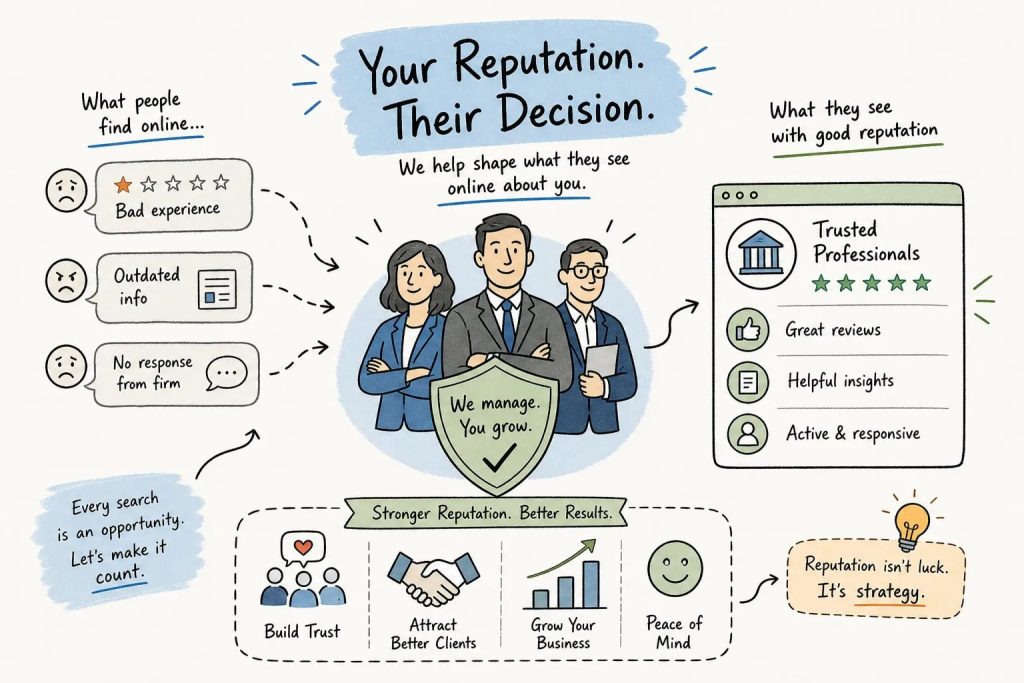
The good news: this research follows a predictable pattern. Buyers check the same kinds of signals, in roughly the same order, and industry research shows the gaps that hurt most are rarely the ones firms focus on first. Understanding what those signals communicate about your credibility is the foundation of any effective online reputation management strategy.
Key takeaways
- Research happens before contact: Prospective clients search your name, your firm, and your specialty before they ever fill out a contact form or pick up the phone.
- Trust signals are layered: Reviews, profiles, third-party mentions, and brand messaging consistency all contribute to the picture a buyer forms about your credibility.
- Inconsistency costs you: Mismatched information across platforms weakens both buyer confidence and search visibility at the same time.
- Diagnosis before action: Fixing the wrong gaps first scatters effort and delays real results. A structured audit shows you where to start.
- AI search is part of the picture: AI assistants can surface and recommend professional firms, and they appear to use many of the same authority signals that buyers rely on.
What prospective clients actually see when they research your firm
Before a prospect calls or completes your contact form, they run a search. That search rarely starts on your website. It starts with your name, your firm’s name, or the service you provide in a specific city or market. What appears in those results is your digital reputation in its most visible form, and it shapes the buyer’s first impression before you’ve said a word.
The first page of results for a branded search functions as an informal credibility report. It may surface your website, a Google Business Profile, a LinkedIn page, review platform listings, directory citations, or third-party coverage. Each result adds or subtracts from the picture a buyer forms about whether your firm is legitimate, active, and worth considering. According to research published by Hinge Marketing, buyers of professional services use an average of 3.2 research methods before making contact, and more than 80 percent visit a firm’s website during evaluation, according to data from Octo Agency.
Review content tells a story beyond star ratings. Buyers read what past clients actually said, how recently they said it, and whether the firm bothered to respond. For professional service firms, review content often signals expertise, communication quality, and reliability, the same attributes buyers are evaluating before they trust you with their business.
Online reputation signals buyers notice
Not every element of your online reputation carries equal weight, and knowing which ones matter most helps you direct your energy where it counts. A complete, consistent LinkedIn profile, an accurate Google Business Profile, and relevant industry directory listings each communicate that a firm is established and verifiable. When these profiles are incomplete, inconsistent, or absent, buyers pick up on something being off, even if they can’t articulate why they hesitated or why they’re still hesitating.
Professional profiles function as credibility validators: they confirm that the firm exists, operates actively, and matches what its own website claims. Think of them as the corroborating witnesses that back up your own story.
What trust signals matter most for buyers evaluating a professional firm
Some signals communicate credibility at a deeper level than a polished website or active social media feed. Understanding which ones actually influence decisions is what separates effective reputation management work from effort that looks busy but changes nothing.
Coverage in trade publications, mentions in professional directories, podcast appearances, bylines, and backlinks from credible sources signal authority that a firm cannot manufacture on its own website. These earned signals carry significant weight for buyers who know how to read them, and increasingly, for AI search tools that use them to determine which firms to surface and recommend.
How review management fits in
Review management is often where firms begin their ORM efforts, and for good reason: Google reviews are visible, familiar, and relatively easy to influence. But review management alone doesn’t address the full picture. A strong review profile matters. So does consistent directory information, credible third-party mentions, and a reputation score that holds up across the platforms buyers actually check. Each layer reinforces the others, or undermines them.
How inconsistent brand messaging quietly undermines your online reputation
Professional service buyers are thorough researchers. They cross-reference what your website says against what your profiles show, what your reviews confirm, and what third-party sources describe. When those sources tell different stories, something subtle breaks down: trust. Inconsistent brand messaging is a common and frequently overlooked problem in professional services, one that chips away at credibility without ever showing up as a formal complaint.
When your specialization is described differently on LinkedIn than it is on your website, or your location information conflicts across directories, buyers interpret that inconsistency as a signal about how the firm operates. It’s rarely a conscious judgment; it’s a feeling that something is off. Research on NAP consistency from ROI Spectrum confirms that discrepancies make it harder for search systems to verify a firm’s identity, relevance, and location, weakening the signals that determine whether a firm appears in search results, map listings, or AI-generated recommendations.
Your website can say anything. What review platforms, directories, news mentions, and professional associations say carries a different kind of weight because it comes from outside your control. When owned and earned channels align, they reinforce each other. When they diverge, the earned sources tend to win in the buyer’s mind. That divergence creates a double penalty: lower conversion from hesitant prospects and weaker discoverability in search systems that can’t reconcile what they’re finding. ROI Spectrum’s research on NAP consistency supports both effects.
How to audit your online reputation before you try to fix it
Many professional firms that decide to address their online reputation start by responding to reviews, refreshing their website, or claiming a few directory listings. These are reasonable first steps, but they’re only effective if the right problems are being solved. Without a clear picture of which reputation gaps actually affect buyer decisions the most, effort gets scattered across fixes that may not move the needle on trust or visibility.
Consider an illustrative scenario: a firm might spend months strengthening its Google reviews while the more significant problem is that AI assistants are surfacing a competitor, because that competitor’s authority signals are broader and better-documented. Without a diagnostic step, there’s no way to know which gap actually needs to move first. Research on reputation repair campaigns published by Reputation X confirms that efforts without a clear baseline often miss the highest-impact issues entirely.
The TW3 Marketing Authority Audit™ is a structured, 100-point assessment of how a professional firm’s positioning, proof, expertise, reputation, and visibility hold up against buyer expectations and competitor benchmarks.
It evaluates the specific signals buyers actually use to make decisions: review quality and recency, profile consistency, third-party mentions, brand messaging alignment, and AI visibility. The result is a prioritized roadmap that identifies which reputation gaps to close first, before any implementation begins. That diagnostic foundation keeps authority-building work focused on what matters instead of what’s simply most visible.
Start with what buyers actually find
Your online reputation isn’t just what you’ve posted or the reviews you’ve collected. It’s the full picture buyers assemble from search results, professional profiles, third-party mentions, and how consistently your firm’s story holds across every platform where it appears. Effective ORM, reputation monitoring, closing gaps, aligning earned and owned signals, starts with understanding what that picture currently looks like and where it’s doing the most damage.
For professional service firms ready to take that step, the right move is diagnosis before action. A structured reputation and authority assessment gives you a clear view of where your digital reputation stands, what buyers and AI systems are finding, and which gaps deserve attention first. Reach out to our team to learn how the TW3 Marketing Authority Audit™ works and whether your firm is a good fit for the process.
Frequently Asked Questions
How do AI assistants influence which firms buyers find?
AI assistants can surface and recommend professional firms using many of the same authority signals that buyers rely on. That means earned signals like credible third-party mentions and backlinks can affect whether an AI tool recommends your firm, not just your owned content.
Why isn’t focusing only on review management enough?
Review management matters but doesn’t address the full picture because reviews are only one layer of trust signals. Consistent directory information, credible third-party mentions, and a reputation score that holds up across platforms also need attention for visibility and buyer confidence to improve.
How does inconsistent brand messaging hurt our discoverability?
Inconsistent messaging and NAP discrepancies make it harder for search systems to verify your firm’s identity, relevance, and location, which weakens your visibility in search results, map listings, and AI recommendations. Those same inconsistencies also create a subtle loss of trust for buyers who cross-check your website against profiles and third-party sources.
How many research methods do buyers typically use before contacting a professional firm?
Buyers of professional services use an average of 3.2 research methods before making contact, and more than 80 percent visit a firm’s website during evaluation. That means your website is commonly part of the evaluation mix but rarely the only source prospects consult.
