
Search has shifted in important ways for professional firms, and those that understand this shift will own visibility while others keep wondering why their SEO results have stalled. Many buyers increasingly use conversational AI assistants or receive synthesized answers rather than relying solely on traditional results. They ask AI assistants conversational questions and expect curated, confident recommendations in return. Building a modern search evolution strategy means moving from keyword-driven tactics to authority-driven visibility, because the firms getting recommended by those systems aren’t necessarily the ones with the most backlinks or the most carefully optimized meta tags. They’re the ones that have positioned themselves as credible, specific, and trustworthy sources on a defined topic for a defined audience.
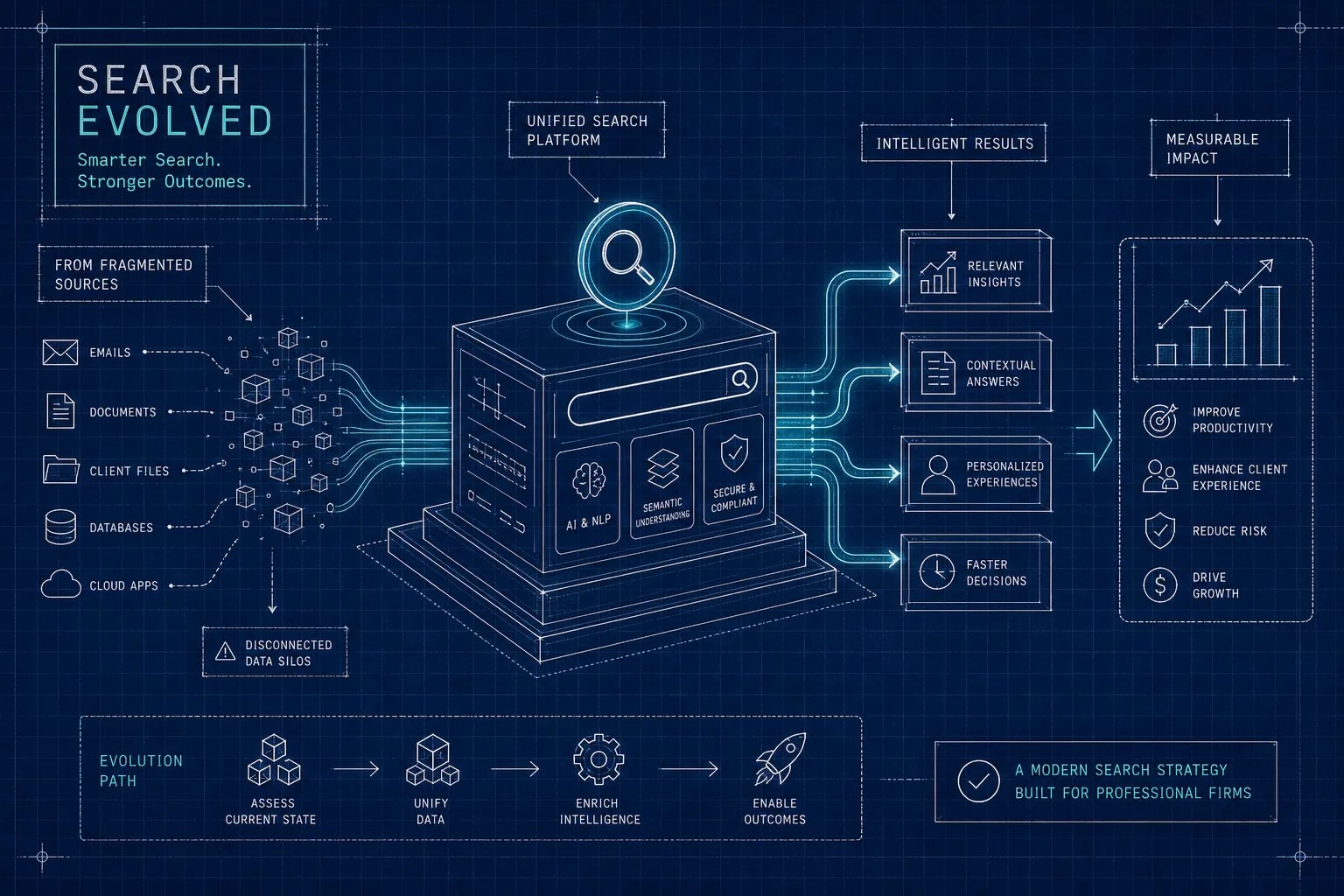
This article walks through what changed, why the old approach falls short on its own, what a modern search evolution strategy actually looks like, and why diagnosis has to come before tactics.
Key takeaways
- Search is now conversational: Many buyers ask AI assistants for recommendations rather than browsing lists of links.
- AI evaluates authority, not just optimization: Ranking on page one doesn’t guarantee you appear in AI-generated answers.
- Three layers drive modern visibility: Positioning, authority content, and trust signals each reinforce the others.
- Greater specificity substantially increases the likelihood of being cited: Generic positioning is invisible to both buyers and AI systems.
- Diagnosis before tactics: Implementing the wrong fix wastes time; the actual constraint must be identified first.
How search has actually changed for buyers of professional services
Buyers have shifted from browsing search result pages to asking conversational questions of AI assistants, and AI systems synthesize answers from sources they’ve already determined to be authoritative and credible. A buyer used to type “business consultant Chicago” and browse ten links at their own pace. Now they ask ChatGPT or Google’s AI Overview, “Who is the best consultant for scaling a service firm in Chicago?” and they expect a recommendation, not a list to evaluate on their own.
Based on how these systems behave in practice, what AI answer engines evaluate when deciding who to cite includes demonstrable expertise on a specific topic, a consistent and trustworthy web presence, structured content that directly answers buyer questions, and third-party validation through reviews and mentions. Search is also now fragmented across platforms: buyers move among Google AI Overviews, ChatGPT, Perplexity, and other tools depending on what they’re trying to learn. The common thread across all of them is that they favor sources they can clearly identify, verify, and trust.
Why traditional SEO alone no longer guarantees firm visibility
Traditional SEO optimized for crawlers and keyword density. AI answer engines optimize for authority and trustworthiness. Those are two different games with different scoreboards, and confusing them is how firms end up invisible in an environment where they’re technically doing everything their old playbook told them to do.
A firm can rank on page one of Google for a keyword and still be invisible in AI-driven search, because AI systems don’t just surface the most optimized page. They cite the most credible and relevant source for the specific question being asked. Traditional SEO rarely addresses the three things that modern search visibility is built on: clear positioning (who you serve and what you actually do), demonstrable expertise (content that proves depth of knowledge on a defined topic), and trust signals (reviews, credentials, associations, and verifiable evidence of good work). Without those elements, even a technically sound website stays invisible to the systems buyers are increasingly turning to first.
What your search evolution strategy actually looks like in practice
A strong search evolution strategy is built in three layers, positioning, authority content, and trust signals, with each reinforcing the others. Weakness in one limits what the remaining two can accomplish.
Positioning: defining your niche
Positioning is the foundation. A firm that is specific about who it serves and what problem it solves gives AI systems something clear to match against buyer intent. Generic positioning (“we help businesses grow”) is invisible to both buyers and AI. An insurance agent who clearly serves contractors, for example, is far more relevant to a query about contractor liability coverage than an agent whose site simply lists “commercial insurance.” Greater specificity substantially increases the likelihood a firm will be cited by answer engines.
Authority content: formats that justify citations
Authority content means content built around the actual questions buyers ask during their evaluation process, not just posts targeting search volume. This includes comparison content, decision-making guides, and expertise-demonstrating articles that go deeper than surface-level answers. AI systems need publicly available material they can use to justify a recommendation, and vague claims like “tailored solutions” provide nothing to retrieve or cite. Think of authority content as the evidence file AI systems consult when deciding whether your firm deserves a mention.
Trust signals: verification and third-party proof
Trust signals are the visible proof layer: verified reviews with descriptive language about specific outcomes, professional credentials, consistent name and contact information across directories, industry associations, media mentions, and structured website content. These are the signals AI systems use to decide whether a firm is safe to recommend to a buyer who hasn’t yet had a conversation with anyone at that firm.
Why strategy without diagnosis leads to wasted effort
Implementing tactics without understanding where your authority gaps actually are is how firms spend months on content that doesn’t move their visibility needle. Not every firm needs more content. Not every firm’s visibility problem is a trust-signal problem. The actual constraint has to be identified before the right search evolution strategy can follow from it, not the other way around.
Before recommending a program, TW3 Marketing conducts the TW3 Marketing Authority Audit™: a 100-point assessment that evaluates positioning, proof, expertise, visibility, engagement, and experience. This tells the firm exactly where the gaps are, what competitors are doing in that space, and what moves the needle first. The result is a prioritized roadmap rather than a scattered set of tactics pulled from a general best-practices list. Execution that builds on a clear roadmap compounds over time; scattered tactics simply disappear.
The order of operations matters
Search has evolved from keyword-matching to authority-recognition, and professional firms that invest in positioning, credible content, and visible trust signals now are the ones AI systems will recommend as that shift deepens. The order of operations matters: diagnosis before strategy, strategy before tactics. Skipping the first step doesn’t save time, it just means the tactics land on a foundation that hasn’t been evaluated.
Ask honestly where your firm stands on each layer of your search evolution strategy: positioning, authority content, and trust signals. If the answer to any of them is uncertain, that uncertainty is itself useful information. The TW3 Marketing Authority Audit™ exists to replace that uncertainty with a clear picture of what’s working, what’s missing, and what to address first. If you’re ready to build a defensible search evolution strategy, reach out to our team to learn more about starting with the TW3 Marketing Authority Audit™ before choosing a path forward.
Frequently Asked Questions
If our site ranks on page one of Google, will AI assistants still cite us?
No, ranking on page one of Google does not guarantee AI assistants will cite your firm. AI answer engines prioritize demonstrable expertise, clear positioning, and trust signals over traditional optimization metrics, so a technically well-optimized page can still be invisible to those systems if it lacks authority and verification.
What does the TW3 Marketing Authority Audit™ evaluate?
The TW3 Marketing Authority Audit™ is a 100-point assessment that evaluates positioning, proof, expertise, visibility, engagement, and experience. It shows exactly where your authority gaps are, what competitors are doing, and what moves the visibility needle first so you get a prioritized roadmap instead of scattered tactics.
If we already publish a lot of SEO content, do we still need to change our approach?
Possibly not, more content alone is not always the solution. We diagnose whether your constraint is positioning, authority content, or trust signals, because implementing the wrong fix wastes time and content that doesn’t move your visibility needle.
How does being specific about our niche affect whether AI systems will recommend us?
Greater specificity substantially increases the likelihood that AI systems will cite your firm. Clear, audience- and problem-focused positioning gives AI systems something concrete to match against buyer intent, whereas generic positioning is largely invisible to both buyers and answer engines.
