
SEO still matters. But ranking on the first page of Google is no longer the same as being found, trusted, or recommended, and for consultants and advisors, that distinction now has real revenue consequences. According to Ipsos, 66% of U.S. B2B professionals who use AI at work now regularly use AI assistants to research vendors and solutions. A well-optimized page can sit at position one and still be invisible in every AI-generated answer a prospective client receives.
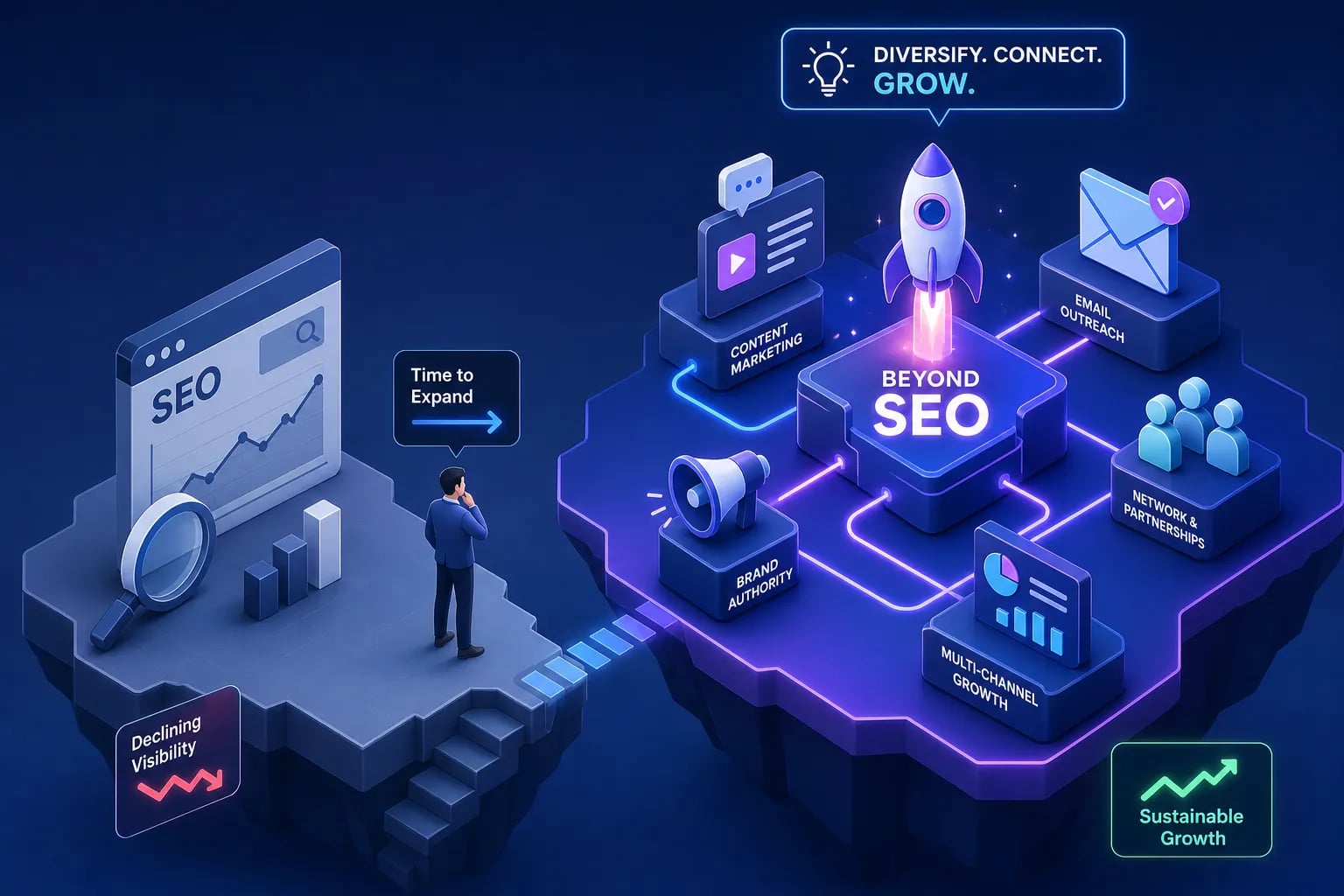
SEO did its job well for a long time. It connected firms to buyers who already knew what to search for. The problem is that discovery has changed faster than most firms’ marketing has. Why traditional SEO alone is no longer enough for consultants and advisors comes down to a structural gap: technically sound SEO paired with near-zero AI visibility. That combination is increasingly common among established professional services firms, and standard SEO reports don’t surface it.
What follows covers why traditional SEO has structural limits for professional services, what AI systems actually evaluate, which channels fill the gaps, and how to find where your current SEO leaves off.
Key SEO takeaways
- SEO captures existing intent: It connects you to buyers who already know what to search for. It rarely creates discovery among buyers who don’t.
- AI evaluates different signals: Entity clarity, corroborated mentions, structured answers, and consistent authorship matter more to AI systems than keyword density and backlinks alone.
- Referrals remain the highest-converting channel: Referrals convert at 30–45% lead-to-client rates, but they need visible authority behind them to scale.
- Conversion is a credibility problem: Traffic that lands on generic pages doesn’t convert. Specific proof, clear fit criteria, and outcome-led content do.
- A different diagnostic is required: Standard SEO audits don’t surface AI visibility gaps. That requires a different kind of assessment entirely.
Why traditional SEO alone is no longer enough for consultants and advisors
Rankings capture active searchers, and that’s the problem
SEO was built for a specific scenario: a buyer who already knows they have a problem, types a query, and scans a results page. For consultants and advisors, many high-value buyers don’t work that way. They ask peers, check LinkedIn, or increasingly ask an AI assistant. Organic search captures intent that already exists; it rarely creates it, and that’s not a fixable SEO mistake. It’s a structural ceiling.
Why algorithm dependence is a business risk, not just a marketing one
Businesses that have leaned entirely on organic search have seen traffic declines of 50–90% after major algorithm updates. For a consulting firm, the same logic applies at a smaller scale: if your discovery channel is entirely governed by Google’s ranking rules, you don’t control your pipeline.
What AI systems actually evaluate when recommending a firm
| Area | Traditional SEO | Answer Engine Optimization (AEO) |
|---|---|---|
| Primary objective | Rank pages in search results | Become a cited or recommended source in AI-generated answers |
| User experience | Users scan results and click links | AI synthesizes an answer, often without a click |
| Optimization target | Keywords, metadata, backlinks, site architecture | Clear answer blocks, entity clarity, structured data, topical authority |
| Trust signals | Domain authority, backlinks, technical quality | Consistent firm information, expert authorship, third-party references, case evidence |
| Success metrics | Rankings, impressions, organic traffic | AI citations, brand mentions, inclusion in AI answers |
Beyond keywords: the signals that earn an AI citation
Traditional SEO optimizes for ranked links. Answer Engine Optimization (AEO) optimizes to become the source or recommendation inside an AI-generated answer. AI systems evaluate entity clarity, structured answers, corroborating mentions across reputable sources such as reviews, media, and industry publications, consistent authorship, and evidence of real expertise. High rankings help, but they don’t guarantee AI citations.
The gap between a good ranking and an AI recommendation
A firm can rank on page one for “management consultant Chicago” and still not appear in a single AI-generated answer when a buyer asks ChatGPT or Perplexity for recommendations. AI systems synthesize answers from sources they can verify and validate. If a firm’s digital footprint is thin outside its own website, few credible mentions, no structured expertise signals, no visible client proof, the AI has nothing to cite. That’s the gap most SEO reports never surface, and it’s exactly why traditional SEO alone is no longer enough for consultants and advisors competing for high-value clients.
Which channels actually fill what SEO leaves behind
Thought leadership, referrals, and owned media for advisors
Referrals convert at 30–45% lead-to-client rates, making them the strongest channel for consulting and advisory firms. But referrals don’t scale in isolation. They need visible authority behind them to make the recommendation credible to the person receiving it. Thought leadership content, LinkedIn presence, newsletters, and podcasts build the substantiation that both human referral sources and AI systems use to verify that a firm is worth recommending.
Combining SEO with thought leadership and email newsletters can make digital channels a leading source of new business. The result wasn’t SEO alone. It was SEO paired with channels that build trust before the first conversation.
What converts organic interest into qualified conversations
Organic traffic that lands on a generic homepage or a service page with no proof doesn’t convert. The content formats that actually produce discovery calls for professional services include outcome-led case studies with a situation-approach-result structure, diagnostic assessments offered in place of a generic “free consultation,” and service pages that name the specific problem a buyer is facing. Relevant client proof near the call to action and a clear process preview close the loop.
Conversion isn’t a traffic problem. It’s a credibility and clarity problem, and fixing it doesn’t require more content. It requires the right content matched to the right intent.
How do you find where your SEO ends and AI visibility begins?
The questions your SEO report won’t answer
A standard SEO audit tells you rankings, backlinks, page speed, and crawlability. It won’t tell you whether AI systems recognize your firm as an authority in your specialty. It also won’t tell you whether your content is structured for citation, whether your digital footprint substantiates your claimed expertise, or whether a buyer asking an AI assistant for a recommendation in your niche would ever see your name. Those are different questions, and they require a different kind of diagnostic.
What TW3 Marketing Authority Audit™ identifies
The TW3 Marketing Authority Audit™ is a paid 100-point diagnostic that evaluates positioning, proof, expertise, visibility, engagement, and experience. The audit maps exactly where a firm’s current SEO leaves off and where AI visibility gaps begin, covering the signals that determine whether buyers and AI systems recognize a firm as credible and worth recommending. The output is a prioritized roadmap, not a generic checklist. For consultants and advisors who have invested in SEO but aren’t seeing it translate into better-fit clients or AI-driven discovery, the audit identifies which gaps to close first.
Build what buyers and AI systems actually trust
SEO is still worth doing. It’s the floor, not the ceiling. Consulting and advisory firms that treat keyword rankings as their primary visibility strategy are optimizing for buyer behavior that is shifting underneath them. The firms that earn consistent, high-value clients build visible authority: structured expertise, verified credibility, owned media, and clear proof that both humans and AI systems can find, validate, and trust. That’s the real answer to why traditional SEO alone is no longer enough for consultants and advisors.
If you’ve earned real expertise and strong client results but aren’t showing up where buyers and AI systems are looking, the practical starting point is knowing exactly where your current visibility ends and where the gaps begin. The TW3 Marketing Authority Audit™ is built for that purpose. Get in touch with our team to start with the audit.
Frequently Asked Questions
Can SEO still generate leads for consultants and advisors?
Yes, SEO still generates leads, but it primarily captures buyers who already have search intent. We say SEO is the floor, not the ceiling, it connects you to buyers who know what to search for but rarely creates discovery among buyers who don’t, so it should be paired with other channels to reach higher-value prospects.
What signals should we prioritize to increase the chance an AI assistant cites our firm?
Prioritize entity clarity, structured answers, corroborating third-party mentions, consistent authorship, and visible client proof. We note that AI systems evaluate those signals more than keyword density or backlinks alone, and clear answer blocks, topical authority, and corroboration from reviews, media, and industry sources improve the odds of AI citation.
How do referrals interact with online visibility and AI discovery?
Referrals remain the highest-converting channel, converting at 30–45% lead-to-client rates, but they require visible authority to scale. We explain that referrals need the same visible substantiation, thought leadership, LinkedIn presence, newsletters, and podcasts, so both human recipients and AI systems can verify and recommend your firm.
What does the TW3 Marketing Authority Audit™ actually evaluate and produce for a firm?
The TW3 Marketing Authority Audit™ is a paid 100-point diagnostic that evaluates positioning, proof, expertise, visibility, engagement, and experience. We provide a prioritized roadmap showing where current SEO leaves off and where AI visibility gaps begin, rather than a generic checklist, so you can close the gaps that prevent buyers and AI systems from recognizing your credibility.
