
A homeowner’s furnace stops working on a cold Tuesday morning. She picks up her phone, opens ChatGPT, and types: “Who’s the best HVAC contractor near me in Columbus?” Two names come back within seconds. This is AI local search recommendations in action, and neither business ran an ad that morning. One of them is your competitor.
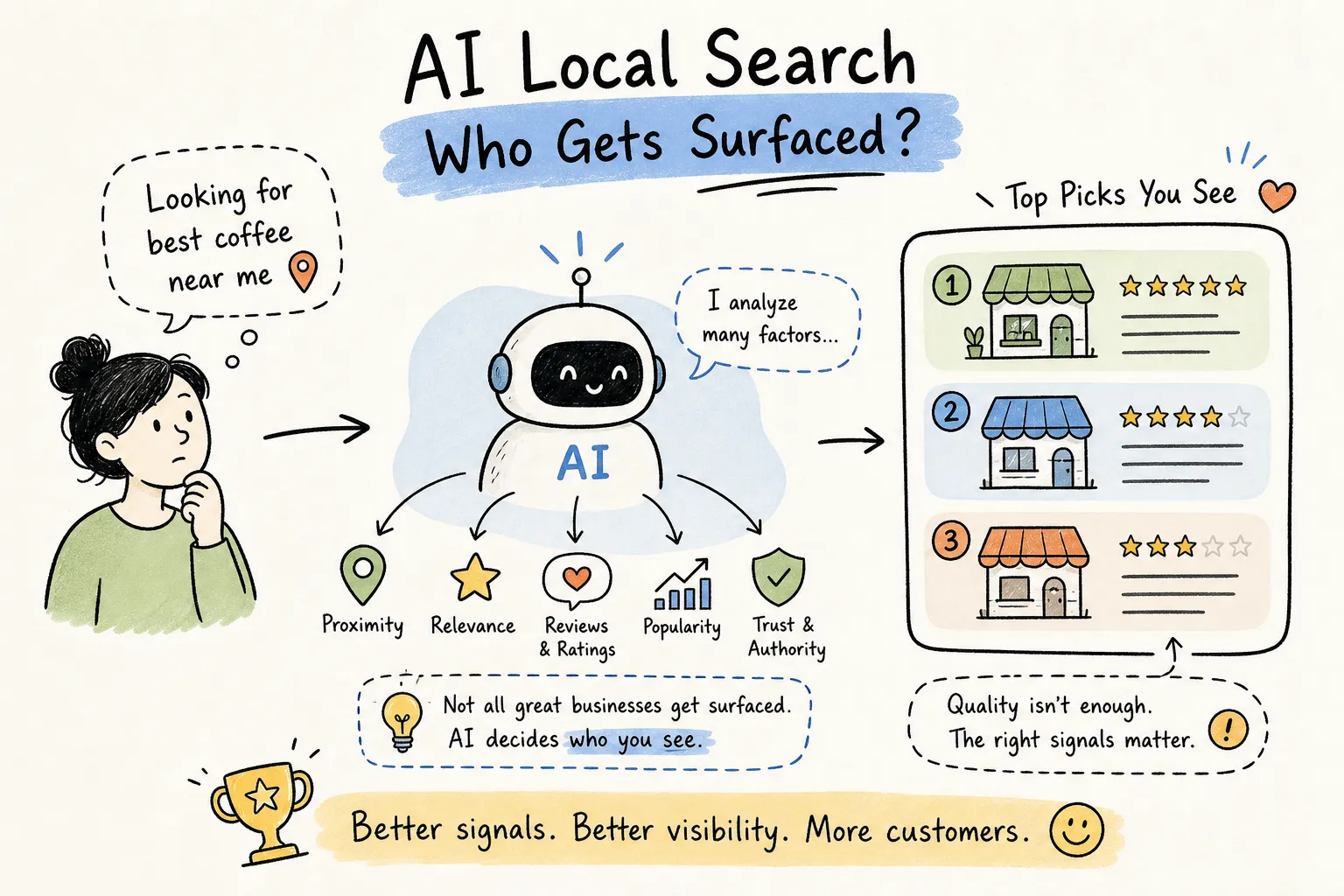
This scenario happens frequently across virtually every service category: plumbing, roofing, solar, insurance, general contracting. AI platforms are actively making business referrals, and many local service business owners have no idea what criteria determine who shows up. The assumption is usually that reviews drive it, or maybe Google rankings. The reality is more layered than that.
AI recommendations aren’t random, and they aren’t purely review-based. There are specific, repeatable authority signals at work. Understanding them is the difference between being the business that gets called and being the one that never enters the conversation.
How AI Local Search Recommendations Are Generated
Traditional search worked on a fairly straightforward premise: match keywords, count backlinks, weigh proximity, and return a ranked list. That model is being rapidly complemented, and in many cases displaced, by AI-driven synthesis. Platforms like ChatGPT, Google AI Overviews, and voice assistants often skip the list entirely; they return a judgment. When someone asks “who’s the best plumber near me,” the platform synthesizes patterns across structured data, content quality, third-party mentions, and authority signals to form a confident single answer. Results can vary by platform, prompt, and location settings, but the directional shift is consistent.
The change here is significant. AI systems are increasingly functioning like a knowledgeable friend rather than a directory. A trusted friend recommending a contractor doesn’t give you ten options ranked by distance; they tell you who they’d actually call and why. That’s the mode AI is operating in, and it changes the entire goal of local digital marketing. You’re no longer optimizing to rank; you’re optimizing to be considered trustworthy enough to recommend.
The businesses AI tends to surface share common patterns: detailed content that demonstrates real expertise, strong review profiles across multiple platforms, clear service area and specialization signals, and structured data that makes it easy for AI to categorize exactly what they do and who they serve. Generic positioning and thin digital footprints don’t make the cut.
Authority Signals That Drive AI Local Search Recommendations
Not all signals carry equal weight, but three categories consistently separate the businesses that get recommended from those that don’t: positioning, proof, and expertise and visibility.
Positioning
Positioning is a critical signal AI evaluates, and it’s the one most businesses get wrong. A business that claims to do everything gives an AI platform nothing to confidently recommend. A contractor who consistently frames themselves as the go-to expert for custom home additions in a specific metro area is sending a signal AI can process and repeat. The language in your headers, service descriptions, and bios either reinforces a clear category claim or muddies it.
Proof Signals
Proof signals go well beyond star ratings. Review volume, recency, and sentiment across Google, Yelp, and industry directories all feed into the recommendation calculus. Third-party citations, press mentions, and links from credible industry sources carry real weight too. A review that says “Mike’s team replaced our HVAC system in one day and the new unit cut our energy bill by 30%” is an authority signal. A review that says “great service!” is not. Research on AI-driven synthesis systems consistently identifies review specificity and recency as factors in how businesses are assessed, and those differences show up in who gets recommended.
Expertise and Visibility
AI platforms infer expertise from content signals: published articles, FAQ sections, service-specific landing pages, and schema markup that tells systems exactly what the business provides. Visibility refers to how consistently a business’s name appears in trusted digital spaces beyond its own website, directories, local media, and industry associations. A business that exists only on its own site looks narrow. One with a presence across credible external sources looks established. This is where AI local SEO differs most sharply from traditional optimization: authority has to be distributed, not just hosted.
Why Most Local Businesses Get Skipped Despite Doing Everything “Right”
The most frustrating reality for local service businesses is this: you can have a great reputation in your community, a stack of satisfied customers, and a decent review score, and still not appear in AI local search recommendations. The reason is what we call the “trust gap.” AI platforms can’t see word-of-mouth reputation the way humans pass it along. If your digital footprint doesn’t consistently signal authority across the specific dimensions AI systems evaluate, you simply don’t appear credible to the algorithm, regardless of how good you actually are.
Outdated SEO tactics compound the problem. Keyword-stuffed homepages and dozens of thin service pages may have helped with basic search rankings in an earlier era, but they look like noise to an AI system trying to assess genuine expertise. The signals have evolved; most local businesses are still running the old playbook.
Inconsistency across platforms does the most damage. If your Google Business Profile calls you a “general contractor,” your website calls you a “home remodeler,” and your Yelp listing says “handyman services,” AI systems see fragmentation, not expertise. Mismatched positioning across your digital properties actively works against AI recommendation likelihood because the system can’t confidently categorize what you do or who you serve. Consistency is foundational, and most businesses underestimate how broken theirs actually is.
How TW3 Marketing Reverse-Engineered AI Recommendation Criteria
If you’re wondering what this looks like in practice, here’s how our team built a repeatable answer to that question. At TW3 Marketing, we spent years studying which local service businesses consistently appeared in AI-generated recommendations and why. Rather than speculating, we analyzed patterns across industries and markets to identify the repeatable authority signals that drove those results. What emerged was a proprietary framework built around six dimensions: positioning, proof, expertise, visibility, engagement, and experience. These became the foundation of TW3 Marketing’s Authority Framework and the basis for our 100-point Authority Audit.
The Authority Audit isn’t just a website review. It evaluates the entire digital footprint of a local service business: how clearly it signals expertise across platforms, how consistent its messaging is, how credible it looks to third-party AI systems, and exactly where the gaps are. For most businesses, the audit surfaces two or three critical trust gaps that are quietly costing them AI local search recommendations every single day. Those gaps are often diagnosable and fixable once you know where to look.
The actionable output is a prioritized roadmap built around the specific signals that have the most impact for that business type. An HVAC contractor’s trust gap looks different from a solar installer’s, and the fix should be targeted accordingly. That specificity is what separates authority-focused strategy from generic SEO work.
Practical Steps to Strengthen Your AI Visibility Signals
Start with consistency before anything else. Audit your business name, description, service categories, and contact information across every digital platform you appear on: Google Business Profile, Yelp, Facebook, industry directories, and your own website. AI systems interpret consistent, structured data as a sign of a legitimate, well-established business. Inconsistencies, even small ones, create signal noise that works against you. Fix the inconsistencies first, then build from there.
Build proof signals that AI can actually read. Encourage customers to leave detailed reviews that mention the specific service, the outcome, and the location. Pursue third-party citations through local media coverage, industry association memberships, and listings on credible platforms. Each addition strengthens the proof layer that AI systems draw from when deciding whether your business is credible enough to recommend.
Then focus on content that demonstrates category expertise. Publish detailed answers to the questions your customers ask before hiring you. Service-specific landing pages, FAQ sections, and short-form educational content each add a data point for AI to reference. Every piece of content that clearly explains what you do, who you serve, and what results you deliver strengthens your position as the recognizable expert in your category.
Measuring AI Local Search Recommendations for Your Business
Traditional SEO tools show keyword rankings in a list. AI recommendation visibility works differently because the outputs are conversational and context-dependent. The most direct way to track your progress is to test AI platforms directly. Ask ChatGPT, Google AI, and Perplexity to recommend businesses in your service category and city. Note whether your business appears, how it’s described, and what sources the AI cites. Keep in mind that results can vary by prompt phrasing, model version, and platform, so standardize your test queries as much as possible. Run the same tests monthly and look for changes in how you’re described or whether you appear at all.
Before making any changes, establish a baseline. TW3 Marketing’s Authority Score Check gives local service businesses a concrete snapshot of how they currently appear across Google and ChatGPT. That score, measured across the six authority dimensions, gives you something concrete to improve against. Repeating the assessment after three to six months of targeted work shows exactly which signal improvements translated into better AI recommendation likelihood. Without a baseline, you’re making changes and hoping; with one, you’re building a system.
The Businesses Getting Recommended Earned It
AI local search recommendations aren’t a future trend. They’re a growing channel that more of your customers are already using to decide who to call, and adoption is accelerating. The businesses showing up earned their spot by building the specific authority signals AI systems are trained to recognize: clear positioning, credible proof, demonstrated expertise, and consistent visibility across the web.
If your business isn’t appearing, the gap is often diagnosable. Common culprits include NAP inconsistency, an incomplete Google Business Profile, thin content, and weak review depth, all identifiable, all fixable. The starting point is understanding where your authority currently stands across the dimensions that actually matter to AI systems. That’s exactly what TW3 Marketing’s 100-point Authority Audit is built to reveal. AI local search recommendations aren’t luck, they’re a system you can build, and the businesses that start building it now will own those recommendations for years.
For the bigger picture on why AI recommends some businesses and quietly skips others, read The AI Authority Paradox.
Frequently Asked Questions: AI Local Search Recommendations
How does AI decide which local businesses to recommend?
AI systems pull from the information they can find and verify: your Google Business Profile, reviews, business details, and mentions across the web. The businesses with clear, consistent, and credible signals are the ones AI feels confident naming.
Why isn’t my business showing up in AI recommendations?
Usually there is not enough reliable information online for an AI system to understand or trust you. Inconsistent business details, few recent reviews, thin service information, and little third-party proof all make it harder for AI to surface you.
What is the difference between ranking and being recommended?
Ranking places you in a list of links. A recommendation is one answer that names a business. Recommendations require more than relevance, they require evidence, so proof and reputation matter more than ever.
How can a local business improve its AI search visibility?
Strengthen the signals AI reads. Keep your Google Business Profile complete and accurate, earn steady reviews, keep your business information consistent everywhere, and publish clear, helpful content that answers real customer questions.
