
AI optimization for contractors is already changing how homeowners choose service pros, and most contractors don’t know they’re losing jobs because of it. A homeowner in your service area opens ChatGPT, types “best licensed HVAC contractor near me,” and gets three names back. One of them is your competitor. They rank below you on Google. Their website isn’t as polished. But they just landed the job, and you never got the call.
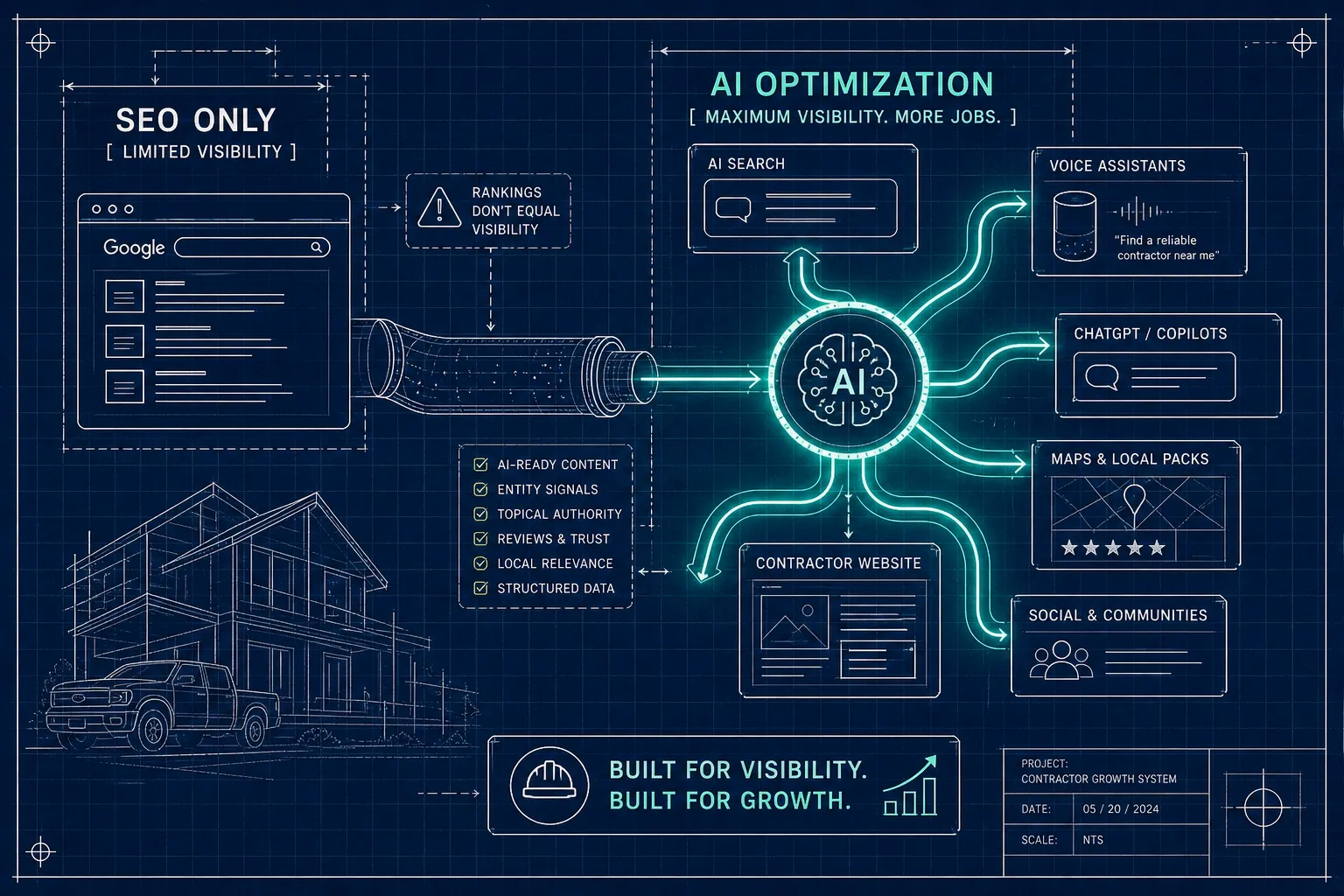
This isn’t a story about SEO failing. Traditional search optimization still improves your position in blue-link results. The problem is that AI assistants don’t show blue links. They synthesize a recommendation from a merged set of evidence signals, and most contractor websites have almost none of them in place. Research from 2026 puts the share of U.S. homeowners using AI to find local contractors at roughly 45%. That’s not a future trend. That’s your current market.
This article breaks down exactly what those signals are, how platforms like Google Gemini and ChatGPT actually source local business recommendations, and what a contractor needs to fix before spending another dollar on ads or content. The playbook is practical and prioritized. Start with the diagnosis, then build from the foundation up.
Why Ranking on Google No Longer Guarantees You Get the Call
Traditional SEO gets you higher on the search results page. But when a homeowner or procurement manager asks an AI assistant for a contractor recommendation, there is no results page. The AI generates a direct answer using a synthesized evidence graph: structured business data, website content, reviews, third-party citations, and entity consistency across the web. A contractor who ranks number two organically can be completely absent from that answer if their authority signals are thin.
How AI Assistants Source Local Business Answers
Google Gemini doesn’t simply pull from search rankings. It grounds its answers in Google Business Profile (GBP) data, Maps, reviews, website schema, and supporting directory listings, then synthesizes a recommendation based on how well that combined evidence matches the query. ChatGPT and other large language models rely more heavily on crawlable third-party content and structured web presence. Neither system cares about your domain authority score in isolation. What they care about is whether they can extract enough structured, trustworthy information about your business to confidently name you by name.
The Trust Gap Most Contractor Websites Don’t Know They Have
The pattern shows up constantly: contractors invest in backlinks and keyword rankings but have thin or missing structured data, inconsistent name, address, and phone number across directories, and a GBP profile that is technically filled out but doesn’t signal credibility to a machine. Standard SEO audits don’t catch this because they measure technical performance and backlinks, not authority signals. The gap is invisible until you run a diagnostic built specifically for AI visibility, and that’s precisely what keeps otherwise strong contractors off the list when a homeowner asks an AI who to call.
What AI Optimization for Contractors Actually Means in Practice
Answer engine optimization, or AEO, is about making your business legible and trustworthy to AI systems, not just search crawlers. Think of it this way: a contractor with 200 five-star reviews and a polished website still gets skipped if the AI can’t extract structured proof of what you do, where you work, and why you’re credible. The signals that matter are authority signals, how well your entire digital presence proves your expertise, credibility, and local relevance to a machine that can’t shake your hand or see your work truck.
AEO vs. Traditional SEO: The Core Difference
SEO asks: “Does Google index and rank this page?” AEO asks: “Can an AI extract enough structured, trustworthy information from this contractor’s entire digital presence to confidently recommend them by name?” The inputs are different, the optimization process is different, and the results show up in completely different places. Ranking higher on Google gets you a better position in a list. Getting cited by Gemini or ChatGPT puts your name directly in the homeowner’s answer, with no competition on the same screen. This is the core distinction that makes AI SEO for contractors a separate discipline, not a replacement for traditional SEO, but a necessary addition to it.
The Six Authority Signals AI Platforms Use to Evaluate a Contractor
The signals break down into six categories: positioning, proof, expertise, visibility, engagement, and experience. A roofing contractor with no published project data, no structured credentials, and inconsistent service descriptions across their site gives an AI nothing concrete to cite. Strong positioning means your site clearly states what you do and who you serve.
Strong proof means completed jobs, reviews, and ratings are machine-readable. Strong expertise means your content covers the specific questions homeowners ask, not just generic service descriptions. When all six signals are weak, the AI skips you entirely, regardless of your Google ranking.
TW3 Marketing’s 100-Point Authority Audit: The Starting Point
TW3 Marketing built its Authority Audit specifically for this problem. Unlike standard SEO audits, it scores a contractor’s digital presence across all six authority signals and surfaces the specific gaps that prevent AI platforms from recommending the business. For contractors who don’t know where they stand, this is the logical first step before touching anything else on their site. Fixing content and schema without knowing which signals are broken is guesswork, not a strategy.
The Structured Data Foundation That Makes You Machine-Readable
Most contractor sites have no schema markup at all. For AI systems that need to parse what a business does, where they serve, and whether they’re credible, that’s the equivalent of having no listing in any directory. Schema markup is the data layer that separates a trustworthy entity from an anonymous website.
Schema Types That Earn AI Citations for Contractors
Start with a trade-specific LocalBusiness subtype: GeneralContractor, HVACBusiness, RoofingContractor, Plumber, or Electrician, depending on your primary service. Add Service markup on each service page, linked back to your business using the provider property and specifying your coverage area with areaServed. Apply AggregateRating and Review markup wherever you display real customer reviews. Then add FAQPage and HowTo schema to relevant pages. These two formats are especially powerful for AI extraction because they map directly to how AI assistants structure their answers: a question paired with a concise, authoritative response.
Marking Up Project Data and Case Studies for AI Credibility
Contractors have proof of work sitting in photo galleries and project pages that AI systems can’t interpret without markup. Model project pages as CreativeWork or structured content with linked Service and Organization entities so completed jobs become machine-readable credibility signals. A before-and-after photo gallery with no schema is invisible to an AI. The same content marked up with ImageObject and connected to the relevant service becomes a verifiable proof signal. One is a website. The other is a business an AI can verify and name.
Local Signals and Google Business Profile Optimization for AI Answers
Gemini specifically pulls from GBP data, Maps, and the consistency between a GBP profile and the business website before synthesizing a local recommendation. Most contractors set up their GBP once and never touch it again. That’s a significant missed opportunity for contractor lead generation with AI-assisted search, where GBP completeness directly affects recommendation probability.
What Gemini Actually Reads from Your GBP Profile
Go beyond filling out the basics. The fields Gemini prioritizes for contractor recommendations include:
- Primary category and secondary categories
- Services section depth
- Attributes like “emergency service available”
- Business hours
- Business description
Critically, Gemini checks whether the language and service descriptions in your GBP align with what your website says. Inconsistencies between the two reduce the AI’s confidence in the entity and lower your recommendation probability. Recent posts and photo updates also function as freshness signals that tell the AI the business is active and current.
Review Volume, Recency, and Citation Consistency Across Directories
Reviews are a trust signal for AI systems, not just social proof for humans. Review recency matters because Gemini reads review content to confirm reliability, communication quality, and service specifics. Set up a consistent review solicitation process so new reviews come in regularly, not in bursts.
Beyond reviews, NAP consistency across directories, including Google, Yelp, Houzz, the Better Business Bureau, and contractor-specific platforms, is critical for entity recognition. An AI system corroborates business information across multiple sources. When those sources conflict, the AI’s confidence drops and your name is less likely to appear in the answer.
Content Formats That AI Assistants Cite When Recommending Contractors
The content AI assistants pull from isn’t keyword-optimized blog posts chasing traffic. It’s concise, direct-answer content structured around the specific questions homeowners and procurement managers actually type into an AI assistant. The structure of that content matters as much as the information in it.
Direct-Answer Content for Questions That Trigger AI Recommendations
Structure your service pages and FAQ sections so the content can be extracted as a direct answer. Specific question formats that work well for AI marketing for home contractors include: “How much does roof repair cost in [city]?” “What should I look for in a licensed HVAC contractor?” “Do you serve [neighborhood or ZIP code]?” Each answer should run 40 to 80 words, be factual and specific, and sit inside a clearly labeled FAQ block with FAQPage schema applied. Generic answers like “we provide quality service at competitive prices” give AI systems nothing to cite. Specific answers with details give them exactly what they need.
How-To and Project Content That Builds Topical Authority Over Time
Topical coverage matters as much as individual page optimization. A contractor with 15 well-structured service and how-to pages covering related topics becomes a recognized entity in that niche. This is different from writing blogs for traffic volume. It’s about giving AI systems enough corroborating evidence to confidently match your business to a broad range of relevant queries. A single service page about roof replacement is a data point. Ten pages covering roof replacement, storm damage repair, flat roofs, roof inspections, and material comparisons build an entity that an AI can recognize as the local authority on roofing.
Measuring Whether Your AI Optimization Is Actually Working
Traditional metrics like organic traffic and keyword rankings don’t tell you whether you’re showing up in AI answers, and that gap is now costing contractors real jobs. You need a different measurement layer to know if the investment is producing results.
The Right Metrics to Track AI Visibility for Local Service Businesses
Start with prompt tracking: manually test relevant queries in ChatGPT, Gemini, and Perplexity weekly and log when your business appears and when it doesn’t. Use GBP Insights to monitor search queries, map views, and calls from search as AI-adjacent indicators. Track lead source attribution carefully for any “found you online” or “searched for contractor” inquiries, since these are the leads most likely to have come through an AI-assisted search. Initial gains from schema and GBP optimization typically appear within four to six weeks. Broader entity recognition gains, the kind that put your name in Gemini’s answers consistently, tend to materialize in the 90 to 180 day range.
Starting with a Diagnosis Before Spending More on Marketing
Spending more on ads or content before fixing your authority and AI visibility gaps is building on a leaky foundation. The leads you’re paying to attract land on a digital presence that AI systems can’t verify or recommend. The right first step is knowing your current score across the six authority signals. TW3 Marketing’s 100-point Authority Audit gives contractors a concrete baseline so every dollar spent after the audit goes toward closing a known gap, not guessing at one.
AI Optimization for Contractors: The Contractor Who Gets Recommended Wins the Job
The contractors winning local jobs in 2026 aren’t always the ones ranking number one on Google. They’re the ones AI assistants have enough structured, trustworthy evidence to recommend by name when a homeowner asks. The gap between a strong traditional SEO presence and strong AI visibility is real, measurable, and fixable.
If you want to improve AI optimization for contractors in your local market, start with a scored baseline. Run through the checklist in this article against your own site and GBP profile. If you want a full picture across all six authority signals, TW3 Marketing’s Authority Audit was built specifically for service contractors who are ready to stop guessing and start closing the trust gap that’s costing them jobs they never even knew they were competing for.
Frequently Asked Questions: AI Optimization for Contractors
What is AI optimization for contractors?
It is preparing your online presence so AI systems like ChatGPT, Gemini, and Google AI Overviews can understand your business and recommend it. That means clear service information, verifiable proof, structured data, and consistent details across the web, not just traditional keywords.
Why isn’t SEO alone enough for contractors anymore?
SEO helps you rank in a list of links. AI search often skips the list and gives one answer or a short set of recommendations. To be included, you need the trust signals and evidence that let an AI system choose you, on top of solid SEO fundamentals.
What proof helps a contractor get recommended by AI?
Real reviews, licenses and certifications, years in business, completed project examples, consistent business information, and clear service pages. AI can copy a polished look, but it cannot manufacture genuine, verifiable proof, so that proof becomes your advantage.
Does AI optimization replace SEO?
No. It builds on it. Google says its core SEO best practices still matter for AI Overviews and AI Mode. AI optimization adds a layer: making sure enough credible evidence exists online for systems to understand and trust your business.
