
How do I get my business recommended by ChatGPT? That’s the question homeowners are effectively asking when they type things like “best HVAC company near me” into ChatGPT right now, and then call whoever shows up. Not the business with the most Google reviews. Not the one with the biggest ad budget. The one the AI decided to recommend. If your business isn’t appearing in those answers, you’re not losing to better competitors. You’re losing to businesses that have better signals.
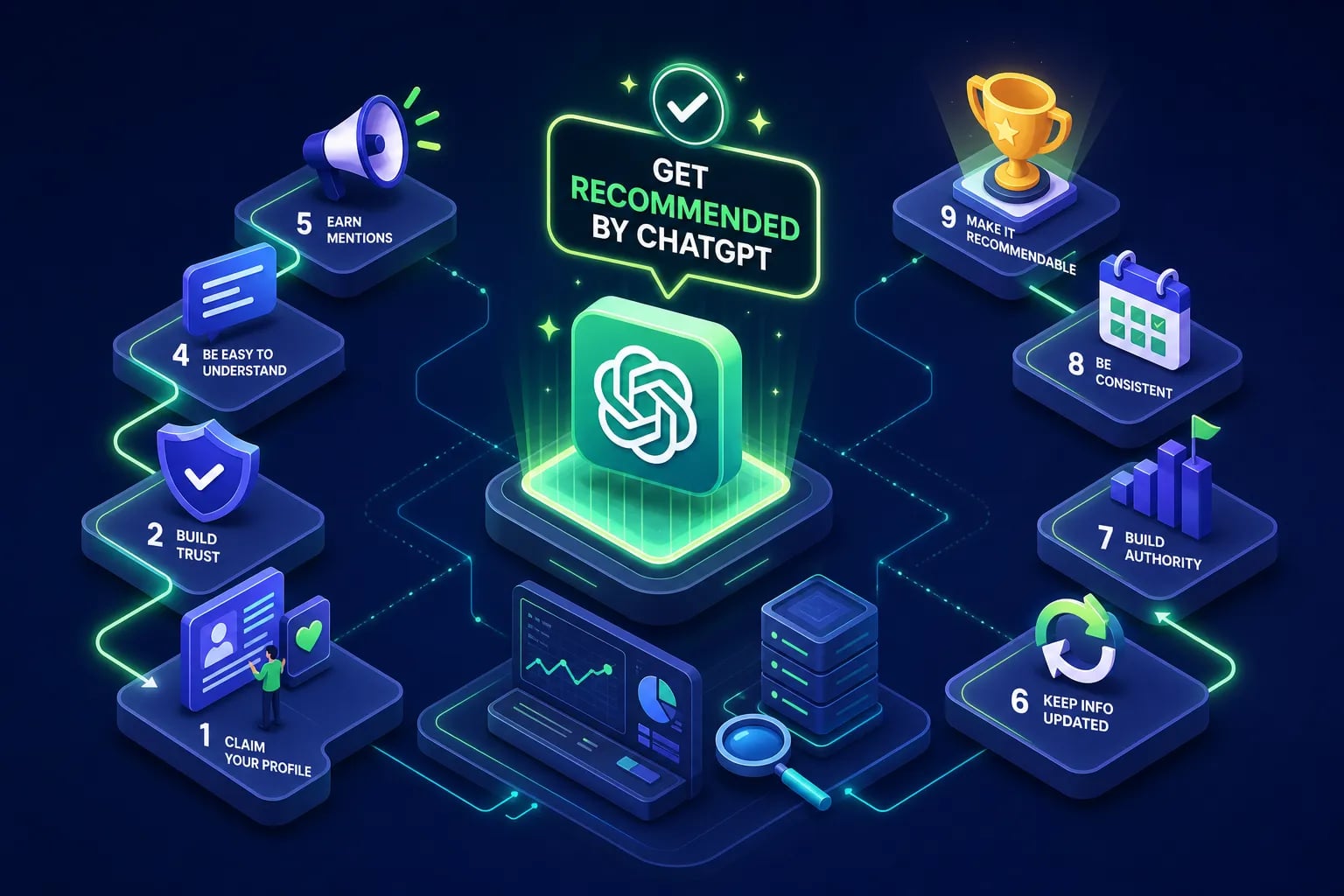
Together, Bobby Christy and his partner Terry Wilson III of TW3 have served more than 4,500 clients across 70 industries since 2008. At TW3 Marketing, we’ve spent a significant portion of 2025 and 2026 tracking exactly what separates the businesses AI surfaces from the ones it skips. The signals are specific. They’re auditable. And most of them are fixable without a massive budget. Here are the nine steps, in priority order, so you can see where your gaps are and start closing them.
How ChatGPT actually decides which businesses to recommend
The two-mode system: training data and live web retrieval
ChatGPT doesn’t work like Google. In its default mode, it generates answers from patterns learned during training, which means it’s drawing on a snapshot of the internet that could be months or years old. When search is enabled, it pulls from live web sources and can cite them directly. For business recommendations, it typically blends both. The practical implication for your business: you need to show up credibly in the crawlable web and in the kinds of sources AI systems have learned to weight over time.
The specific signals AI weights when recommending a business
When ChatGPT or a similar AI assembles a local recommendation, it’s drawing on five broad signal categories: business descriptions and category labels, reviews and ratings, press and editorial mentions, directory and profile pages, and general prominence across crawlable sources. Analysis of ChatGPT’s sourcing patterns consistently surfaces Foursquare, Yelp, Bing-indexed listings, and Google Business Profile as the dominant underlying sources. The nine steps below are a direct response to each of those signal categories.
Steps 1, 3: Build a Google Business Profile AI can actually read
Getting your business recommended by ChatGPT starts with Google Business Profile, the single most influential local data source feeding AI assistants, including ChatGPT when search is enabled. Most businesses have a profile. Very few have one that communicates trust and relevance the way AI systems need. These first three steps address the fields that make the biggest difference.
Step 1: Verification and primary category selection
Start with verification status. Unverified profiles get deprioritized consistently, and no amount of optimization elsewhere compensates for that. Next is primary category selection: this is the field that determines which queries your business gets matched to. Choosing “Contractor” when “Roofing Contractor” exists is leaving relevance on the table.
Step 2: NAP accuracy across your profile and website
NAP consistency, your name, address, and phone number matching exactly between your Google Business Profile and your website, is an entity trust signal AI systems rely on heavily. Even small discrepancies introduce noise into how the system identifies your business. Get these details locked down before you build anything else on top of them.
Step 3: Reviews, response cadence, and the fields most owners leave blank
Reviews matter in four dimensions: overall rating, volume, recency, and specificity of the review text. Businesses with steady recent reviews consistently outperform those with large but stale review counts. A business with 30 reviews from the past six months will often rank ahead of a competitor sitting on 200 reviews from three years ago. Owner responses add a trust layer and inject natural, keyword-rich language directly into your listing. Beyond reviews, the fields most owners ignore are where real AI visibility gets built: service descriptions, Q&A, posts and updates, and attributes. Each one is machine-readable data that AI systems use to determine whether your business is a credible match for a specific query.
Steps 4, 5: Add structured data so AI can parse your business clearly
Structured data is the technical layer that turns your website from a page of text into a machine-readable business entity. Without it, AI systems have to infer who you are from unstructured content and make their best guess. With it, you’re giving them a formatted briefing on exactly what your business does, where it operates, and how to reach you.
Step 4: The LocalBusiness schema properties that actually matter
Implement JSON-LD LocalBusiness schema markup on your homepage and key service pages. Use the most specific @type subtype available, “PlumbingService” or “RoofingContractor” rather than the generic “LocalBusiness.” The must-include properties are name, address, telephone, url, openingHoursSpecification, geo , sameAs, and areaServed for service-area businesses. Pay particular attention to sameAs. This property links your website entity to your Google Maps listing, social profiles, and major directory pages, which helps AI systems connect the dots across sources and confirm they’re all talking about the same business.
Step 5: How to validate your markup before it goes live
Before publishing any schema changes, run them through Google’s Rich Results Test and the Schema Markup Validator. The most common errors on local business sites are missing geo coordinates, using a generic @type of “LocalBusiness” when a more specific subtype exists, and listing outdated hours. These aren’t minor issues, they reduce the confidence AI systems have in your data and quietly pull you out of recommendation pools.
Steps 6, 7: Get consistent citations across directories AI trusts
AI assistants don’t pull from a single source. When ChatGPT looks up a local service business, it cross-references multiple platform signals to determine whether the business is real, currently active, and trustworthy. Inconsistent citations introduce entity confusion that lowers the system’s confidence in recommending you.
Step 6: The tier-one platforms that feed AI assistants directly
Prioritize these platforms in this order:
- Google Business Profile, the primary data source for Google-integrated AI systems
- Apple Business Connect, feeds Siri and Apple Maps
- Bing Places, feeds Microsoft Copilot and Bing local results
- Facebook Business Page, used for verification and discovery across AI platforms
- Yelp, one of the most frequently surfaced directories in AI recommendation outputs
- BBB, a meaningful trust signal for service businesses specifically
- Category-specific platforms, such as Angi or Houzz for home services, and Tripadvisor for hospitality
Step 7: Audit your NAP consistency before it silently kills your visibility
Name, address, and phone discrepancies across directories create what’s called entity fragmentation. The AI system isn’t sure whether “ABC Plumbing, Suite 200” and “ABC Plumbing Ste. 200” are the same business or two different ones. That uncertainty shows up as reduced recommendation confidence. The audit is straightforward: search your business name in quotes and review what each major directory shows. Fix every variation until they match exactly.
Steps 8, 9: Content authority and diagnosing your AI visibility gaps
Structured data and citations tell AI systems what your business is. Authoritative content tells them why your business deserves to be recommended. These final two steps address the content layer and how to know whether your combined signals are actually working.
Step 8: Create content AI can cite, quote, and recommend
AI systems favor content that directly answers the questions buyers ask before making a purchase decision. For local service businesses, that means service-specific pages with clear expertise signals, FAQ sections with schema markup, and an About page that establishes credentials and track record. Thin, generic content is invisible to AI. A page that says “We offer plumbing services in Chicago” competes against nothing useful. A page that explains your licensing, your service area by specific neighborhood, your process for emergency calls, and what customers can expect from start to finish becomes the kind of source AI systems reference and quote. Write for the buyer’s questions, not for keywords.
Step 9: Audit your AI visibility gaps before you spend another dollar on marketing
Most business owners stall here because they don’t know which of these signals they’re actually missing. They guess, they patch one thing, and they wonder why nothing changed. That guessing game is exactly the problem TW3 Marketing’s Authority Audit™ was built to solve. It’s a 100-point diagnostic that measures the six authority signals AI platforms use to recommend businesses: positioning, proof, expertise, visibility, engagement, and experience. The output is a prioritized roadmap, not a generic checklist. If you’d rather know your exact gaps in 48 hours than guess for weeks, it’s the fastest diagnostic available for local service businesses.
How do I get my business recommended by ChatGPT, starting today?
AI assistants are routing buying decisions right now. A homeowner asks ChatGPT who to call for a furnace replacement and gets three names back. One of them is your competitor. None of them is you. Not because you’re less qualified, but because you have fewer of the right signals in the right places. That’s a fixable problem.
Getting recommended by ChatGPT and other AI assistants doesn’t require a massive budget. It requires getting each signal right and making sure they all point to the same business entity consistently. Start with an honest audit of where you currently stand: your Google Business Profile optimization, your schema markup, your citation consistency, your review recency, and your content depth. Once you know your gaps, closing them is straightforward work. The businesses that act now will hold those AI recommendation slots before their competitors figure out what changed. Run the Authority Audit™ and get your score in 48 hours.
