
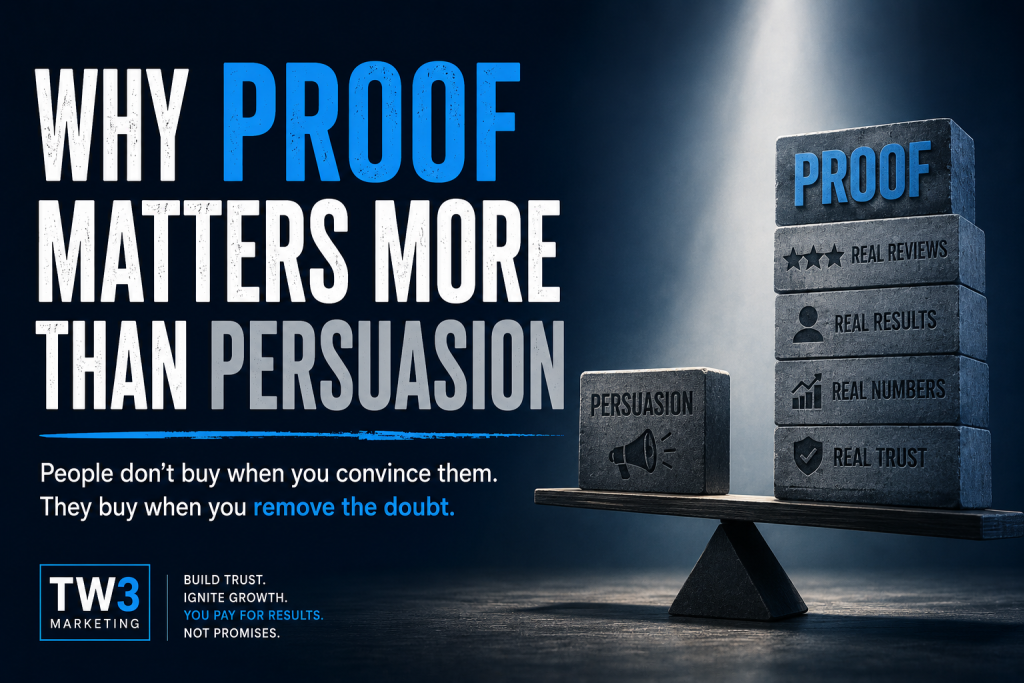
Proof matters more than persuasion because people do not buy when they are convinced. They buy when they stop worrying. Persuasion tries to push someone into a yes. Proof removes the doubt that was holding them back.
See the evidence: Explore Bobby Christy’s results, reviews and professional recommendations—because authority should be demonstrated, not merely declared.
Watch how a customer actually decides. They are not sitting there waiting to be talked into it. They are looking for a reason to feel safe. The business that hands them that reason wins. The one still trying to persuade gets a polite “let me think about it.”
What Is the Difference Between Proof and Persuasion?
Persuasion is what you say about yourself. Proof is what other people can see for themselves.
Persuasion sounds like “We are the best choice in town.” Proof looks like forty real reviews, a case study with a real name on it, and a result someone can go check. One asks to be believed. The other does not have to ask.
Picture two contractors, side by side. Same skill, same price. The first says he does great work and cares about his customers. The second shows you sixty five star reviews, three before and after photos, and a note from a neighbor two streets over. You have not met either one. But you already trust the second one more. Nothing changed about the quality. Only the proof did.
Why Persuasion Stopped Working
Persuasion used to be enough because good information was hard to find. If you sounded confident and showed up first, people gave you the benefit of the doubt.
That world is gone. Now every competitor makes the same claims. Best service. Trusted for years. Award winning. When everyone says it, it stops meaning anything. Buyers have learned to tune it out.
So here is the trap. The harder you persuade, the more you sound like everyone else. Louder does not read as better. It reads as desperate.
The Real Reason Most Businesses Lose the Sale
After years of looking at why good businesses stall, one pattern shows up again and again. They do not lose because they lack experience. They do not lose on quality. They lose because they never showed enough proof.
Think about that. The work is good. The results are real. But the buyer cannot see any of it before they decide. So the doubt wins. A great business with hidden proof loses to an average one that puts its evidence out front. That is not fair, but it is how trust works.
Most owners try to fix a slow month by shouting louder. More ads. Bolder claims. A new tagline. The fix is almost always the opposite. Show more, claim less.
What Actually Counts as Proof?
Proof is any evidence a stranger can look at and believe without taking your word for it. The strongest kinds are simple:
- Real reviews with real names, not anonymous praise.
- Case studies that show a before, an after, and who it was for.
- Specific numbers instead of vague claims.
- Testimonials from people your buyer recognizes or relates to.
- Credentials, press, and mentions from sources outside your own website.
Related perspective: See Bobby Christy’s results, reviews and professional recommendations for the evidence behind the authority framework.
Notice what these have in common. None of them are you talking about you. They are other people and hard facts doing the talking. That is what makes them land.
Why AI Engines Reward Proof, Not Persuasion
Something new is changing the game. Your customers are not only reading your website anymore. They are asking ChatGPT, Gemini, and Perplexity who to trust.
Those tools do not fall for persuasion. They cannot be charmed by a clever headline. They look for evidence they can verify, reviews, consistent information, real signals of expertise. The businesses that show that evidence get recommended. The ones that only make claims get skipped.
So proof is no longer just how you win the human. It is how you win the machine that the human now asks first. The same evidence that reassures a buyer is what teaches an AI to put your name forward. Persuasion cannot do that. Only proof can.
How to Put More Proof in Front of Buyers
You do not need more clever words. You need more visible evidence. Start here.
Collect your reviews and put them where buyers actually decide, on your homepage and your service pages, not buried on a reviews tab. Turn your best results into short case studies with names and numbers. Answer the real questions buyers ask, out in public, so both people and AI can see you know your field.
None of this is about being louder. It is about being seen. Every review you show, every result you document, every honest answer you publish is one more reason for a stranger to stop worrying and choose you.
This is the exact work the Authority Framework™ from TW3 Marketing is built to do. And if you are not sure where your proof is thin, the Authority Audit™ shows you which signals are missing and what to fix first.
The Takeaway
Here is the part most businesses miss. Proof does not create trust. Proof removes doubt. And doubt, not your price and not your competition, is usually what costs you the sale.
Expertise is invisible. Your customers cannot see how good you are. They can only see the evidence you give them. So stop trying to be more convincing. Start being more visible with your proof. That is how you become the business people choose first.
Frequently Asked Questions
What is the difference between proof and persuasion in marketing?
Persuasion is what a business says about itself. Proof is evidence others can verify, like reviews, case studies, and results. Persuasion asks to be believed. Proof does not have to ask.
Why is proof more important than persuasion?
People buy when they stop worrying, not when they are convinced. Proof removes the doubt that holds a buyer back, while persuasion often just makes a business sound like every competitor making the same claims.
What are examples of proof in marketing?
Real reviews with names, case studies with before and after results, specific numbers, recognizable testimonials, and credentials or press from sources outside your own website.
How does proof help with AI search?
AI engines like ChatGPT, Gemini, and Perplexity recommend businesses based on verifiable evidence, not marketing claims. Businesses that show real proof get surfaced and recommended, while businesses that only make claims get skipped.
