
Many service businesses lose leads not because their traffic is wrong but because their website doesn’t look credible when a stranger lands on it. Online trust signals are the credibility infrastructure that converts visitors into calls and booked jobs. Without them, you’re paying for attention you can’t keep.
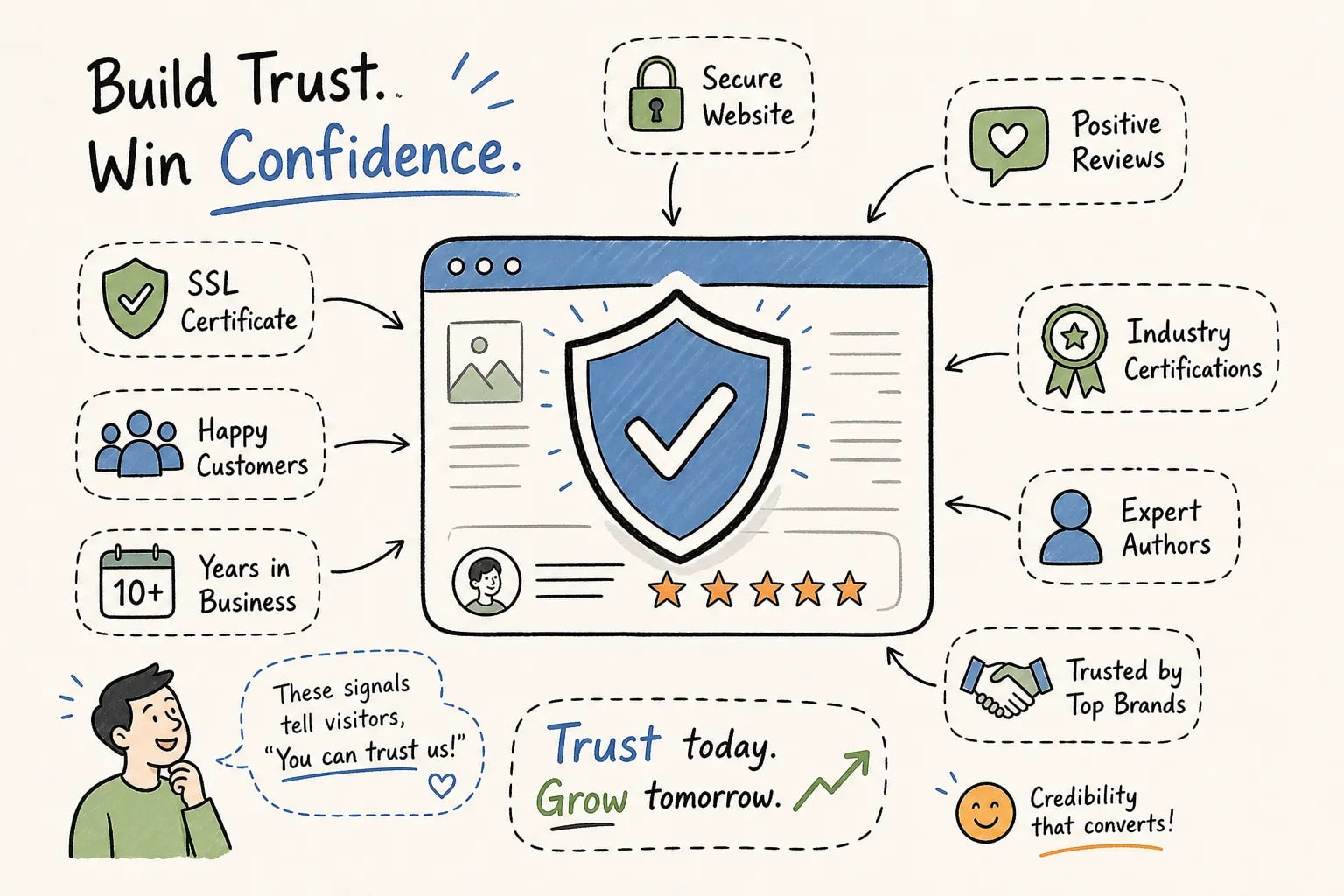
There’s a name for this problem: the trust gap. It’s the distance between how good your business actually is and how credible it looks to someone who found you five seconds ago. TW3 Marketing built a diagnostic framework around closing this gap because it’s one of the most consistently overlooked reasons service businesses lose leads despite solid traffic numbers. This article covers 12 high-impact credibility signals, where to place them, and how to test whether they’re actually working.
What online trust signals actually are (and why they matter more now)
A trust signal is any element on your website that answers the visitor’s silent question: “Can I trust this business?” That includes reviews, security badges, guarantees, credentials, consistent contact information, and even the visual quality of your design. They’re not decorations. They’re conversion infrastructure.
How trust signals work on a visitor’s brain
Visitors make a credibility judgment about your site before they read a single word of copy. It’s fast, largely unconscious, and hard to reverse once it goes negative. A 2026 Edelman-style consumer trust survey found that 82% of shoppers are more likely to trust a site that displays verified third-party trust badges. That’s not a design statistic; it’s a revenue statistic.
The trust gap service businesses face
Service businesses typically have strong reputations offline and weak online trust signals. Your customers know you’re reliable. Strangers don’t. Without structured credibility indicators, even warm leads who found you through a referral will bounce when your site doesn’t match the confidence they expected. The fix isn’t adding badges randomly; it’s auditing systematically and closing your highest-impact gaps first.
The trust signals with the biggest proven impact on conversions
Not all online trust signals are equal. Research consistently shows a clear performance hierarchy: reviews at the top, guarantees in the middle, security seals further down. Here’s what the data actually shows.
Signals 1, 4: Customer reviews, star ratings, and social proof
Customer reviews are the single highest-performing trust signal in conversion research. According to field studies cited by the Spiegel Research Center, products and services with reviews are up to 270% more likely to be purchased than those without. Field tests show review widgets producing conversion lifts of 6% to 18% depending on placement and context. The key is specificity: “4.8/5 from 1,240 verified reviews” outperforms “trusted by customers” because it’s verifiable. Social proof works because it answers the psychological question “Have others done this safely?” before the visitor has to answer it themselves.
Related perspective: See how reviews, proof and consistency work together inside the TW3 Marketing Authority Framework™
Signals 5, 7: Money-back guarantees and risk reversal
Guarantees often outperform security badges in A/B tests because they reduce perceived financial risk directly rather than just signaling site safety. Well-placed guarantee messaging has produced conversion increases of 10% to 30% in documented tests. One landing page test moved from 2.1% to 3.1% conversion after updating trust signals, with guarantee language as the primary change, a 47% lift. For this to work, the guarantee must be specific, easy to claim, and placed near your CTA rather than buried in a footer policy link.
Signals 8, 12: Security seals, trustmarks, and verified badges
Security seals from Norton, McAfee, BBB, and TrustedSite carry meaningful weight, but the context determines the impact. Near payment fields and checkout buttons, these badges can lift conversions by 15% to 30%. In lower-stakes contexts like a homepage hero, the lift is often minimal. One documented retail test showed Norton badges moving conversion from 4.87% to 5.47%, a 12.2% increase. Among U.S. consumers, Norton and BBB consistently rank as the most recognized; PayPal logos and SSL seals also score high because consumers already trust those brands.
Credentials, website design, and NAP consistency: underrated online trust signals
The signals most service businesses overlook don’t come with a badge you can download. They’re baked into how your site looks, what your pages say about your qualifications, and whether your business information matches across every directory that lists you. Each of the three subsections below addresses one of these often-ignored credibility layers.
How credentials and industry certifications build authority
Licenses, certifications, association memberships, and awards answer the question every prospect is silently asking: “Is this business actually qualified to do what I’m hiring them for?” These belong on your service pages and about page, not buried in a footer. Frame them in plain language. “Licensed HVAC contractor in [State], 18 years in business” reads better than a list of acronyms no one outside your industry recognizes.
Website design as a credibility signal
Visitors form credibility judgments in under a second based on visual design alone. A cluttered layout, outdated typography, stock photos that look like they’re from 2009, or slow load times actively erode trust before your copy gets a chance to do anything. According to a Deloitte and Google web performance study, improving load time by 0.1 seconds has been shown to increase lead-generation form completions by 21.6%. This isn’t about aesthetics; it’s about whether your site signals “established professional operation” or “someone’s weekend project.”
Why consistent NAP data matters more than most businesses realize
For local service businesses, inconsistent Name, Address, and Phone data across Google Business Profile, Yelp, Angi, and your website sends a credibility red flag to both human visitors and search systems. Search engines cross-reference this information to confirm business legitimacy. True mismatches, different phone numbers, address variations, or name discrepancies, reduce local ranking strength and can split your authority across duplicate listings. Run a NAP audit across your top 10 directory listings at least once a year and treat inconsistencies as conversion problems, not just housekeeping tasks.
Where to place online trust signals for maximum effect
Having trust signals isn’t enough. The wrong signal in the wrong place on the wrong page produces little to no lift. Placement should match the buyer’s psychology at that specific moment in their journey.
Homepage and landing page placement
Your homepage needs to establish broad credibility before the visitor decides whether to keep reading. Place your overall star rating with review count above the fold or immediately below the hero. Follow that with recognizable client logos or partner badges. Mid-page, include two to three specific testimonials, full name, role, and a concrete outcome, not vague praise. Keep your contact details easy to find. Limit trust badges to no more than three per section; beyond that, the visual weight starts working against you.
Service pages and checkout flows
Service pages need proof specific to that service, not just your general company reviews. Place review snippets near your CTA or pricing information, where hesitation is highest. On contact forms and quote request pages, website trust signals like security seals, payment logos, and guarantee language do the heaviest lifting. Repeat your guarantee statement just above the submit button and add copy like “Your information is encrypted” next to form fields. That placement matches the signal to the moment of maximum anxiety, which is exactly where it earns its conversion lift.
How to audit your trust gaps instead of guessing
Randomly adding badges and testimonials without a baseline measurement is how service businesses spend time on the wrong fixes. A structured audit tells you which gaps are costing you the most before you commit to anything.
The problem with the “add a badge and hope” approach
Most service businesses build their trust signal strategy reactively: a badge here after a competitor adds one, a testimonial there after a sales call goes well, a guarantee buried in the terms page because someone mentioned it once. Without a baseline score for each signal, you have no way to measure improvement and no way to know which gap is actually costing you conversions.
What a structured trust audit actually examines
A real audit scores review volume and recency, credential visibility, design consistency, NAP accuracy, social proof placement, guarantee clarity, and security indicators, all systematically across every key page. This is the approach behind TW3 Marketing’s Authority Audit™, a proprietary 100-point diagnostic that scores six trust and authority signal categories to identify exactly where your credibility is leaking. The framework matters because it tells you what to fix and in what order, before you spend another dollar on traffic.
How to prioritize fixes after your audit
Not all trust gaps carry the same cost. Missing reviews on your service pages hurt more than the absence of a padlock icon. A vague or buried guarantee hurts more than an outdated logo in the footer. Apply a simple prioritization rule: highest-impact signal plus fastest to implement equals your first fix. Start with reviews and guarantees before you touch security badges, and place them closest to your highest-intent CTAs before you worry about the homepage header.
Measuring conversion lift with simple A/B tests and KPIs
The only way to know your online trust signals are working is to test them against a control and track the right numbers. You don’t need an enterprise CRO budget to do this well.
What to test first and how to set it up
Start with your highest-impact signal in your weakest placement. If your service pages have no reviews, that’s your first test. Run the page with and without the review widget using a tool like VWO, Convert, or Zoho PageSense (Zoho PageSense starts around $14 per month for basic testing, check the current pricing page, as rates change). Let each test run for at least two weeks, or until you reach statistical significance given your traffic volume. Test one signal at a time; testing multiple elements simultaneously means you won’t know which change drove the result.
KPIs that show trust is actually working
Conversion rate is your primary metric, but track supporting indicators too: bounce rate on key service pages, form completion rate, time on site, and for e-commerce-adjacent businesses, cart abandonment rate. Use real case study benchmarks to set realistic expectations. Norton badges produced a 12.2% conversion lift in a documented retail test. A simplified trust signal setup on one site produced a 19% conversion lift and an 8% revenue increase. Security signals on a low-trust e-commerce site produced a 133% jump, though that figure reflects a very low starting baseline, not a typical scenario. Results like these depend heavily on the baseline trust level, traffic source, and audience, but they illustrate what systematic placement can accomplish when the right conversion-trust signals meet the right moment in the buyer’s journey.
Start with your highest-impact gap, not your easiest fix
Online trust signals are not decoration. They’re the infrastructure that turns traffic into revenue for service businesses. The difference between a site that converts and one that doesn’t often comes down to a systematic approach to credibility, not more ad spend or a prettier design.
Start with an honest audit. Score your review volume, your guarantee visibility, your credential placement, your NAP consistency, and your design quality against each other. Fix your highest-impact gap first and measure the result before moving to the next one. That process compounds faster than any single badge you can add this afternoon.
If you want a structured starting point, TW3 Marketing’s Authority Score™ Check is a proprietary diagnostic offer that shows you how your business appears across Google and key AI-driven search tools, giving you a baseline before you change anything. Closing your trust gaps systematically is how service businesses stop losing leads and start converting the traffic they already have.
