
You can rank second on Google and still be completely invisible. That’s not a hypothetical. In 2026, the difference between Google AI vs. traditional SEO is the single biggest factor reshaping how businesses measure search visibility, and most sites are optimized for the wrong one. A synthesized AI answer now sits above every organic result for a growing slice of queries. Users read the answer, get what they need, and leave. No click. No session. No lead. Your page one ranking did its job and delivered nothing.
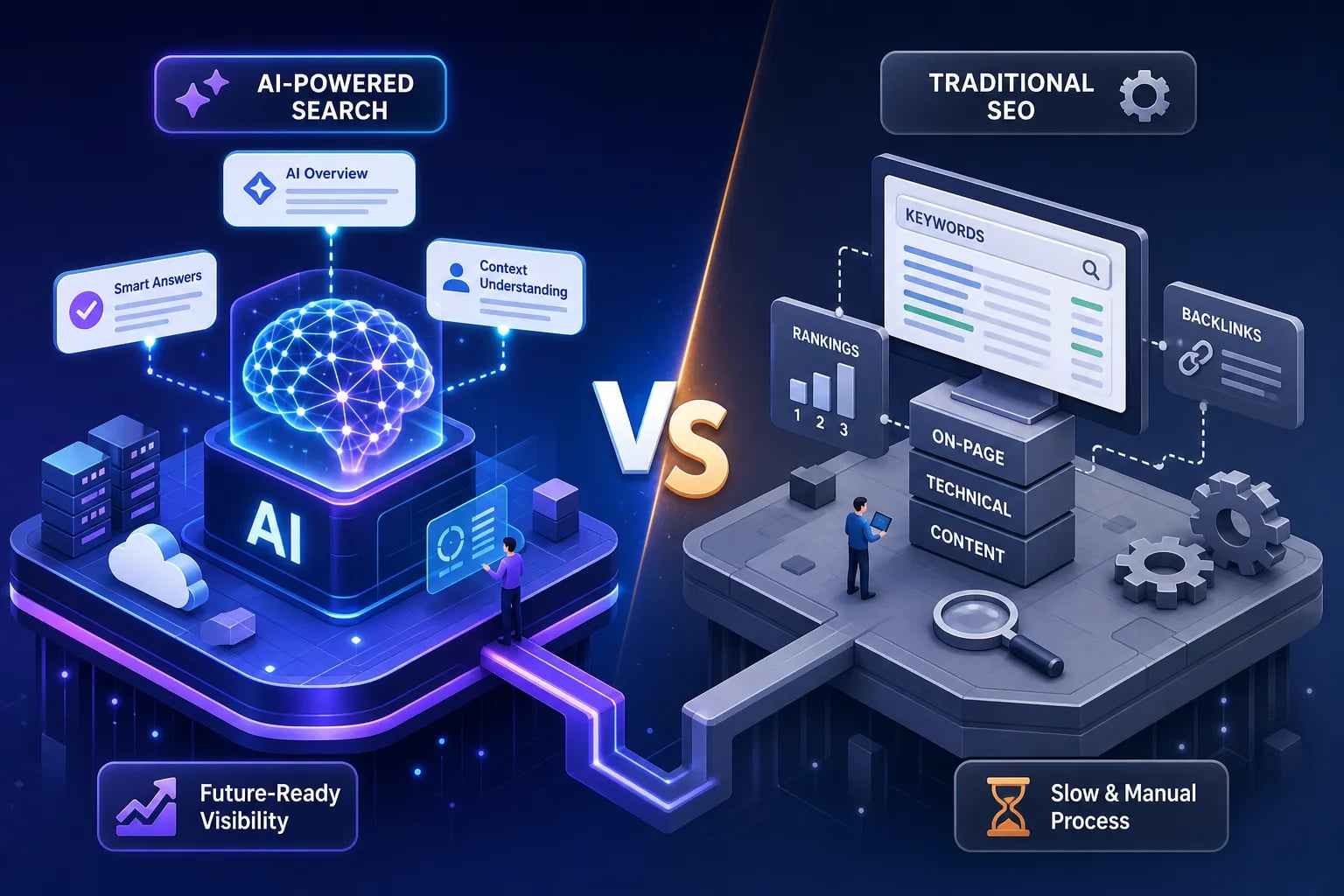
Google AI Mode and AI Overviews have changed what “showing up” actually means. Not incrementally. Fundamentally. The search engine’s job used to be pointing people toward pages. Now it answers the question itself and shows sources as a courtesy. That’s a different contract between Google and its users, and it has direct consequences for how your content needs to be built.
After running authority diagnostics across hundreds of service businesses this year, a clear pattern has emerged: most sites are optimized for the old game. They’re built to rank. They’re not built to be cited. It’s the same gap we surface every week when we run an Authority Audit™ for a new client. This article covers how the two systems actually differ, what traditional SEO still gets right, where it falls short, and what you need to change to earn a seat at the AI citation table.
How Google AI Mode Actually Works (And Why It’s Not Just a SERP Update)
Traditional search returns a ranked list so the user can decide which result to click. AI Mode generates a synthesized answer directly, pulling from multiple sources using a process called query fan-out: Google breaks your question into subtopics, searches across those in parallel, and assembles a combined response. The user experience shifts from “here are pages that might help” to “here is the answer, with sources attached.” That’s a fundamentally different job for the search engine to do, and it’s the core of why Google AI vs. traditional SEO now represents two distinct visibility challenges.
Zero-Click Rates by Search Type
The clickstream data reflects that shift. AI Mode registers roughly 93% zero-click rates compared to approximately 68% for traditional Google search, according to Seer Interactive’s 2026 analysis of 25.1 million impressions and SparkToro’s early-2026 clickstream study. AI Overviews fall in between at around 83%. Those are not small differences.
The nuance worth holding onto is that not all queries are equally affected. Informational queries, the ones asking “what is,” “how does,” or “why does”, are heavily impacted because AI Mode is purpose-built to answer those completely. Transactional and navigational queries, where someone is trying to buy something or get to a specific site, still generate clicks at much higher rates. The risk to your site depends significantly on what kind of traffic you were counting on.
What Traditional SEO Still Gets Right in 2026
Traditional SEO signals didn’t become worthless. They became table stakes. AI systems draw from the same web that Google has always indexed, which means a page that lacks credibility in traditional search also lacks credibility as an AI citation candidate. Topical authority, trusted backlink profiles, and clear site architecture still matter because they help a page qualify for consideration in the first place.
Why Ranking Still Matters as an Entry Point
One study summary found that 99.5% of AI Overview sources come from pages already in the top 10 organic results. That number tells you exactly how much traditional ranking still matters as an entry point into AI SEO visibility. You can’t skip the foundation and expect to appear in AI-generated answers.
E-E-A-T (experience, expertise, authoritativeness, trustworthiness) was already the direction SEO was heading before AI Mode existed. AI-driven search accelerated that trajectory rather than replacing it. For local service businesses specifically, review volume, structured NAP consistency across directories, and citation-based visibility all still feed into how AI systems assess credibility. These are traditional SEO fundamentals, and they still work. Domain authority isn’t the whole picture for AI citation selection, but it functions as a trust filter that gets a page into the eligible pool.
Where Traditional SEO Falls Short in AI-First Search
Here’s the gap that most 2026 planning hasn’t accounted for: ranking and citation are now two separate outcomes driven by different signals. You can rank second organically for a query and still be completely absent from the AI Overview answering that same query. Ranking position and citation selection have diverged, and most sites are only optimizing for one of them.
The Three-Filter Citation Process
Traditional SEO optimization targets ranking position. AI SEO citation optimization targets extractability and authority alignment. A page can have perfect title tags, clean schema, and a strong backlink profile and still fail to get cited if it doesn’t answer the query directly in the first 100 to 300 words. The AI selection process uses a layered filtering approach: first, does the page answer the question? Second, is the answer easy to extract? Third, is the source credible enough to cite? Most traditional SEO preparation addresses only the third filter, and partially the first.
Content written to rank for keywords rather than to answer questions clearly is the biggest missed opportunity in AI-first search environments. Pages that build gradually to their main point, use extensive preamble before delivering the answer, or structure content around keyword density rather than user questions are consistently at a disadvantage when AI systems scan for citable passages. The writing approach that made sense for a click-based search engine doesn’t map cleanly onto an answer-generation engine.
The Content Signals That Earn AI Citations in 2026
Direct answer match is the primary filter Google applies when selecting sources for AI-generated responses. Pages that state the answer plainly in the opening paragraphs are consistently favored over pages that take several paragraphs to arrive at the point. The inverted pyramid approach, borrowed from journalism, puts your most extractable content exactly where AI systems are most likely to find it.
Structure, Schema, and Format
Structural clarity compounds that advantage. Clear H2 and H3 hierarchies, scannable sections, and short self-contained paragraphs make it significantly easier for an AI system to extract and attribute a specific passage. Schema markup, including FAQPage, HowTo, Article, and Organization types, signals to AI systems what type of content they’re reading and who produced it. Schema is supportive rather than decisive on its own, but it differentiates between otherwise similar pages. Freshness matters for time-sensitive topics; recent publication dates and content revisions signal ongoing relevance.
The content formats that consistently appear in AI answers follow a recognizable pattern:
- Lists and bullet points are among the most frequently cited elements in AI Overviews and generative results
- Step-by-step how-to guides surface heavily for procedural queries
- Comparison tables map well to AI synthesis tasks, especially for “X vs. Y” questions, including Google AI vs. traditional SEO comparisons
- FAQ sections and Q&A structures mirror the question-answer format of AI prompts and are often quoted verbatim
- Answer-first formatting places extractable content where AI systems look first
None of this requires rebuilding your site from scratch. It requires auditing which pages matter most to your business and restructuring how those pages deliver information, not just what information they contain.
Measuring Visibility When Clicks Aren’t the Full Story
Clicks alone are no longer a complete picture of search visibility. AI Mode can surface your brand in a cited answer while sending zero clicks, and that mention still influences buyer behavior before anyone reaches your site. Measuring only click volume in 2026 is like measuring a radio ad campaign by counting how many people drove directly to the store: it misses most of the impact.
AI-Era Metrics That Actually Matter
The metrics that now matter alongside clicks include AI impressions (how often your URLs appear in generative features), citation frequency (how often your brand or URL is cited across tracked prompts), mention rate (brand appearances in AI answers even without a direct link), and branded search lift over time. Google Search Console now includes AI feature reporting that tracks impressions, pages surfaced, country, and device data, making it the starting point for any AI-era measurement setup. The current limitation is that it covers impressions only; clicks from AI surfaces remain folded into standard performance totals.
The most practical reporting structure separates AI visibility from traditional organic performance rather than blending everything into one organic traffic number. Build your reporting around four panels: visibility (impressions, prompt presence, mention rate), authority (citation frequency, citation share, cited pages), demand (branded searches, assisted traffic, conversions), and trend and coverage by topic cluster, country, device, and time period. Third-party AI trackers that monitor citation share across a defined prompt set pair well with GA4 conversion data to show downstream business impact even when direct clicks decline.
Diagnosing Where Your Site Actually Stands Before Changing Strategy
The most common mistake businesses make when they hear about AI Mode is jumping straight to tactics: adding FAQ sections, tweaking meta descriptions, dropping in some schema. Without knowing which specific signals are weak, those moves are largely guesswork. You might improve the third citation filter (credibility) when your real gap is in the first (direct answer match). You might restructure content when your authority baseline is too low to qualify in the first place.
The Right Diagnostic Question
The real question isn’t “am I ranking?” It’s “am I being cited, and if not, which citation filter am I failing?” Answering that requires examining both traditional authority signals and AI-specific content factors simultaneously, not as separate audits, but as one integrated assessment of how your business appears to both classic search systems and AI-driven ones.
TW3 Marketing’s Authority Audit™ is a 100-point diagnostic scoring system that measures six core authority signals across your full digital presence: positioning, proof, expertise, visibility, engagement, and experience. It’s built around the signals that AI platforms like Google AI and ChatGPT use to surface and recommend businesses, not just the ranking factors traditional SEO tools report. For service businesses that want to know exactly where they stand before restructuring content or changing site architecture, the Authority Audit™ provides the baseline that makes every subsequent move more targeted and more likely to produce measurable results.
The Bottom Line on Google AI vs. Traditional SEO
Google AI Mode and traditional SEO aren’t competing strategies for the same outcome anymore. They’re two separate visibility channels with overlapping foundations but distinct requirements. Understanding where Google AI vs. traditional SEO diverges is what determines whether your content gets ranked, cited, or both. Traditional SEO authority still matters because it determines whether your pages are even eligible to be cited. But eligibility alone doesn’t produce citations. Extractable, answer-first content structure is what closes that gap.
The practical sequence is straightforward: build on traditional SEO authority because it remains the entry requirement, then layer in citation-optimized content structure, then measure with AI-aware metrics rather than clicks alone. Skip the first step and you have no foundation. Skip the second and you’ll rank without being cited. Skip the third and you won’t know which of those problems you have.
Before restructuring content or changing site architecture, know exactly where you stand. That’s what an audit is for. TW3 Marketing’s Authority Score™ Check gives you a clear read on how your business currently appears in both Google and ChatGPT within 48 hours, the fastest way to see whether your current strategy matches the AI-driven search environment you’re actually operating in.
