
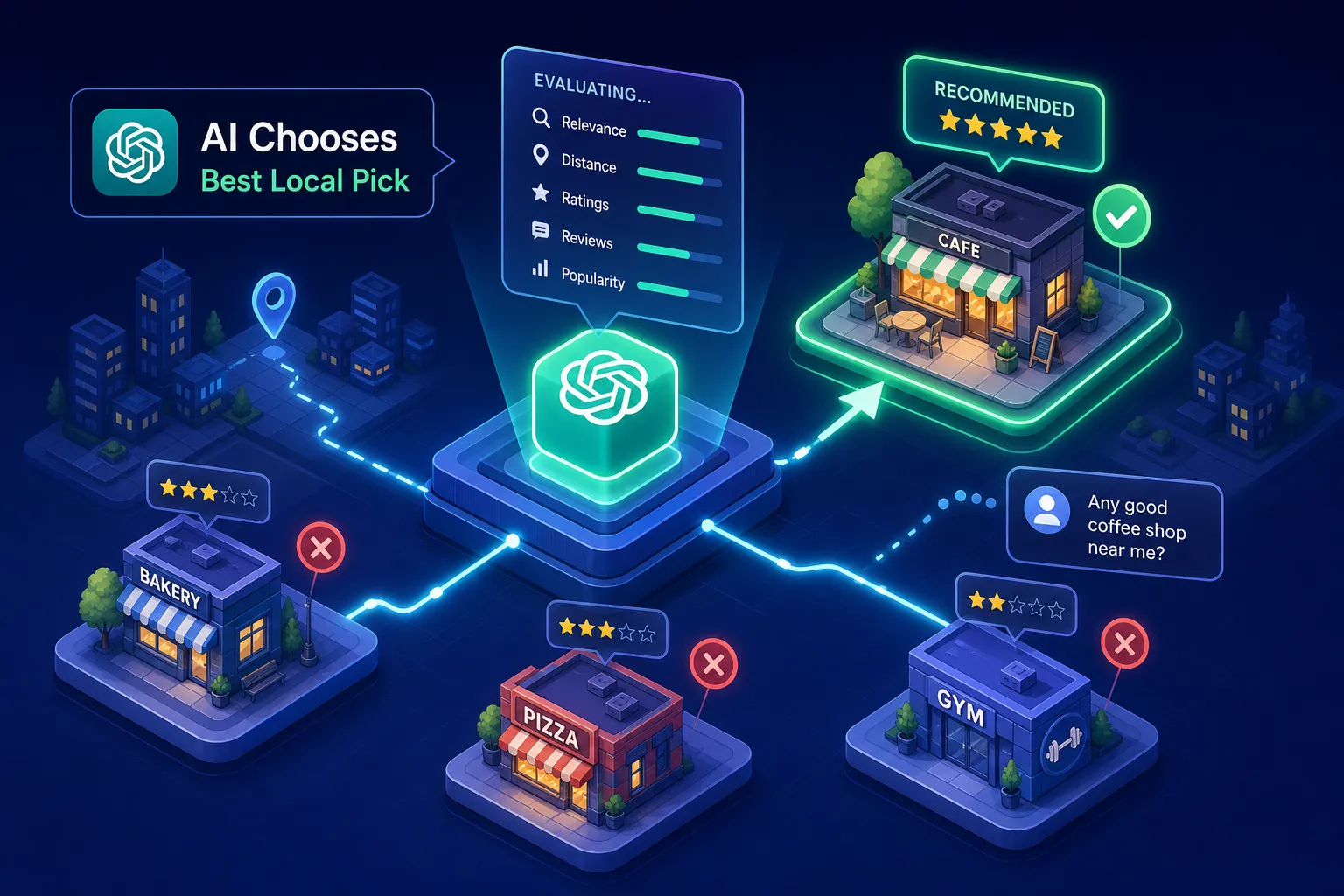
Customers aren’t just Googling anymore. They’re opening ChatGPT, typing “best HVAC company near me” or “who should I call for a roof leak in [city],” and trusting whatever comes back. If you’ve ever wondered how does ChatGPT decide which local business to recommend, the answer isn’t about who does the best work, it’s about who AI systems can actually read, verify, and confidently surface. The businesses showing up in those answers are the legible ones, not necessarily the best ones in the area.
Together, Bobby Christy and his partner Terry Wilson III of TW3 have served more than 4,500 clients across 70 industries since 2008, and they see the same pattern constantly: solid companies with real reputations and loyal customers that AI simply cannot find or verify. The gap isn’t quality. It’s legibility. And that’s a solvable problem once you understand how the system actually works.
This article breaks down exactly how ChatGPT decides which local business to surface, what data it draws from, which signals carry the most weight, and the seven concrete steps you can take to show up before your competitors do.
How ChatGPT Actually Sources Local Business Information
ChatGPT does not work like a search engine. It doesn’t crawl the web in real time by default, and that distinction matters enormously for how you approach your visibility strategy.
Training Data vs. Live Web Retrieval
The base model was trained on data up to a cutoff date. Businesses that weren’t documented online before that cutoff may not exist in ChatGPT’s knowledge at all. Newer businesses, rebranded companies, and businesses with thin digital footprints are especially vulnerable here. If the internet didn’t know about you when the model was trained, the model doesn’t know about you either.
In 2026, ChatGPT’s web retrieval mode has changed this significantly. When live retrieval is active, ChatGPT pulls from indexed web pages, directories, review platforms, and editorial sources at the moment someone asks a question. Across the more than 4,500 clients Bobby Christy and his partner Terry Wilson III of TW3 have served since 2008, the most consistently cited sources for local home service queries include Yelp, Google Business Profile, Bing Places, Angi, Thumbtack, the BBB, Foursquare, and the business’s own website. Business websites appear to account for a substantial share of all ChatGPT local search citations, a number that should get your attention if your site is thin or outdated.
Why “Live” Doesn’t Mean Instant
Even with live retrieval, ChatGPT is only as current as the pages and indexes it can access. If your listings are outdated, your website is thin, or your reviews are stale, the live version of ChatGPT finds the same problems the base model would. Being present in the right places with accurate, consistent information is what separates businesses that get recommended from businesses that get skipped.
How Does ChatGPT Decide Which Local Business to Recommend, The Signals That Matter
Not all signals carry equal weight. Most businesses spend time and money on the wrong ones first, which is why they’re not seeing results.
Why Reviews Are the Highest-Weighted Signal
Reviews aren’t just social proof for humans. They’re one of the strongest trust inputs for AI systems. Volume, recency, sentiment, and specificity all factor into how an AI model judges and describes your business. A business with 200 detailed, recent reviews looks very different to a recommendation engine than one with 12 generic five-star ratings.
What reviewers actually say about your services matters as much as your star rating. Reviews that mention specific services, locations, technician names, or outcomes give AI systems concrete language to work with when constructing a recommendation. Generic reviews don’t. If your reviews say “great service, highly recommend,” you’re giving AI almost nothing to differentiate you from any other business in your category.
Directory Consistency and Entity Verification
AI systems need to confidently identify one business entity across many sources. If your name, address, or phone number conflicts across Google Business Profile, Bing Places, Yelp, Apple Maps, and industry directories, that inconsistency creates uncertainty. The model can’t confidently say “this is the business” when the data doesn’t agree. NAP consistency isn’t optional, it’s the foundation everything else is built on, and citation cleanup typically begins affecting AI recommendation patterns within six to twelve weeks.
Website Clarity and Structured Data
Schema markup and clear service pages help AI systems interpret what your business does and who it serves. The most useful types for local service businesses include:
- A specific LocalBusiness subtype (Plumber, HVACBusiness, RoofingContractor, etc.)
- Service schema for individual offerings
- FAQPage schema for question-and-answer content
- areaServed to define the locations you cover
One important caveat: schema confirms signals that already exist. It rarely compensates for weak reviews or inconsistent listings on its own.
How Does ChatGPT Decide Which Local Business to Recommend, Seven Steps to Improve Your Visibility
Here’s the priority order, based on what we’ve seen produce the fastest and most durable results across thousands of service businesses.
Steps 1, 3: Fix the Foundation First
Step 1: Make your business information identical everywhere. Your name, address, phone number, hours, service categories, and service area descriptions need to match across your website, Google Business Profile, Bing Places, Apple Maps, Yelp, and any industry-specific directories. Inconsistencies erode entity confidence in AI systems. Fix them before anything else.
Step 2: Fully complete and optimize your Google Business Profile. Every field. Correct primary and secondary categories. Active photos. Recent posts. Hours that are actually current. GBP is one of the most-cited sources in ChatGPT local search results, and an incomplete profile undermines your visibility across every downstream platform that pulls from it.
Step 3: Add LocalBusiness schema and structured data to your service and location pages. Use the most specific subtype that fits your business. Pair it with Service schema, FAQPage where relevant, and areaServed to define your coverage area.
Steps 4, 6: Build the Authority Signals AI Trusts
Step 4: Rewrite key pages to answer customer questions directly. Service pages, location pages, and FAQs should use clear, specific language. Name the services, the cities you serve, rough pricing ranges, and the common objections customers have before they hire. AI systems favor businesses whose content directly answers the questions people are asking, not businesses with dense, self-promotional copy.
Step 5: Build recent, detailed reviews on Google and relevant platforms, and respond to them consistently. Ask satisfied customers to describe the specific service they received, not just to leave a star rating. Respond to every review. Active, responsive review profiles signal that the business is legitimate and engaged, not dormant.
Step 6: Earn local citations and mentions from trusted sources. Directories, local news outlets, chambers of commerce, industry publications, and partner websites all contribute to entity confidence in AI systems. Off-site mentions from reputable sources tell the model that this business is real, relevant, and recognized by the broader community. This is the step most businesses skip, and it’s the one that often closes the gap between appearing occasionally and appearing consistently.
Step 7: Stay Active and Current
AI systems favor businesses that look operational. Regular Google Posts, photo updates, FAQ refreshes, and accurate hours signal that your business is running today, not just that it existed two years ago. Ongoing maintenance matters as much as initial setup. A listing that was perfect in 2024 and hasn’t been touched since reads as stale to both AI systems and the people who find it.
What Realistic Timelines Look Like for AI Visibility
Most business owners want to know when they’ll see results. The honest answer: it depends on what you’re fixing and how deep the problems go.
Quick Wins vs. Long-Term Authority
Fixing data inconsistencies and completing your profiles can produce AI-visible changes within days to two weeks. These are the highest-leverage, lowest-effort improvements you can make. Review and citation building begins to produce consistent AI recommendation patterns at two to four months, that’s when the signals start accumulating enough weight to shift how AI systems describe and recommend your business. Durable authority, the kind where your business gets recommended across ChatGPT, Gemini, Perplexity, and Google AI Overviews without constant effort, builds over six to twelve months.
Think of it as a compounding investment rather than a campaign. The businesses showing up most reliably in AI recommendations aren’t running a sprint, they’ve been building these signals consistently, and the model has learned to trust them. Earn that trust and it tends to hold, which is exactly the point.
How to Test Whether ChatGPT Is Recommending Your Business
Most service businesses have no idea where they currently stand in AI search results. Here’s how to find out in about 20 minutes.
Querying the Major AI Platforms
Once a month, run the service and location queries your customers actually use across ChatGPT, Gemini, Perplexity, and Google AI Overviews. Search for phrases like “best [your service] in [your city]” or “who should I call for [specific problem] near [neighborhood].” Note which businesses get named, which sources get cited, and whether your business appears at all.
If your business doesn’t appear, look at which sources are cited in the answers that do come back. Those cited sources are the gap to close. If Yelp is cited and your Yelp profile is incomplete, that’s your next move. If a competitor’s website is cited and yours isn’t, look at how their content is structured compared to yours.
What Good Results Actually Look Like
A strong AI visibility result means your business is named in the response, linked to a reputable source, and described with specifics that match your actual services and service area. That’s the benchmark. Being absent entirely or lumped into a generic “there are several options in your area” non-answer means your signals aren’t strong enough yet. Running this test monthly gives you a real before-and-after baseline that makes the seven steps above measurable, not just theoretical.
The Gap Is Fixable, But Only If You Know Where It Is
Now you know how does ChatGPT decide which local business to recommend: it picks the most legible one, not the best one. The business with consistent data, strong reviews, clear website content, and trusted third-party mentions wins the recommendation over the business that’s been around the longest or does the best work. That’s the reality of AI-driven business discovery in 2026, and it’s not going to change.
If you want to skip the guesswork and know exactly which signals are weak and in what order to fix them, TW3 Marketing’s Authority Audit is a 100-point diagnostic built for this. It shows you where you actually stand across the six authority signals AI systems use to recommend businesses, and it gives you a clear priority order so you’re not spending time on low-leverage fixes while the high-leverage ones sit untouched.
Start with the test above. Run the queries. Check whether you appear. If you don’t, you know where to start, and now you know exactly what to do about it.
