
Most service business owners assume they have some level of online credibility. They’ve been in business for years. They have a website. They get reviews. That assumption is not authority. Online authority is not what you believe about your own reputation. It’s what Google, ChatGPT, and your next customer actually see when they search for you. Those two things are often very different, and if you’re asking how do I know if my business has strong authority online, this guide gives you a concrete, signal-by-signal answer.
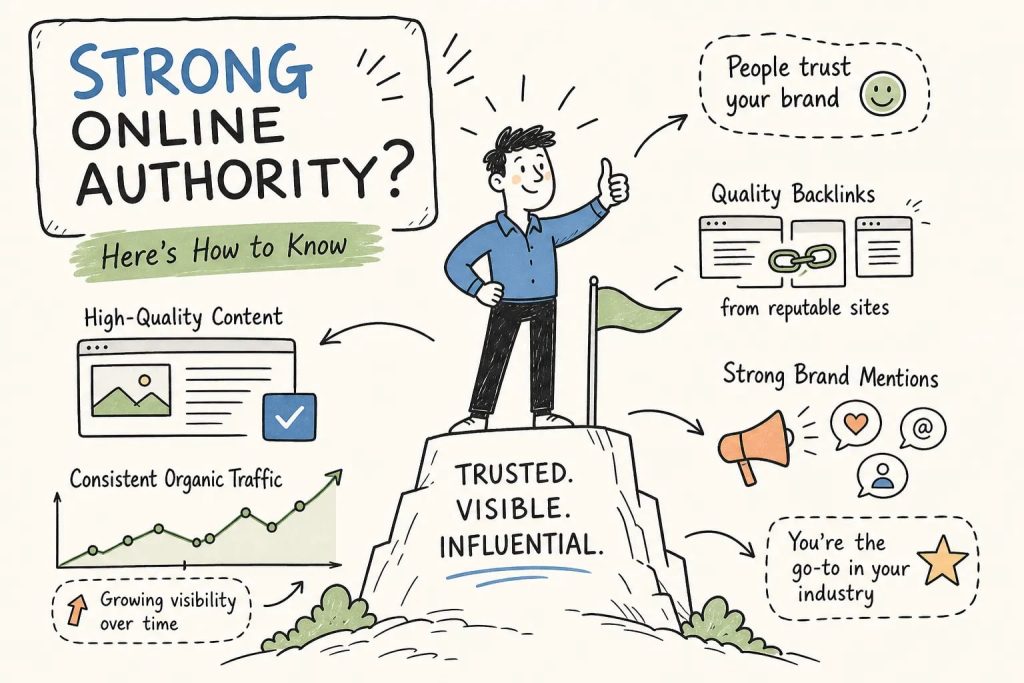
Think of what follows as a self-administered authority audit: honest, diagnostic, and actionable. You’ll know what to check, what the benchmarks look like, and what to fix first.
What “authority” actually means in a digital context
Most business owners confuse authority with traffic or social following. They’re not the same thing. Online authority is the degree to which Google and AI platforms trust your business enough to surface it, recommend it, and treat it as a credible source. That trust is built from specific, measurable signals, not from how often you post on social media.
Those signals fall into four categories: reputation signals (reviews, citations, mentions), content signals (E-E-A-T and expertise indicators), structural signals (HTTPS, schema, NAP consistency), and AI visibility (how Google and ChatGPT perceive and represent your business). The rest of this article walks through each one.
The difference between visibility and authority
You can rank on page one and still not be authoritative. Ranking means you showed up. Authority means a search engine or AI system trusts you enough to recommend you unprompted. Consider the difference: a homeowner asks ChatGPT, “Who is a reliable HVAC contractor in Dallas?” ChatGPT doesn’t pull from whoever bought the top Google ad. It pulls from businesses with layered, verifiable authority signals. If your business isn’t built that way, it won’t appear in that answer.
Why this matters more in 2026 than it did three years ago
The shift to AI-driven search has changed the standard. Google AI Overviews, ChatGPT local suggestions, and voice assistants now answer the questions that used to send people to a list of ten blue links. The businesses that get recommended are not just the ones with polished websites. They are the ones with consistent, credible, layered authority signals that AI systems can verify and trust. That is a different game than traditional SEO, and most service businesses haven’t caught up yet.
Your reputation layer: reviews and business listing consistency
The most immediately checkable part of your authority is your reputation layer. Two things matter here: your review profile and your NAP (Name, Address, Phone) consistency across directories. Neither requires a paid tool, and both can reveal serious gaps in under twenty minutes.
For reviews, recency matters more than total count. A business with 12 reviews from this month often outperforms one with 200 reviews from three years ago in how AI systems perceive it. Google and ChatGPT are looking for evidence that your business is actively serving customers right now, not just that it once did.
How to evaluate your review profile in under 10 minutes
Check these five things on your Google Business Profile: total review count, average rating, date of your most recent review, percentage of reviews that received a business response, and whether reviews appear on more than one platform. For a local service business, a baseline signal of active credibility looks like this: 50+ Google reviews, a 4.5+ rating, at least one review in the past 30 days, and a response rate above 70%.
Under 20 reviews puts you in weak territory for AI visibility. At 100+ with strong recency, you’re competitive in most local markets.
The NAP consistency check most businesses skip
Your business name, address, and phone number need to match exactly across every directory where you appear. Not approximately. Exactly. A missing suite number, a phone number formatted differently on Yelp than on your website, an abbreviated business name on one platform: these inconsistencies fragment what Google and ChatGPT treat as your entity signal. They make your business harder to verify as real and established. Use a free tool like NAPCHKR to scan common directories in about 30 seconds, or audit manually against your Google Business Profile, Yelp, Bing, and BBB listings. Fix every mismatch against your canonical version.
Test how you appear in branded search and AI responses
Most business owners have never run this check. Open Google, search your business name exactly, and audit the first page of results. Do you control those results? Is your website at the top, followed by your Google Business Profile and a few review platforms? Or are there competitor mentions, old directory listings, or outdated information showing up instead? A strong branded search result shows a business with a controlled, consistent identity. Scattered or weak branded results are an authority warning sign worth taking seriously.
The branded search audit (and what the results tell you)
A well-controlled branded search result typically includes your website, your Google Business Profile, two or three review platform listings, and any press or third-party mentions. What you don’t want: competitor ads targeting your business name, outdated directory listings with wrong information, or negative content ranking without a business response. Each of those is an authority leak, and fixing them starts with knowing they exist.
Running the AI visibility test yourself
Open a fresh ChatGPT session and ask the kind of question a real customer would ask: “Who is a reliable [your service type] in [your city]?” Test four or five variations of that prompt. Note whether your business appears, what position it appears in, how it’s described, and which competitors are named instead. Run the same test in Perplexity and Google AI Overviews. If you’re not showing up at all, that’s not a branding problem. It’s a concrete authority gap with a specific cause: weak review signals, inconsistent entity data, thin content, or some combination of those factors.
Evaluate your content and on-site credibility signals
This is the E-E-A-T layer: the signals on your website that tell Google and AI platforms a real expert runs this business. Google’s evaluation focuses on proof, transparency, and technical trust, and all of it is checkable without a specialist. Does your site have HTTPS? Is your contact page complete with a phone number, email, and physical address, not just a form? Do you have an About page with real credentials, a founder story, or team photos? Are your certifications and industry associations listed and clickable? These signals separate “this is a real business run by someone who knows what they’re doing” from “this looks like a placeholder website.”
The E-E-A-T signals your site either has or doesn’t
Strong E-E-A-T for a service business comes down to a few concrete things: author attribution on published content, documented client outcomes such as case studies or project photos, specific service pages that demonstrate real expertise rather than generic descriptions, and visible credentials. If your About page is two sentences long with a stock image, you’re signaling nothing to Google or to potential customers. Real business identity content, honest team bios, and documented work are what move the needle on this layer.
Domain authority metrics: what the numbers mean and what to ignore
Three tools dominate this space: Moz Domain Authority, Ahrefs Domain Rating, and Semrush Authority Score. All three are worth checking, but none is an absolute target. They’re comparative metrics. For local service businesses, a practical benchmark is Moz DA 20-40 for growing SMBs, with DA 35-45 being a stronger target in competitive city markets like HVAC or plumbing. Ahrefs Domain Rating tends to read higher, so a DR of 30-50 corresponds roughly to the same range. Check your score against the top three to five competitors in your local market using any free-tier checker. That gap, not a universal number, is what tells you where you actually stand.
Score yourself and decide what to fix first
Run through this checklist and score each signal from 0 to 2. A score of 0 means missing or broken. A score of 1 means present but weak, outdated, or inconsistent. A score of 2 means strong, current, and consistent.
The authority self-assessment checklist (score yourself 0-2 on each signal)
- Google review profile: 50+ reviews, 4.5+ rating, at least one review in the past 30 days
- NAP consistency: business name, address, and phone match exactly across all major directories
- Branded search results: you control the first page for your business name
- AI visibility: your business appears in ChatGPT and Google AI responses for relevant local queries
- E-E-A-T content signals: author attribution, case studies, credentials, and specific service expertise on your site
- Domain authority vs. competitors: your Moz DA or Ahrefs DR is within range of the top local competitors
- On-site trust signals: HTTPS, complete contact page, privacy policy, and industry certifications
A score of 12-14 means your authority foundation is solid. A score of 7-11 means meaningful gaps exist that are costing you visibility and leads. A score of 6 or below means your authority foundation needs real work before additional marketing spend makes sense.
What to do when your score reveals weak spots
Fix in this order. Start with HTTPS and NAP: structural issues with the lowest effort and the highest foundational impact. Then address your review profile by building a consistent, repeatable request process. Next, update your content credibility signals: About page, credentials, and case studies. Finally, invest in backlink building and domain authority over time, targeting the gap between your score and your top local competitors.
If you’re scoring low across multiple areas, or you’re in a competitive local market where the gap between you and the top-ranked competitors is significant, a professional diagnostic saves a lot of time. TW3 Marketing’s Authority Score™ Check delivers a 48-hour snapshot of exactly how your business appears across Google and ChatGPT, including what’s working, what’s broken, and where the highest-impact opportunities are. It’s the professional version of this checklist, built specifically for service businesses competing in local markets where trust is the primary purchase driver.
Authority is a set of layers, not a single score
No single metric tells you whether your business has strong online authority. It’s a combination: reviews, NAP consistency, branded search control, AI visibility, on-site credibility, and domain strength. When those layers align, Google and AI platforms treat your business as a verified, trustworthy option worth recommending. When they don’t, you get passed over, regardless of how long you’ve been in business or how good your work actually is.
The self-assessment in this article gives you a clear starting point. Run through it today and note your score. Then fix what you can, starting with the structural wins: HTTPS, NAP, and your review process. The businesses getting recommended first in AI-driven search have done this work. Most of their competitors haven’t. That gap is still open. Knowing your number is the first step. Fixing it is what drives real growth.
