
AI SEO for businesses has fundamentally changed what it means to show up where customers are looking. Picture this: a local HVAC contractor ranks on page one of Google for every major keyword in their market. They’ve done the work, solid backlinks, optimized service pages, consistent posting. Then a homeowner opens ChatGPT and asks, “Who’s the best HVAC company near me?” The contractor doesn’t appear. A competitor with a shorter track record but stronger digital trust signals does. That page-one ranking meant nothing in that moment.
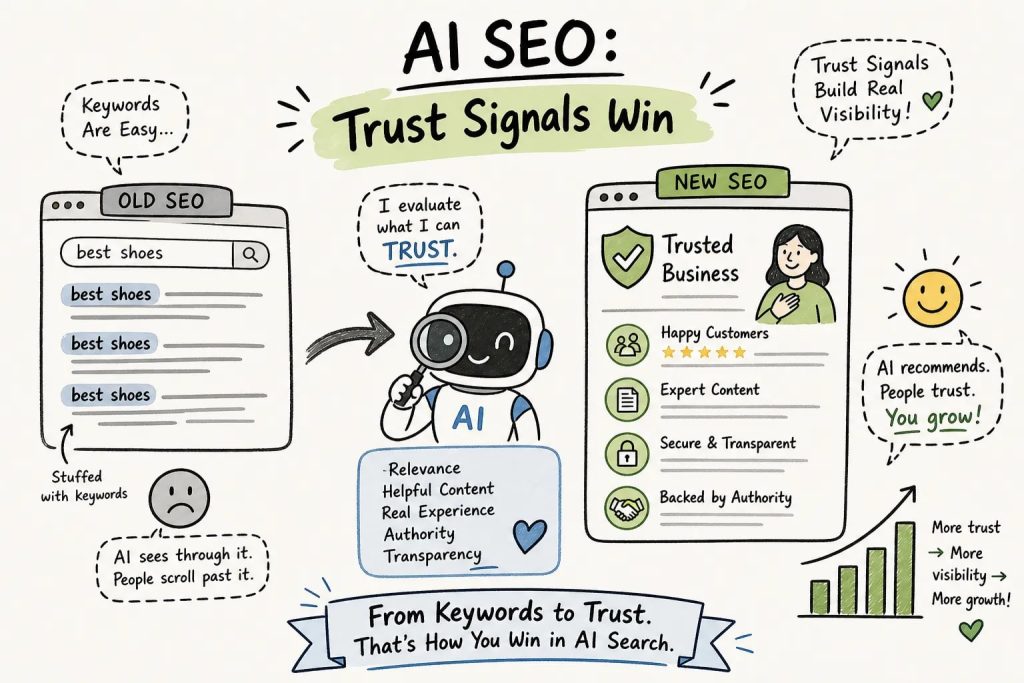
The gap is real and widening. While traditional SEO factors still matter for relevance and discoverability, AI systems place increasing emphasis on verifiable trust signals, and that shift changes the game for service businesses. AI platforms like ChatGPT, Google AI Overviews, and voice assistants don’t just crawl pages and match queries. They evaluate credibility. They synthesize signals across a business’s entire digital footprint and decide whether that business is worth recommending.
Some agencies have already rebuilt their frameworks around this reality. TW3 Marketing structured their entire approach around the signals AI systems actually use, developing the Authority Framework™ to address the trust gap that traditional SEO leaves open, a proprietary methodology grounded in client work across local service categories. That framework identifies six core signals, and those six signals are what this article is built around.
What Actually Changed When AI Entered Search
Traditional SEO was built on a clear premise: match user queries with the most relevant page. The mechanics were keyword targeting, backlinks, technical site health, and on-page optimization. If your page was the best answer to a query, search engines surfaced it. For years, that model worked well enough that entire industries grew up around it.
AI search engines operate on a different logic. They don’t retrieve the best-matching page and present it as a link. They synthesize information from multiple sources and generate a recommendation, citing only the sources they consider credible and authoritative. A top Google ranking no longer guarantees inclusion in an AI-generated answer. The selection criteria are different in kind, not just in degree.
The gap this creates is where service businesses are quietly losing ground right now. Most businesses optimized their sites for click-through from a results page, building for the moment a user chooses their blue link. AI systems don’t give users a list of links to evaluate, they make a recommendation. If your business isn’t seen as trustworthy enough to recommend, you’re invisible at that moment, regardless of where you rank.
AI SEO for Businesses: The Six Trust Signals That Actually Matter
TW3 Marketing’s Authority Framework™ identifies six signals that AI systems use to determine whether a business is worth surfacing. These aren’t theoretical constructs, they’re the measurable factors that separate businesses appearing in AI answers from those that don’t.
Positioning and Proof
Positioning is how clearly and specifically a business communicates what it does, who it serves, and why it’s different. AI systems favor businesses with sharp, consistent positioning across their entire digital presence. Vague or generic messaging reads as low-confidence to an AI evaluating whether to stake a recommendation on your brand. Proof includes reviews, testimonials, case studies, and third-party validation. Without visible, accessible proof, AI platforms have no basis to choose your business over a competitor who has documented their results.
Expertise and Visibility
Expertise shows up in the depth and quality of published content, credentials, and the knowledge a business demonstrates publicly. AI platforms are increasingly capable of distinguishing thin, keyword-stuffed content from genuine subject matter authority. Generic service pages don’t earn AI citations. Content that answers specific questions with real depth does. Visibility measures how broadly a business is mentioned and cited across the web, including directories, industry publications, local news mentions, and consistent NAP (name, address, phone) signals across every source.
Engagement and Experience
Engagement reflects how users interact with a business’s content and digital presence, think time on page, click-throughs, form completions, and call events. Strong engagement patterns signal to AI systems that real people find this business relevant and useful. Experience covers the quality of the user journey on the site itself: speed, mobile usability, clarity of information, and how easy it is for a visitor to take the next step. Those aren’t just UX concerns. They’re signals that tell AI systems whether this business is operating at a professional standard.
Why Service Businesses Are Most Exposed to This Shift
Service businesses rely on reputation and word-of-mouth more than almost any other business category. The problem is that when that reputation lives only in the minds of past customers, and not across structured digital trust signals, AI systems can’t access it. A business with 20 years of excellent work but weak online proof signals loses to a competitor with fewer years but stronger digital authority. The AI doesn’t know about the 20 years. It only knows what it can see and verify.
The industries feeling this hardest are home services and local trades. According to local search tracking data, roofing-related queries have dropped roughly 80% in traditional results as AI captures the intent, with concrete contractor searches down approximately 56% year over year, declines that align with broader industry research on AI’s impact on high-consideration local queries. The industries most exposed include HVAC companies, general contractors, roofing businesses, insurance agencies, and local service providers. These are high-consideration, trust-driven purchases where customers increasingly start with an AI assistant rather than a search bar. When an AI doesn’t recognize a business as credible, that business simply doesn’t get mentioned, regardless of how long it’s been operating.
What AI-Optimized Websites Do Differently
Traditional on-page SEO focused on keyword placement, meta tags, and header structure. AI-driven content optimization goes deeper. It ensures AI systems can clearly identify what a business does, who it serves, the problems it solves, and the evidence that it solves them well. Schema markup (LocalBusiness, FAQPage), clear entity signals, FAQ sections with substantive answers, and organized proof sections all contribute. The goal isn’t to manipulate an algorithm, it’s to make the business’s credibility legible to systems that evaluate it automatically.
The diagnostic step before any of this is knowing where the gaps actually are. TW3 Marketing’s 100-point Authority Audit™ measures all six trust factors across a business’s digital presence and produces a scored gap analysis. Service businesses that skip this step often spend on tactics that don’t address their actual problem, adding more content when proof signals are weak, or running more ads when positioning is the real issue. The audit identifies the right problem before resources get allocated to the wrong solution.
Content strategy also shifts under this model. AI platforms reward content that demonstrates genuine depth: original perspectives, real examples, and clear answers to specific questions. TW3 Marketing’s own client work has documented AI Visibility Score improvements from the low 30s to the mid-70s within 90-day engagements across multiple service business accounts, results driven not by adding keywords, but by restructuring how expertise was demonstrated and proof was surfaced.
A Prioritized 90-Day Roadmap for Closing Your Trust Gaps
The most effective approach sequences improvements by impact speed. Start with the signals AI systems can pick up quickly, then build toward the slower-burning authority signals that compound over time.
Days 1 to 30: Establish Your Baseline
Audit your current six trust signals and establish a scored baseline. Where is your positioning unclear or inconsistent across platforms? Where is proof missing or buried deep in the site? Where does your content fail to demonstrate expertise beyond surface-level descriptions? Without a baseline, prioritization is guesswork. TW3 Marketing’s Authority Score™ Check delivers this assessment and shows exactly how your business currently appears in Google and ChatGPT, surfacing where the gaps are before any budget gets committed.
Days 31 to 60: Fix the Highest-Impact Gaps
Proof signals and positioning clarity typically deliver the fastest lift. Consolidate reviews onto priority platforms. Build or update case study content. Sharpen homepage and service page messaging so AI systems can immediately parse who you serve and what you deliver. Audit all business listings for NAP consistency, because conflicting signals across directories actively weaken AI recommendation confidence. These changes affect both traditional search and AI recommendations simultaneously, and they start working relatively quickly.
Days 61 to 90: Scale Visibility and Track AI-Specific Performance
Expand expertise-signaling content into adjacent topic areas your target customers are already asking about. Pursue citation mentions on industry directories and local publications. In Google Analytics 4, monitor AI-attributed referral sessions separately from organic SEO traffic using UTM tagging and source segmentation. Track citation frequency in AI Overviews through Search Console impression data. Measure leads and form fills from AI-referred sessions specifically, not as part of a blended organic number, so you can see what AI search visibility is actually generating.
Measuring Whether the Investment Is Working
Traditional SEO KPIs don’t fully capture AI search performance. Ranking position and total organic sessions tell you how you’re doing in traditional search. They don’t tell you whether you’re appearing in AI answers or how often.
The KPIs that actually reflect AI search performance are:
- AI-attributed referral sessions in GA4
- Citation frequency in AI Overviews (via Search Console impression data)
- Brand mention volume across indexed sources
- Conversion rate from AI-referred traffic
- Cost per AI-driven lead
Track these separately from your standard organic metrics. Realistic expectations: meaningful gains in lead volume and AI citation frequency are achievable within 60 to 90 days for service businesses that address proof signals and positioning clarity first. Longer-term, the compounding nature of authority signals means businesses that invest early increasingly pull ahead of competitors who don’t. The gap between businesses with strong trust signals and those without isn’t narrowing, it’s growing.
The Bottom Line on AI SEO for Businesses
Optimizing for AI-driven search isn’t about gaming a new algorithm. It’s about building the kind of digital presence that AI systems interpret as trustworthy, credible, and worth recommending. The businesses winning in AI search aren’t the ones with the most keywords. They’re the ones with the strongest authority signals across all six factors: positioning, proof, expertise, visibility, engagement, and experience.
The businesses losing ground aren’t failing because they’re bad at their trade. They’re failing because their reputation hasn’t been translated into the digital trust signals AI systems can actually read. That’s a solvable problem, but it starts with knowing where the gaps are, not with adding more content or running more ads on top of a weak foundation.
For service brands, investing in AI SEO for businesses means translating hard-won reputation into verifiable trust signals that AI systems can surface when it counts. If you want to know exactly where your business stands in Google and ChatGPT right now, TW3 Marketing’s Authority Score™ Check gives you that picture. It surfaces exactly what AI systems see when evaluating your business, before you spend another dollar on tactics.
