
Authority score marketing is the framework that separates businesses building lasting search visibility from those renting it one campaign at a time. Many marketers spend their days tracking traffic, click-through rates, and cost-per-click. Those metrics tell you how much activity you’re generating, they don’t tell you how much trust you’ve earned. In 2026, trust is what determines whether your site ranks organically or quietly loses ground to a competitor who figured this out first.
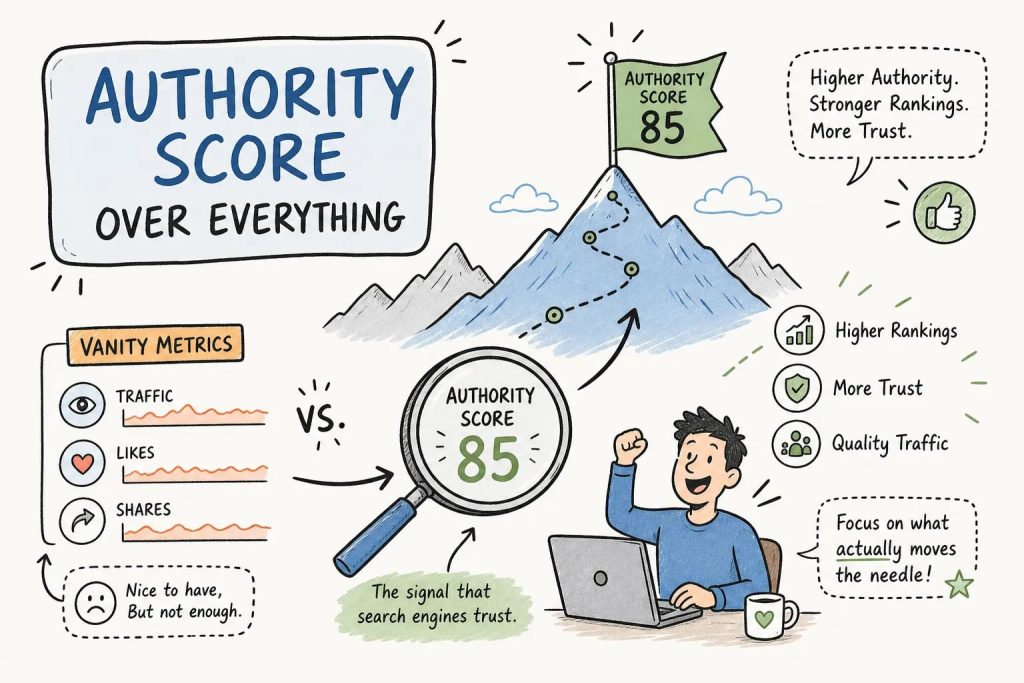
Building and tracking your site’s authority signals isn’t a specialty SEO task anymore. It’s a core business strategy. Some forward-thinking agencies have stopped leading with campaign metrics and started auditing authority from the ground up, before a single dollar gets spent on ads. That’s the philosophy behind TW3 Marketing’s Authority Score™ Check, which gives business owners a clear baseline of how their site currently performs in Google within 48 hours. The metric-first approach changes what you build toward.
What authority score marketing actually is
The shift from traffic metrics to trust signals
Traditional digital marketing metrics measure activity, not credibility. Traffic tells you people showed up. Authority tells you whether those visitors, search engines, and AI platforms have a reason to trust what they find when they get there. Authority score marketing is a distinct discipline: it measures how much trust is assigned to your domain based on your backlink profile, content depth, and the organic signals your site has accumulated over time.
Authority has always been a ranking factor operating beneath the surface, Google’s own documentation has long recognized backlinks and site credibility as core inputs to search quality. What’s changed is that AI-driven search features, like Google AI Overviews, increasingly surface businesses based on credibility signals rather than keyword density alone. That shift has elevated authority measurement from a background SEO concern to a strategic variable that shapes every channel you invest in.
Why authority is now a competitive differentiator
Two businesses competing in the same local market can be separated by their authority scores rather than their ad budgets. A business with a strong backlink profile, consistent organic signals, and a clean domain earns accumulating advantages over time. Every quality link it earns makes the next ranking a little easier. Every editorial citation generally produces third-party endorsement signals that paid placements don’t replicate and that tend to be more durable in organic performance.
That self-reinforcing dynamic is why authority-building has moved from an SEO specialty into a full business strategy. Businesses that understand this stop treating it as a checkbox and start treating it as infrastructure.
How Moz DA, Ahrefs DR, and Semrush Authority Score each measure authority differently
Moz Domain Authority: ranking prediction, not just link counting
Moz Domain Authority (DA) runs on a machine-learning model trained on Moz’s own link graph. The metric is designed to predict how likely a domain is to rank in Google search results compared to competitors. It evaluates linking root domains, link quality, MozRank, MozTrust, spam score, and anchor distribution, then outputs a score from 0 to 100.
The critical thing to understand about DA is that it’s a relative, comparative metric. A DA of 35 is strong or weak depending entirely on who you’re competing against. Against a local HVAC competitor with a DA of 22, it’s dominant. Against a national home services brand with a DA of 68, it’s not enough on its own. Never read DA in isolation.
Ahrefs Domain Rating: pure backlink profile strength
Ahrefs Domain Rating (DR) isn’t trying to predict rankings. It measures the strength of a site’s backlink profile using a referring-domain-weighted scoring model built from Ahrefs’ own crawl index. A site can have a high DR and still struggle to rank if its content and on-page factors are weak, including page authority signals at the individual URL level. That’s not a flaw in the metric; it’s exactly what DR is designed to tell you.
Think of it this way: DR equals backlink profile strength; DA equals ranking potential proxy. When you’re evaluating a link-building opportunity or auditing a competitor’s off-page foundation, DR gives you the clearest picture. When you want a broader ranking likelihood comparison across multiple domains, DA is the more appropriate lens.
Semrush Authority Score: the composite approach
Semrush Authority Score uses a three-pillar formula: Link Power (quality and quantity of backlinks), Organic Traffic (estimated monthly search traffic), and Natural Profile factors that detect manipulated or unnatural link patterns. Those spam signals include things like an unnaturally high percentage of dofollow domains, a mismatch between link volume and traffic, and multiple referring domains sharing the same IP address.
This composite approach makes Semrush Authority Score more holistic than DR alone, but it also means the score can fluctuate more with traffic shifts. A site that loses organic rankings will see its Authority Score drop even if its backlink profile hasn’t changed. That drop is useful information. It confirms the score is tracking real performance, not just raw link authority counts.
Authority score marketing benchmarks by business type
What’s actually competitive for local and service-based businesses
Local service businesses don’t need the same scores as national e-commerce brands. They’re competing in a defined geography, and location signals, reviews, citations, and Google Business Profile strength all carry significant weight alongside domain authority. A local HVAC company or general contractor with a DA in the 18, 25 range can outrank a national brand in a specific zip code when those other signals are strong.
Here are realistic benchmark ranges by niche competitiveness (approximate, based on typical SERP behavior, your real target is the average authority of the top three organic results for your primary service keywords in your target city):
- Low-competition local niche: DA/AS 10, 25
- Typical local or service niche: DA/AS 20, 35
- Moderately competitive local niche: DA/AS 30, 45
You’re competing against your local niche, not the entire web. Benchmarking your DA against a national competitor is almost always the wrong comparison.
Benchmarks for B2B SaaS and e-commerce
B2B SaaS companies face broader competition. A DA of 30, 40 is a realistic baseline for a smaller SaaS company just establishing organic presence, while 40, 60 is where broader competitive strength develops across multiple keyword categories. Semrush Authority Score in the 35, 55 range maps roughly to that competitive window for most SaaS niches.
Large e-commerce sites competing nationally need considerably more. A working range of 45, 70+ reflects the higher baseline competition in commercial and category keywords. National competitiveness often requires scores in the 50s and above. Again, the best benchmark isn’t an absolute number: it’s the average authority of the sites currently ranking above you for your target keywords.
Why businesses that invest in authority score marketing consistently outperform traffic chasers
The vanity metric trap and what it costs
The pattern repeats constantly. A business runs paid ads, traffic spikes, revenue follows, and then the campaign pauses and everything collapses. The site’s authority never grew because no one was building the underlying signals. Meanwhile, a competitor that spent the same period earning quality backlinks, publishing citable content, and accumulating domain signals is now ranking without paying for every click.
Authority compounds. Ad spend doesn’t. Every quality link a site earns raises the baseline for all its pages. Every editorial citation improves credibility for future content. Businesses that optimize for authority instead of just traffic stop renting their rankings and start owning them.
How agencies are building full strategies around authority measurement
The smarter agencies now lead with authority diagnosis before recommending any marketing spend. TW3 Marketing built its entire methodology around this principle. Their Authority Score™ Check gives a business owner a concrete baseline of how their site is currently performing in Google within 48 hours, before any strategy gets built. That diagnostic-first approach reflects a broader industry direction: you can’t fix what you haven’t measured.
When you know your baseline score, which signals are weak, and where your competitors are outperforming you, every subsequent decision is grounded in data. You stop guessing which tactic to try next and start executing against a prioritized gap analysis.
Authority score marketing: high-impact tactics to raise your score
Backlink strategies that actually move the needle
Not all links carry equal weight. Editorial and contextual backlinks placed within real content on relevant, authoritative pages consistently outperform generic placements across virtually every quality-versus-quantity analysis in the SEO industry. Digital PR placements in news or industry publications produce high-authority links with brand trust signals attached. Link insertions on already-indexed pages (often called niche edits) can produce faster results because the page already has link authority flowing through it. Broken-link reclamation converts existing signals rather than building from scratch.
Be explicit about what to avoid: private blog networks, comment spam, generic directories, and footer links are either low-value or actively harmful. They dilute your natural profile signals and can trigger the spam factors that Semrush’s algorithm is specifically designed to detect. One strong editorial link from a relevant publication outweighs hundreds of low-quality placements.
Content and technical improvements that build authority over time
Link-worthy content, specifically original data, research studies, unique tools, and comprehensive guides, attracts the editorial links that raise authority scores over time. The goal is to publish pages other sites want to cite. That means going deeper than competitors, using current statistics, and structuring content so it’s genuinely referenceable.
Technical fixes are foundational and often overlooked. Crawl issues, poor internal linking, duplicate content, and slow pages all dilute the authority signal flow to your most important pages. Fix the technical foundation first so that gains from backlink building actually reach the pages you want to rank. These fixes can index relatively quickly, but their full effect on authority metrics stacks over time, they set the table for everything else to work.
Choosing the right tools and setting realistic timeline expectations
Which website authority checker to use for what purpose
Use Moz DA when you want a quick comparative benchmark across competitor domains and a rough sense of ranking potential. Use Ahrefs DR when you specifically want to evaluate backlink profile strength and identify link-building opportunities or gaps. Use Semrush Authority Score when you want a composite view that factors in organic traffic and spam signals alongside link power.
None of these tools use Google’s actual algorithm, so treat cross-tool comparisons as directional, not definitive. The value is in tracking your own score over time and benchmarking against direct competitors, not in chasing a specific number in isolation.
How long should you realistically expect to wait?
Most backlink-driven authority gains take 1 to 6 months to register, with around 3 months as the common average before ranking improvements become visible. Faster tactics like link insertions and mention reclamation can show effects sooner because they leverage pages that already exist and carry established authority. Digital PR and editorial links take longer to earn but tend to produce the strongest cumulative impact over time.
Authority score marketing is a long-term strategy. That’s not a caveat, it’s the value proposition. Businesses that commit to it early build advantages that are genuinely hard to reverse. A competitor who has been earning quality links and accumulating authority signals for two years has a structural edge that no ad campaign can quickly overcome. The best time to start is now.
Start with your baseline, then build
Authority score marketing isn’t a replacement for content or technical SEO. It’s the framework that makes everything else more effective. Once you understand what your DA, DR, or Semrush Authority Score actually measures, and where your benchmarks sit relative to competitors, you stop guessing and start building with direction.
Businesses that invest in authority earn advantages that reinforce themselves over time. Organic rankings come more reliably. Trust-based conversions follow because the signals that raise authority scores are the same signals that make customers feel confident choosing you. That flywheel doesn’t exist when you’re optimizing only for traffic.
Start by knowing your baseline. Reach out to the TW3 Marketing team and run an Authority Score™ Check on your domain, then compare it against your top three competitors. What you find will tell you exactly where to focus next.
