
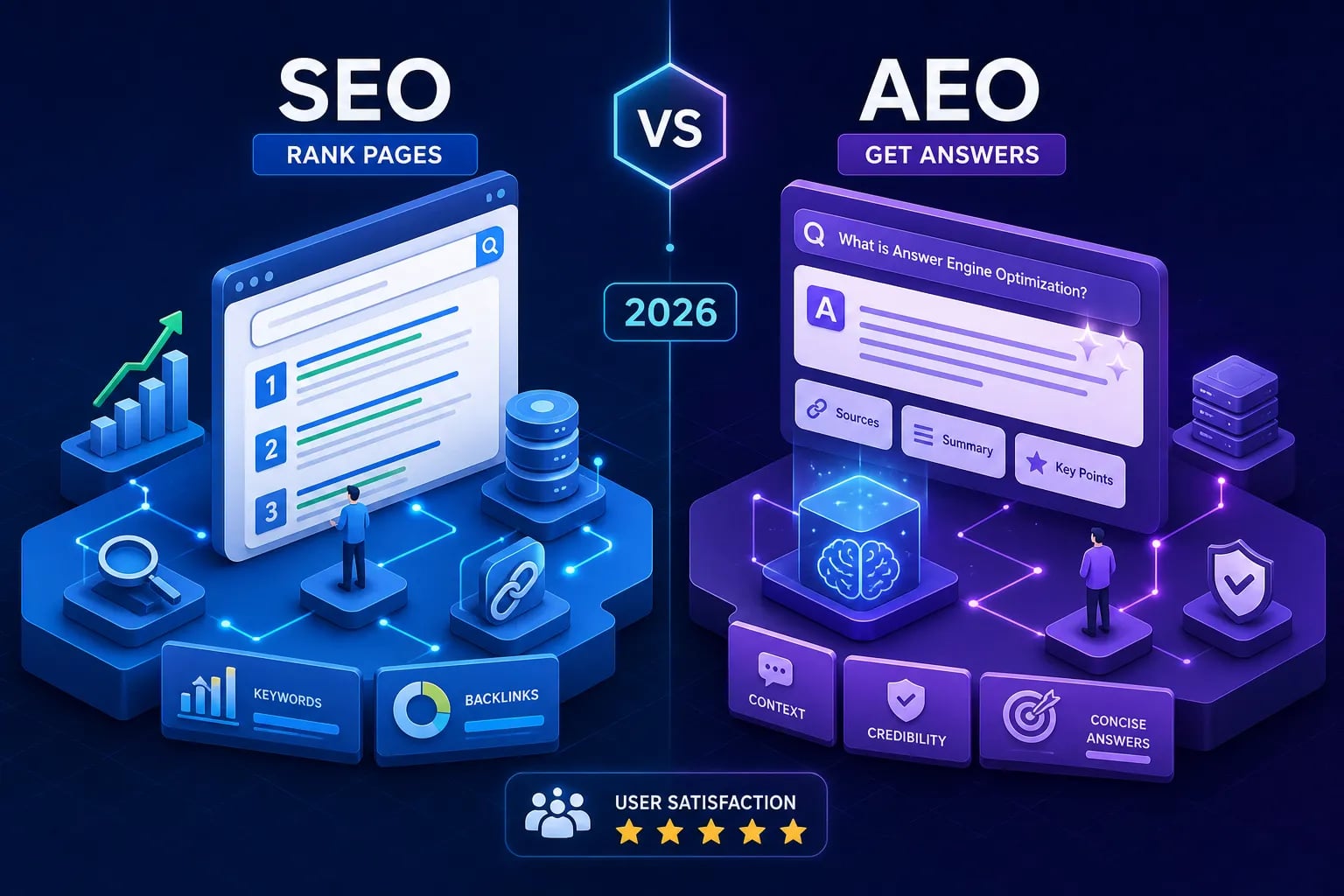
How answer engine optimization differs from SEO in 2026 is not a semantic debate, it is a practical one with direct consequences for search visibility. Many marketers treat AEO as an SEO rebrand, but that framing is a category error. Answer Engine Optimization is not a new name for the same discipline. The unit of optimization changed, the ranking signals changed, and the way you measure success changed. These are parallel disciplines with different inputs and different outputs, and conflating them is costing businesses real visibility.
A recurring gap we see in authority audits is that a business may have traditional SEO in place while its content is not structured clearly enough for answer engines to retrieve and cite. Ranking in Google does not automatically mean a business will be mentioned when someone asks ChatGPT or Google AI for a recommendation. In many cases, that gap is less a content quality problem than a structural one, rooted in how AI answer engines retrieve and evaluate content differently from traditional search crawlers.
This article breaks down where AEO and traditional SEO diverge technically and strategically in 2026, which content structures actually get cited, and which metrics tell you whether your AEO efforts are producing results.
The foundational split: page rankings vs. passage citations
Traditional SEO treats the page as the unit of optimization. The whole document gets evaluated: domain authority, keyword relevance, internal linking, comprehensiveness. All of it contributes to a single page-level score that determines where the page sits in a ranked list of results. A page wins when it earns a top-three ranking and drives clicks.
Answer Engine Optimization (AEO) operates at a different level entirely. The unit of optimization is the passage, the snippet, the answer block. An AEO win happens when a specific passage from your content gets extracted, synthesized, and cited inside an AI-generated answer. The rest of the page may be completely irrelevant to that outcome. In 2026, answer engines do not evaluate your article for overall worthiness, they query for self-contained, quotable passages that satisfy a specific sub-query within the user’s broader request, retrieve candidate passages, score them for relevance and trustworthiness, and synthesize a response.
Why AEO vs. SEO matters in 2026
This distinction has real consequences for content strategy. A long, narrative-style pillar page might perform well in traditional search results but produce zero AI citations because no individual section stands alone as a direct answer. The two goals can conflict, and most content teams are not aware of that conflict until they audit the gap. The strategic shift is moving from “make this page rank” to “make this passage extractable.”
How answer engine optimization differs from SEO in 2026: ranking signal divergence
Backlink authority, domain rating, keyword relevance, page speed, Core Web Vitals, and internal linking still drive traditional search rankings in 2026. These page-level and domain-level signals answer one question: is this page from a trusted source that covers this topic well? That signal stack has not disappeared, but it is no longer sufficient on its own.
AI answer engines weight provenance signals more heavily than raw link authority. For citation selection, the signals that carry the most weight include structured data and semantic HTML, entity consistency across the web, cross-source corroboration (multiple independent sources agreeing on the same claim), answer-first page structure, and visible attribution to credible authors or organizations. A page with clear JSON-LD schema, a self-contained answer passage, and third-party corroboration can outperform a higher-authority page that buries its answer in narrative prose, the engine can extract and trust the lower-authority page more efficiently.
One area where both disciplines converge: freshness and author credibility matter in both systems. Pages updated recently with clearly attributed authorship are more likely to rank in traditional search and more likely to be cited in AI answers. Content maintenance pays dividends in both channels regardless of which discipline you are optimizing for.
Content formats AI answer engines actually extract
Answer engines benefit from short, self-contained answer units inside a useful page. A practical passage should be long enough to answer one question completely, concise enough to understand without surrounding text, and written with the conclusion first. There is no universal word-count guarantee for earning an AI citation.
Question-led headings followed by direct answers can make content easier for people and machines to understand. Tables, numbered steps, and concise FAQ sections can also create clear information boundaries. FAQ schema should be used only when the same questions and answers are visible on the page; it clarifies content meaning but does not guarantee AI citations.
The underlying principle across all of these formats is modularity. Each section of a well-structured page should function as a standalone answer, independent of the sections around it. This is a structural decision that has to happen at the content architecture level, not as a post-edit fix applied to existing pages. Reformatting content without rebuilding the underlying structure produces limited results.
Platform behavior: Google AI Overviews, Bing Copilot, and enterprise LLMs are not the same
Optimizing generically for “AI search” is a strategic mistake because the major platforms retrieve and synthesize content differently, and those differences require separate tactical decisions. Here is how the three primary environments behave in 2026.
Google’s generative features run on top of core Search infrastructure, which means content still needs to meet standard Search quality fundamentals to be eligible for AI Overview inclusion. Google’s system uses query fan-out: it breaks a user’s question into multiple sub-queries, retrieves content for each in parallel, then synthesizes a response from across those sources. The practical implication is that your content needs to answer not just the primary question but the likely sub-questions a user’s query implies. A page can appear in an AI Overview even if it was not optimized for the exact original keyword, because it answered one of the sub-queries generated during fan-out.
Microsoft grounds Bing Copilot answers in public web content retrieved through Bing Search. In 2026, Bing Webmaster Tools includes AI performance reporting that gives publishers direct visibility into how their content appears in Copilot-generated answers, including total citations, average cited pages, grounding queries, and citation share by query. This is a measurable channel with specific optimization levers tied to Bing indexability and content structure.
Enterprise copilots like Microsoft Copilot Studio can pull from public web grounding, private tenant data, or blended retrieval depending on configuration. For businesses targeting enterprise buyers, public web optimization alone may not reach their audience if those buyers operate inside a copilot grounded in internal knowledge bases. Understanding the retrieval stack your audience actually uses is a prerequisite for any enterprise AEO strategy.
Metrics that separate Answer Engine Optimization performance from traditional SEO results
Without distinct measurement, it is impossible to know whether your AEO efforts are working or which discipline deserves budget and attention. The two systems require different KPI stacks, and mixing them obscures performance in both directions.
Citation share and answer surface impressions
For Answer Engine Optimization , the primary visibility KPIs are citation share and answer surface impressions. Citation share measures the percentage of your target queries where your content is cited in an AI-generated answer. Answer surface impressions track how often your brand or content appears inside AI answers, knowledge panels, or zero-click responses. Both metrics require building a target query set and tracking it consistently using tools like Profound, Otterly, Semrush AI Visibility, or manual prompt audits run against ChatGPT, Perplexity, Gemini, and Google AI Overviews.
Assisted conversions and branded search lift
Traditional tools like Google Search Console do not isolate AI citation data cleanly, so you need a separate measurement workflow. AEO does not always produce a direct click, a user who sees your business cited in a ChatGPT answer may convert through a branded search two days later. Assisted conversion tracking and influenced pipeline reporting connect AEO visibility to business outcomes even when the attribution path is indirect. Branded search lift in Search Console can be a useful supporting signal that broader visibility is generating downstream demand, but it should not be attributed to AEO without corroborating evidence.
Organic clicks, rankings, CTR, and organic sessions remain valid for measuring the click-driven portion of search. The shift is treating them as indicators of the click economy, not as evidence of your total search presence. Strong organic click metrics alongside flat or declining AI citation share signals a gap that SEO performance alone will not close. Both measurement systems need to run in parallel.
Auditing your position across both dimensions before you optimize
The most common AEO mistake is rewriting content in Q&A format without addressing the underlying credibility and provenance signals, missing schema types, absent author markup, and weak cross-source corroboration, that determine whether answer engines trust the source in the first place. Format changes alone produce limited results. The sequence that works is: audit first, then optimize.
A traditional SEO audit evaluates domain authority, keyword rankings, technical health, and backlink profile. It tells you how well your pages compete in a ranked list. It does not tell you whether your content is structured for passage extraction, whether your entity signals are consistent enough for AI citation, or whether your authorship and provenance signals meet what answer engines require. Running only an SEO audit in 2026 measures half the field.
TW3 Marketing Authority Audit is a 100-point diagnostic that scores a business across six authority signals, including visibility, expertise, and proof, using criteria that reflect both traditional search performance and AI discoverability. Rather than auditing SEO or AEO in isolation, it maps where a business stands across the full spectrum of signals that affect whether a company ranks, gets cited, and gets recommended. For service businesses that have invested in SEO without seeing AI visibility improvements, this dual-dimension evaluation identifies exactly where the gap is before any optimization budget gets allocated.
If you want to understand your current position across both dimensions, use the free TW3 Marketing Authority Audit assessment. You will get a clear picture of how your business appears across both Google and ChatGPT, and a specific action plan for closing the gaps.
Putting it together
Understanding how answer engine optimization differs from SEO in 2026 helps clarify where to invest: citation share, passage extractability, and provenance signals operate independently from the page-level authority stack that drives traditional rankings. AEO and SEO are not competitors, but they are distinct disciplines with different units of optimization, different signal stacks, and different KPIs. Page-level authority still matters, it is just no longer sufficient on its own. The businesses getting cited in AI answers in 2026 have both: a strong traditional search foundation and AEO-specific content architecture that makes their passages extractable, credible, and easy for answer engines to cite.
Start by understanding how your content and authority signals currently perform across both dimensions. Identify whether your gaps are structural (no extractable passages), provenance-based (weak entity signals and schema), or authority-based (low cross-source corroboration). That diagnosis prevents the common pattern of investing in content format changes while leaving the underlying credibility signals completely unaddressed. Fix the signals, then fix the structure, then measure both.
