
Many HVAC companies struggle less with a marketing problem than with a trust gap problem. They pour money into ads before fixing what’s broken underneath, and the leads stay expensive and slow to close. A solid HVAC marketing strategy in 2026 isn’t one channel, it’s a full funnel: getting found, getting chosen, booking the job, and keeping the customer for life.
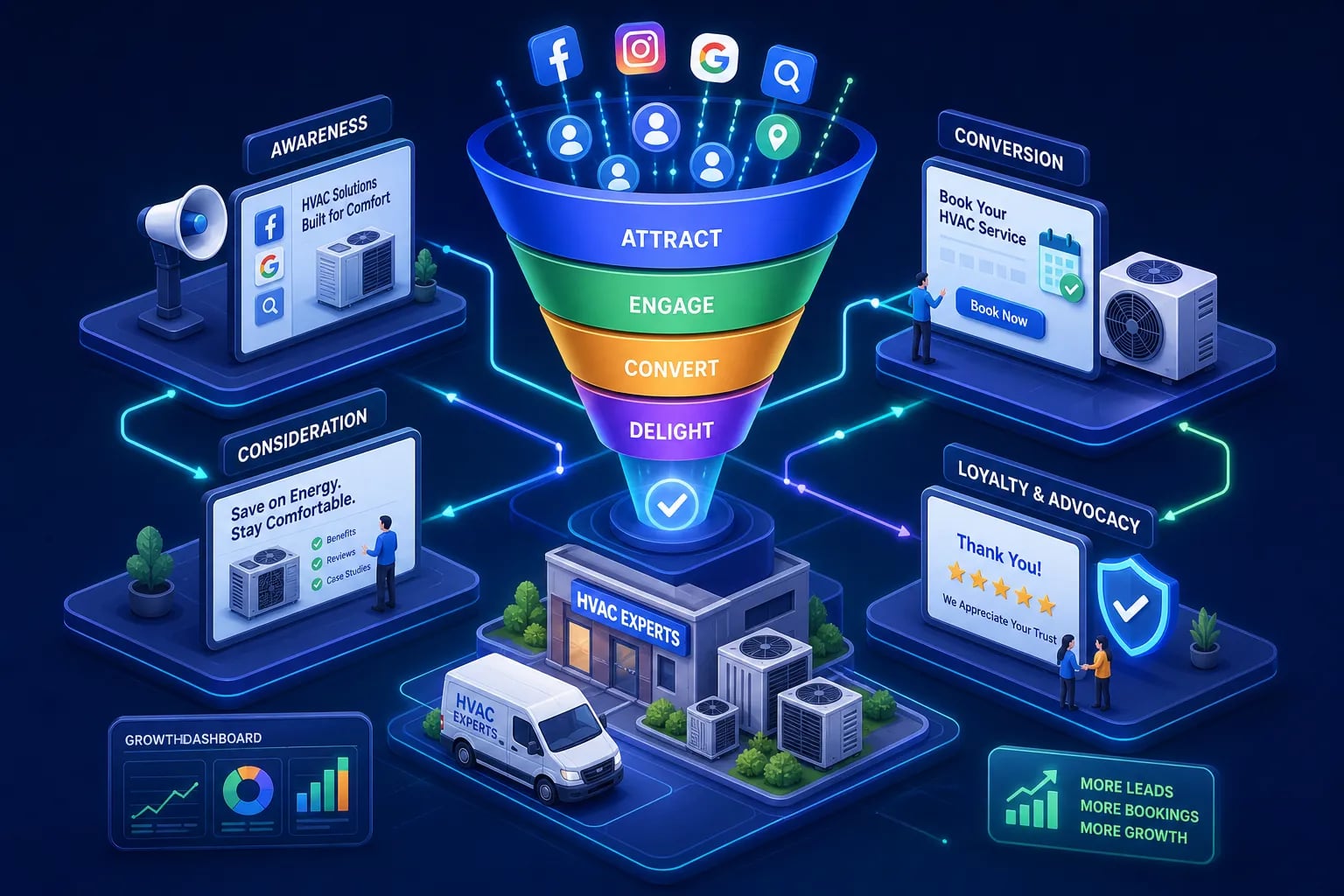
Before building any campaign, the smartest move is a diagnostic. At TW3 Marketing, the first thing we do with any HVAC client is run our TW3 Marketing Authority Audit™. It’s a proprietary 100-point assessment that shows exactly where your digital presence is leaking leads before you spend another dollar. Here’s the full-funnel HVAC marketing framework that works in 2026, starting where every serious plan should begin.
Why your HVAC marketing plan should start with a diagnosis
Skipping diagnosis and jumping straight to tactics is the fastest way to burn your marketing budget. Many HVAC companies repeat the same seasonal mistakes because they never identify the actual trust and visibility gaps costing them leads.
A common pattern: inconsistent authority signals scattered across a company’s digital presence, weak review profiles, generic content, and Google Business Profile listings that barely describe what they do. AI platforms like ChatGPT and Google AI now factor in trust signals, not just keywords, when recommending local businesses. Weak trust signals reduce organic and AI recommendation visibility even when paid ads are running, and paid channels can’t fully compensate for a leaky funnel.
TW3 Marketing Authority Audit™ scores six trust and authority signals using our internal methodology: positioning, proof, expertise, visibility, engagement, and experience. The output is a clear score and a prioritized roadmap, not a generic checklist. For HVAC companies specifically, the audit almost always reveals that review volume, GBP completeness, and content relevance are the most urgent gaps to fix before any channel spend makes sense.
Build your HVAC marketing strategy with local SEO first
Local SEO and Google Business Profile leads carry among the lowest cost-per-acquisition of any HVAC channel, often effectively near zero, and consistently rank among the highest-converting sources for local service businesses. This is where your foundation dollars go first, before paid search and before social.
GBP optimization steps
Your GBP is the single most important local marketing asset you own. Set the correct primary and secondary categories, list every service individually, confirm service areas and hours, and upload photos consistently. Weekly posts, especially seasonal ones, signal to Google that your profile is active.
Review recency and volume are directly tied to local 3-pack visibility. Aim for a steady cadence of 4 to 10 new reviews per month rather than one big push that goes stale. Required volume varies by market competitiveness, but consistency matters more than any single spike.
Local HVAC SEO checklist for service pages
Each core service paired with each target city needs its own dedicated page. Pages built around high-intent phrases like “furnace replacement [city]” consistently outperform generic homepage copy for both rankings and booking rates. Include pricing ranges or free-estimate CTAs on those pages. Industry data and internal client benchmarks suggest that visible pricing can lift conversions meaningfully, some estimates put the range as high as 28%, and it reduces the friction that sends a searcher to a competitor instead of you.
Turn your HVAC website into a booking machine
Most HVAC websites rank reasonably well yet still leave bookings on the table. Industry benchmarks put the average HVAC site conversion rate at roughly 2 to 5%, while dedicated landing pages built around specific search intent can reach 15 to 25% with the right elements in place.
The single most consistent conversion driver is a prominent, click-to-call phone number above the fold on every page. Sites with online booking forms tend to see meaningfully more conversions than phone-only CTAs, particularly for non-emergency requests where a homeowner wants to schedule at 10pm without calling anyone. Fast load times, mobile-first design, and sticky call buttons are table stakes at this point.
On trust signals: star ratings and written reviews placed near your main CTA reduce hesitation in a way that no headline can. FAQ content on service pages can increase the share of visitors who convert by moving them past common objections before they bounce. First-time visitors who don’t know your business yet need licensing callouts, insurance information, and trust badges before they’ll commit to booking. These HVAC marketing tactics cost nothing to implement and directly support every other channel investment you make.
HVAC marketing strategy for AI search visibility
A growing share of homeowners ask ChatGPT or trigger Google AI Overviews when searching for local HVAC help. If your business isn’t structured to appear in those results, you’re invisible to a fast-growing segment of buyers who are ready to book.
AI platforms look for structured expertise signals: detailed service content, consistent business information across the web, strong review profiles, and authoritative third-party mentions. HVAC companies that only optimized for traditional keyword rankings are increasingly absent from AI-generated recommendation results. As AI recommendation systems mature, that gap appears to be growing, making this an urgent HVAC lead generation priority, not a future consideration.
Publishing expertise-led content builds the authority signals AI systems use to evaluate credibility. Effective formats include:
- Seasonal maintenance guides tailored to your local climate
- Equipment comparison pages with brand-agnostic guidance
- Local climate considerations that demonstrate regional expertise
Consistent NAP data, structured data markup, and GBP completeness all feed into those recommendation signals. TW3 Marketing’s AI Website and Content Optimization service is designed specifically to close these gaps for HVAC operators who want to be recommended, not just ranked, and the focus on structured authority signals is what separates it from standard SEO work.
The retention stack that builds HVAC customer lifetime value
Acquiring a new HVAC customer is significantly more expensive than keeping one, a principle well-established across service industries. The companies that build real lifetime value don’t rely on one-time jobs. They use a retention stack that turns a single service call into years of recurring revenue.
Maintenance agreements as an HVAC service marketing foundation
Maintenance agreements anchor every high-performing HVAC retention strategy. According to industry research and TW3 client data, plan members return at substantially higher rates than on-demand-only customers, some benchmarks suggest retention rates near 89% versus roughly 42% for non-plan customers, though results vary by market and plan structure. A household with an active plan, a system replacement captured, and referrals generated can represent $20,000 to $35,000 in lifetime value, based on industry CLV models. Every other retention tactic exists to support plan enrollment and annual renewal.
Automated post-job follow-ups, seasonal tune-up reminders, and anniversary check-ins reduce churn without manual effort from your team. SMS works best for fast, timely nudges like appointment reminders and reactivation campaigns. Email is the better channel for longer-cycle nurture: annual system check reminders, equipment replacement education, and referral ask sequences that generate new HVAC leads from your happiest existing customers.
Build your 2026 HVAC marketing plan from a foundation that holds
A high-performing HVAC marketing strategy in 2026 isn’t one channel working in isolation. It’s a complete funnel: a strong local SEO foundation, a website that converts intent into bookings, AI visibility that puts you in front of next-generation searchers, and a retention system that compounds every customer relationship over time.
None of those investments perform the way they should if your underlying authority signals are weak. Spending more on HVAC advertising into a leaky funnel just accelerates the loss. Before you commit budget to any new push this season, start by running TW3 Marketing Authority Audit™. Know your score, know your gaps, and build your HVAC marketing strategy from a foundation that actually holds.
