
Credibility building is what determines whether a potential client picks up the phone or moves on to your competitor. A homeowner searching for a contractor, a business owner looking for an insurance agent, a property manager vetting a landscaping company: all of them are making a credibility judgment before they ever make contact. If your digital presence doesn’t answer that judgment clearly, the work you do every day won’t save you.
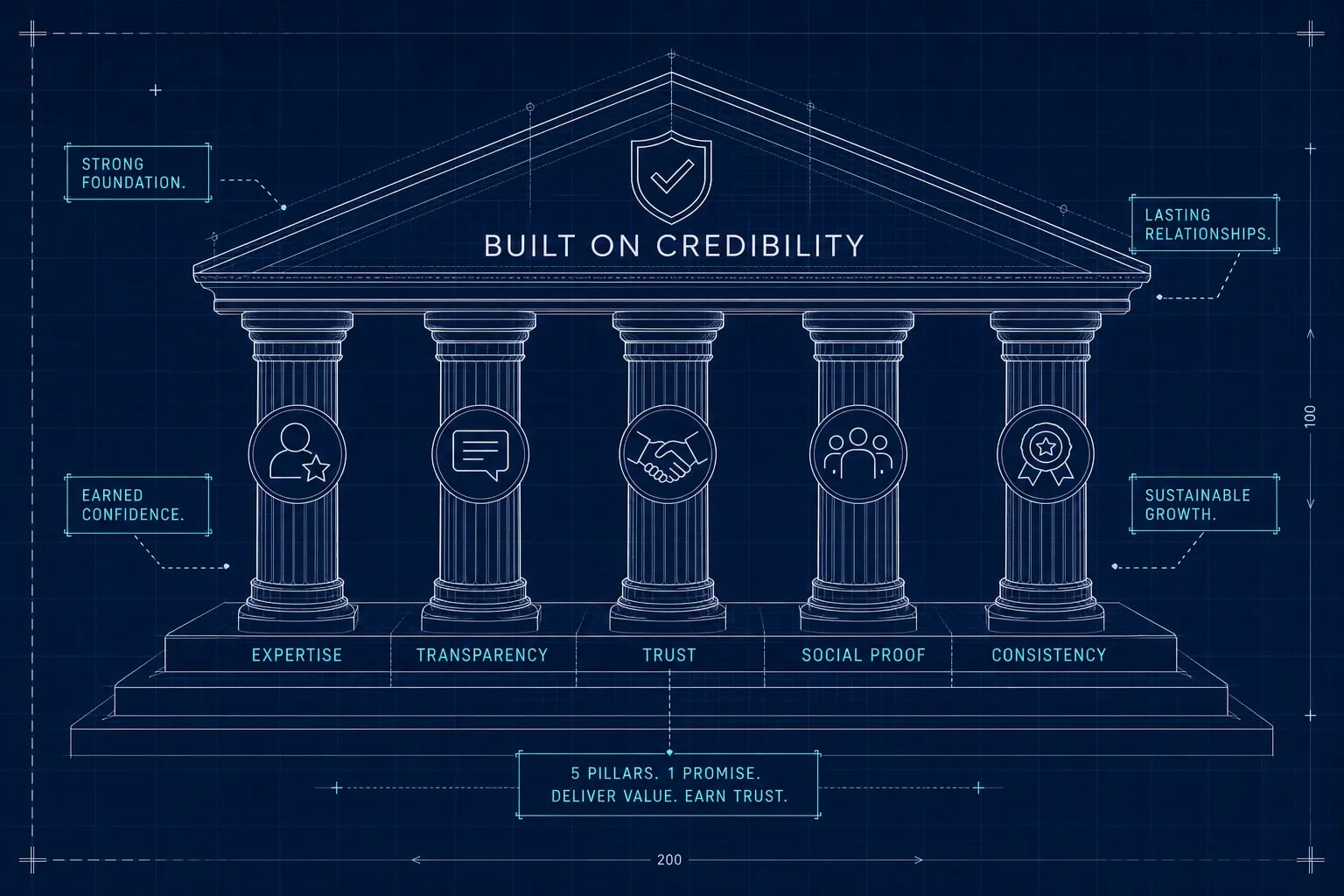
After running hundreds of businesses through TW3 Marketing Authority Audit™ process, the same five gaps show up repeatedly: thin reviews, absent case studies, no expert content, missing credentials, and inconsistent branding. These aren’t cosmetic problems. They’re the trust signals customers rely on to decide who’s worth calling. Fix all five, and your business looks like the obvious choice. Fix one or two, and you’re still losing clients you should be winning.
Why trust signals decide which service businesses actually win clients
Most service businesses assume their work speaks for itself. Digitally, it doesn’t. Customers evaluate credibility before they ever contact you, and the signals they look for are specific: reviews, visible proof, recognizable expertise. Consumers routinely favor evidence-backed sources over anonymous claims, a pattern visible across virtually every conversion study on service businesses. A service business without structured trust signals isn’t just less convincing; it’s invisible to the people doing the research.
The stakes are higher now because of how AI search has changed the evaluation process. Google AI Overviews, ChatGPT, and voice assistants don’t just pull up keywords. They appear to filter results based on authority signals, surfacing businesses that demonstrate structured credibility across their digital presence. A business with weak trust signals may not just rank lower, it risks being excluded from AI recommendations entirely, which means a growing share of high-intent prospects may never see it at all. For service businesses, online credibility is now table stakes, not a differentiator, but the baseline cost of being considered.
Credibility building through reviews and case studies
According to 2026 BrightLocal data, 97% of consumers read online reviews before hiring a local service business. That number alone makes reviews among the most important credibility tools available, and one that many service businesses underuse. What separates businesses that leverage reviews effectively from those that don’t isn’t volume; it’s specificity. Specific, outcome-focused reviews that name the problem solved and the measurable result achieved tend to be far more persuasive than a stack of generic five-star ratings. Build a simple post-project review request into your workflow, timed within 48 to 72 hours of project completion, and you’ll accumulate detailed social proof that compounds over time.
Case studies take that proof a step further. Where a review summarizes a client’s experience, a case study shows your process. The most persuasive structure is straightforward: the client’s original problem, the specific approach you took, and a quantifiable result. Even one well-written case study per quarter can build into a substantial credibility library over 12 months. That library does something no ad copy can: it lets prospects see themselves in a client’s situation and recognize that you’ve already solved exactly their problem.
Credibility building through expert content and certifications
Expert content is credibility in written form. A service business that publishes useful, specific guidance on its niche demonstrates expertise before a prospect ever reaches out. The content doesn’t need to be exhaustive, a focused article answering a common client question does more for establishing professional reputation than a vague company blog post. Consistent publishing also signals to search platforms and AI systems that your business is an active, knowledgeable source in its category, which may influence how often you appear in AI-generated recommendations.
Industry certifications and professional affiliations work differently but serve the same purpose: they answer the “are you qualified?” question before it gets asked. Customers trust certifications because they represent third-party validation, not just your own claims.
The trust effect is strongest in high-stakes service categories like home services, security, and healthcare, where a bad hire has real consequences. Brand consistency reinforces both: when your logo, color palette, tone, and messaging align across your website, Google Business Profile, and social channels, the business looks organized and stable. Even minor inconsistencies can quietly erode trust. Together, credentials and visual consistency tell a coherent story: this business is serious, established, and worth trusting.
A structured approach: the framework that ties all five pillars together
Most service businesses work on credibility in fragments, fixing reviews one month, updating their website the next, then letting both slide. Without a structure connecting the pieces, gaps keep reappearing and the business never reaches the threshold where customers consistently choose it first. Piecemeal tactics produce piecemeal results.
TW3 Marketing’s Authority Framework™ addresses this by organizing all five pillars around six core signals: positioning, proof, expertise, visibility, engagement, and experience. These aren’t separate checklists. They’re interdependent factors that reinforce each other when they’re all strong. The framework was developed from patterns observed across 4,500+ clients in 70 industries, an internal dataset that gives it a diagnostic precision that generic marketing advice doesn’t have. When one signal is weak, it typically drags the others down with it.
The same signals that make a business look credible to human prospects are the signals AI platforms appear to use when deciding which businesses to surface. Strengthening these six factors builds trust with visitors and may also improve how AI systems like ChatGPT and Google AI evaluate your business. For service businesses competing in local markets, that dual benefit makes a structured approach worth prioritizing over any single tactic.
Where to start your credibility building plan
The five pillars covered here, reviews, case studies, expert content, certifications, and consistent branding, aren’t separate projects. They’re a system. Addressing all five trust gaps together is what moves a business from “looks decent” to “obvious choice.” These credibility building efforts compound each other; working on just one or two rarely delivers the same shift.
Before investing more in ads or campaigns, find out where your authority signals actually stand. TW3 Marketing’s Authority Score™ Check gives you a clear picture of how your business currently appears to both customers and AI platforms, including which of the five pillars are strongest and which are costing you clients. Results typically come back within 48 hours. Reach out to the TW3 Marketing team to get your Authority Score™ Check started and put your credibility building on a structured path forward.
