
The best trust signals for local service business websites in 2026 are often deployed wrong: buried in footers, formatted in ways AI systems can’t parse, or outdated enough to actively work against you. Most local service sites have some visible trust elements, but having reviews isn’t the same as sending trust signals effectively. That distinction is quietly costing businesses leads they never know they lost.
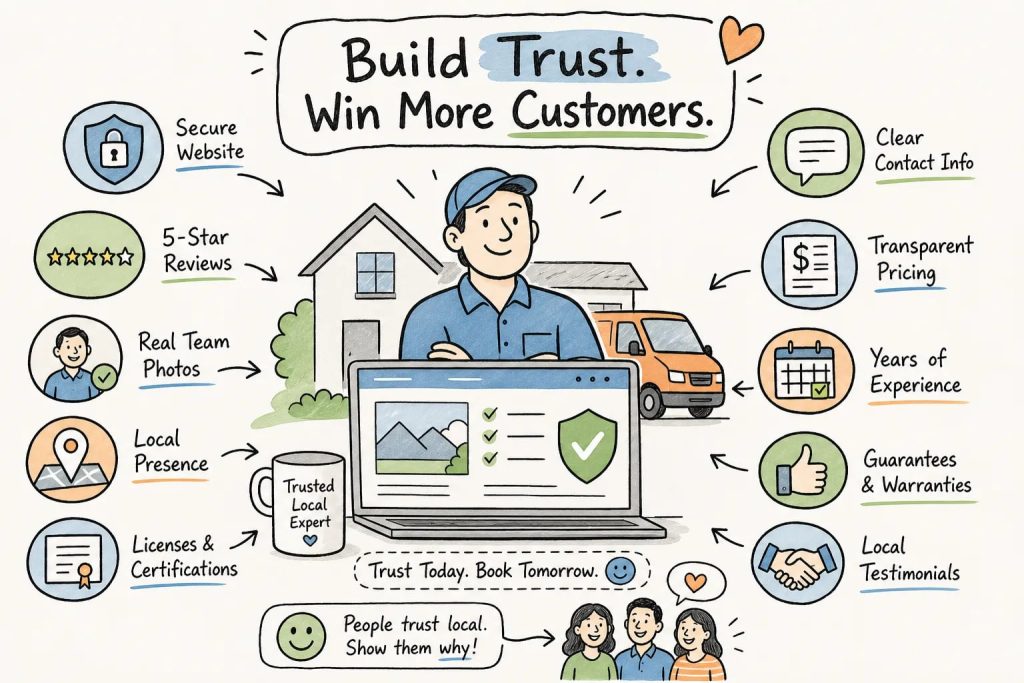
The data makes the stakes clear. Seventy-four percent of consumers cite reviews as a key trust factor (per BrightLocal’s 2026 Consumer Review Survey), and 85% say positive reviews make them more likely to hire a local service business. But if those reviews are stale, missing from key pages, or not supported by machine-readable structure, they’re doing a fraction of the work they could. This guide covers the 10 trust signals that actually move the needle for local service businesses, where to put them, and how to tell which ones your site is genuinely sending.
Reviews are still the single biggest trust lever for local service businesses
Ninety-two percent of consumers say star ratings influence their choice. Thirty-one percent only consider businesses rated 4.5 or higher, and 68% won’t look at anything below 4.0. These thresholds matter because they determine whether your business gets considered at all, not just whether you get chosen.
Volume is a credibility gate too. Forty-seven percent of consumers refuse to consider a business with fewer than 20 reviews. In competitive local markets, 50 or more is a more realistic floor, and metro areas for high-consideration categories like HVAC, roofing, or legal services often require 100 or more to compete meaningfully for local pack placement, though no fixed minimum applies universally across all markets.
The review freshness problem most businesses ignore
Seventy-three percent of consumers only trust reviews from the last month (BrightLocal). When 73% of your potential customers are filtering by recency, a 150-review profile with an eight-month-old most recent review is working against you, not for you. Recency isn’t a nice-to-have; it’s a filter that can eliminate you before a customer ever reads your content. The fix is systematic, build a post-job review request process that generates a consistent flow, not periodic spikes.
Where reviews actually convert on your website
Placement determines whether your reviews do any conversion work at all. The highest-performing positions are the hero section (star summary plus review count), adjacent to the primary CTA on service pages, and near the contact form. Copy like “Rated 4.9/5 by 200+ local homeowners” placed directly next to “Request a Free Estimate” is a stronger conversion driver than the same information buried in a testimonials section, a best practice backed by conversion rate research on social proof for local services. Combining photo content with verified written reviews yields a documented 34% conversion advantage over text alone.
Credential signals that tell visitors, and AI, you’re legitimate
Forty-one percent of consumers perceive businesses with websites as more trustworthy than those without, and 69% say a website is essential for a local business to have credibility at all. But a site’s credibility depends on what’s actually on it. Licenses, insurance documentation, association memberships, and team photos form the credential layer that separates a legitimate operation from an anonymous service provider.
These signals serve two audiences at once. Human visitors use them to reduce purchase risk. AI systems like Google AI Overviews and ChatGPT use them to verify that a business is a real, established entity worth recommending. Credential signals that live only in your footer or only on your About page aren’t carrying enough weight.
Before-and-after proof and local case studies
Twenty-two percent of consumers specifically want before-and-after photos when evaluating a local service business. Generic gallery images don’t carry the same weight because they don’t answer the core question: “Will this company actually solve my problem?” A simple case study format works well, problem, service performed, outcome, city attribution. “Roof replacement in Denver, CO, completed in two days” is more persuasive than a polished photo with no context.
Customer-created content converts 6.73x better than brand-created content across documented studies (Bazaarvoice Benchmark Report), which is reason enough to prioritize real, documented outcomes over stock-quality shots. Results can vary by category and market, but the directional advantage of authentic proof is consistent across local service verticals.
Credential placement that removes hesitation at the decision point
Licenses and insurance confirmation belong in the hero or header, not the footer. Association badges perform best near the CTA. Team photos belong on the About and contact pages, because human faces measurably reduce perceived risk. Trust copy like “Licensed, insured, and serving [city] since 2014” placed near your primary form outperforms the same wording two scrolls away from where the actual decision happens.
Schema markup: a core trust signal for local service business websites in 2026
Schema is where most local service sites fall shortest. Structured data is a dual-purpose signal: it improves rich result eligibility in Google search, and it makes your authority signals machine-readable to AI systems that can’t interpret a webpage the way a human does. Without schema, your other signals are significantly harder for AI and search platforms to parse and corroborate, which matters more every year as AI-driven discovery grows.
Setting up aggregateRating schema correctly
Use JSON-LD format and the most specific LocalBusiness subtype available for your category: Plumber, HVACBusiness, Roofer, Dentist, not a generic LocalBusiness type. Only mark up reviews that are visibly displayed on the page. The common mistake is pulling Google or Yelp aggregate ratings into schema when those platform reviews aren’t shown on-page. Per Google’s structured data guidelines, this can make your markup ineligible for rich results or trigger suppression, outcomes that undercut the local SEO trust indicators you’re trying to build.
A compliant implementation includes ratingValue, reviewCount, and at least one Review object with author, datePublished, reviewBody, and reviewRating. Keep datePublished accurate and consistent with the reviews displayed on the page. Here’s a simplified example:
{
  "@context": "https://schema.org",
  "@type": "Plumber",
  "name": "Example Plumbing Co.",
  "aggregateRating": {
    "@type": "AggregateRating",
    "ratingValue": "4.9",
    "reviewCount": "87",
    "bestRating": "5",
    "worstRating": "1"
  },
  "review": [
    {
      "@type": "Review",
      "author": { "@type": "Person", "name": "Mark R." },
      "datePublished": "2026-08-15",
      "reviewBody": "Fast, clean, and fixed the leak same day.",
      "reviewRating": {
        "@type": "Rating",
        "ratingValue": "5",
        "bestRating": "5",
        "worstRating": "1"
      }
    }
  ]
}
After implementing, validate your markup using Google’s Rich Results Test or the Schema.org validator to confirm eligibility before relying on it as a local SEO trust indicator.
Why structured data is a trust signal for AI, not just search engines
AI platforms build their understanding of a local business by cross-referencing structured listings, consistent NAP data, review signals, and third-party mentions. A site without schema gives those systems no reliable structured authority to reference. When a potential customer asks ChatGPT “who’s the best HVAC company near me,” businesses with clear, consistent, machine-readable signals have a structural advantage. Schema is the foundation that makes every other credibility marker on this list visible to the platforms now influencing a growing share of local purchase decisions.
How to test the best trust signals for local service business websites in 2026
Most business owners assume their site has solid trust signals because they’ve put in the work: some Google reviews on the homepage, a credentials section, a few photos. But having elements isn’t the same as systematically sending the signals AI and search engines use to evaluate authority. Research suggests most service websites are missing three to five core authority signals entirely, even after years of marketing investment.
The gap isn’t always obvious. An HVAC company can have solid reviews, an active Google Business Profile, and a legitimate local reputation, but no schema markup, no credential signals on individual service pages, and no AI-readable content structure. Their trust signals exist. They just aren’t being transmitted in formats that the systems driving recommendations can actually verify.
A structured audit is the clearest way to see where your site stands. TW3 Marketing Authority Audit™ is a 100-point diagnostic that identifies which trust and authority signals your local service website is currently sending, across six core factors including positioning, proof, expertise, and visibility. To get a clear picture of which of these signals your site is actually delivering, reach out to TW3 Marketing to get started with the TW3 Marketing Authority Audit™.
Start with the gaps that cost the most leads
The trust signal hierarchy for local service businesses in 2026 is straightforward: review freshness and volume first, website credibility and credentials second, schema and AI-readable structure third. The goal isn’t to add every signal at once, it’s to identify which gaps are actively costing you leads and address those first.
Knowing your trust signal score is the starting point, not the finish line. Most local service businesses haven’t reached that starting point yet. That means the gap between where your site stands and where it needs to be is likely wider than you think. Start with an honest audit, fix the highest-impact gaps, and build from there, because implementing the best trust signals for local service business websites in 2026 is one of the highest-return improvements a local service business can make to its digital presence.
