
Many professional service firms have spent years building Google visibility, only to open ChatGPT or Perplexity and find competitors they’ve never heard of getting recommended instead. That gap appears to be growing, and the reason isn’t that your competitors suddenly got better. AI engines run on a completely different set of signals than the SEO playbook most businesses know, and ai search visibility in those platforms is determined by criteria your current strategy may not address at all.
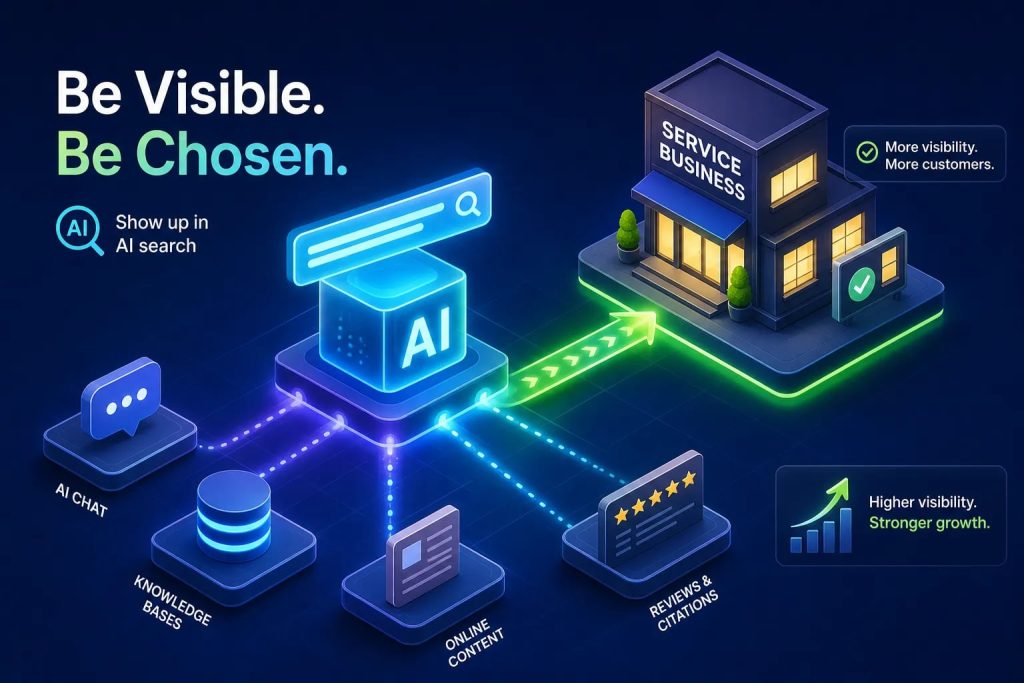
Understanding how your firm appears in AI-generated answers, and how to improve that standing, is one of the most practical decisions you can make right now. This article explains what that visibility actually means, why it behaves nothing like traditional search, and which signals move the needle for service businesses.
What AI search visibility actually means
Traditional search engines rank pages and return a list of links. AI engines do something different: they synthesize an answer and name specific businesses, people, or resources as the recommended choice. Your AI search visibility is the degree to which your firm appears in those synthesized answers when a buyer asks a relevant question.
The mechanics vary by platform. Perplexity is designed to show inline source citations with every response. ChatGPT includes source references primarily when its browsing or search mode is active, and Google AI Overviews cite sources when grounded in Search results, so both may mention a business by name in the answer itself, sometimes without a prominent clickable link to your site. Behavior varies by mode and query type, but in both cases, the underlying driver is the same: signals your firm either has or doesn’t have right now.
Professional service firms are especially exposed here. Buyers ask AI assistants high-stakes questions: “Who is the best independent insurance advisor in [city]?” or “What should I look for in a business consultant?” AI engines are generating answers to those questions right now. If your firm has no footprint in the sources AI systems draw from, you’re not part of the conversation, regardless of how well you rank in Google.
How AI search visibility differs from traditional Google SEO
Google’s ranking system leans on backlinks, page speed, and keyword relevance. AI engines make a different judgment. They ask whether your business is described consistently across the web, whether your expertise is documented and verifiable, and whether credible third-party sources reference you as an authority. A firm can rank on page one of Google and still be invisible to AI if its trust signals are thin or contradictory.
The shift is from page authority to entity authority. In traditional SEO, authority lives at the domain and page level. In AI search, authority attaches to the entity: your firm’s name, specialization, location, and the claims made about you across the web. AI engines build a picture of who you are from your website, your reviews, your mentions in publications, and how consistently all of those sources agree. Gaps or contradictions in that picture reduce how often you’re cited, even when individual pages perform well.
Many established firms lose ground here precisely because of that distinction. They’ve invested in a website and some SEO, but the external corroboration that AI systems use to verify expertise simply isn’t there. The missing piece isn’t more content, it’s verified, consistent, third-party confirmation of the expertise they already have.
The signals AI engines use to surface service businesses
Two categories of signals drive most of the variation in AI citations for service firms: answer-ready content and third-party corroboration. Getting both right is what separates firms that show up in AI-generated answers from those that don’t.
Answer-ready content
AI engines favor pages that directly answer buyer questions. Pages built around specific questions, definitions, and clear process explanations are far more likely to be cited than pages full of vague, marketing-heavy copy. Each service you offer deserves its own dedicated page, structured so an AI can extract a complete answer without interpretation. Entity clarity matters just as much: your firm’s name, specialization, and service area need to be described consistently across your site, Google Business Profile, directories, and any third-party mentions.
A few practical steps make a measurable difference. Write each service page with a clear, question-led headline. Open with a direct definition or answer, don’t bury it. Add an FAQ section that mirrors the exact language buyers use when asking AI assistants. And consider implementing structured data markup (LocalBusiness, Article, or FAQ schema) so AI engines and search platforms can verify entity-level details like your firm name, location, and service area without ambiguity.
Third-party corroboration
AI engines weigh whether your claimed expertise is confirmed by sources they already trust. Verified reviews, editorial mentions, partner references, published case studies, and consistent directory listings all contribute to that signal. For professional service firms, earned trust carries more weight than self-reported claims. Content freshness matters too: pages with visible last-updated dates tend to perform better in AI citations, especially for time-sensitive advisory topics like insurance, financial planning, or legal services where recency signals accuracy.
Building this signal takes deliberate effort: pursue earned media placements, request reviews on platforms AI systems index, keep your directory listings consistent, and publish case studies that document specific client outcomes. Each of those actions adds a data point that helps AI engines validate the expertise you’re claiming on your own site.
How to measure your firm’s AI search visibility right now
Running a few searches in ChatGPT or Perplexity gives you an impression, but it doesn’t tell you which specific signals are missing, how you compare to competitors in AI-generated answers, or which pages AI systems are actually citing. Without a structured baseline, any changes you make are guesswork.
TW3 Marketing’s Authority Score™ Check is a fast, structured assessment that shows service businesses where they currently stand in AI-generated answers, which signals are working, and where the gaps are. You receive a clear picture of how AI engines currently perceive your firm’s authority, including which pages and third-party sources are being cited or ignored, and the highest-leverage steps to improve your standing. Delivery is typically within 48 hours of engagement.
This is distinct from the full TW3 Marketing Authority Audit™, which delivers a comprehensive 100-point assessment and a prioritized roadmap. The Authority Score™ Check is the right first step if you want to understand where you actually stand before committing to a full program, concrete answers without a major time investment on either side.
Build AI visibility before your competitors figure this out
AI search visibility is not SEO by another name. It runs on a different signal set, one that most SEO playbooks don’t track, and the firms that build those signals now will be the ones AI engines recommend when buyers make high-stakes decisions. For service businesses that have spent years building expertise and client relationships, the gap between deserving recognition and receiving it from AI often comes down to three fixable problems: missing trust signals, inconsistent entity information, and content that wasn’t structured to answer buyer questions directly.
Knowing where you stand is the starting point. Contact TW3 Marketing to get your Authority Score™ Check and have a clear picture of your firm’s AI brand visibility within a typical 48-hour turnaround. The firms taking that step now are the ones building an advantage that compounds over time.
