
Picture this: a consulting firm ranks on the first page of Google for half a dozen competitive keywords. Strong reviews, a polished website, years of client work documented in case studies. Then a prospective client opens ChatGPT and types, “Who are the best strategy consultants for mid-market manufacturing companies?” The firm doesn’t appear. Not once. A competitor with a smaller online footprint and fewer backlinks gets recommended instead. For many service firms, ChatGPT SEO is already reshaping how buyers find and act on recommendations, and most businesses haven’t caught up.
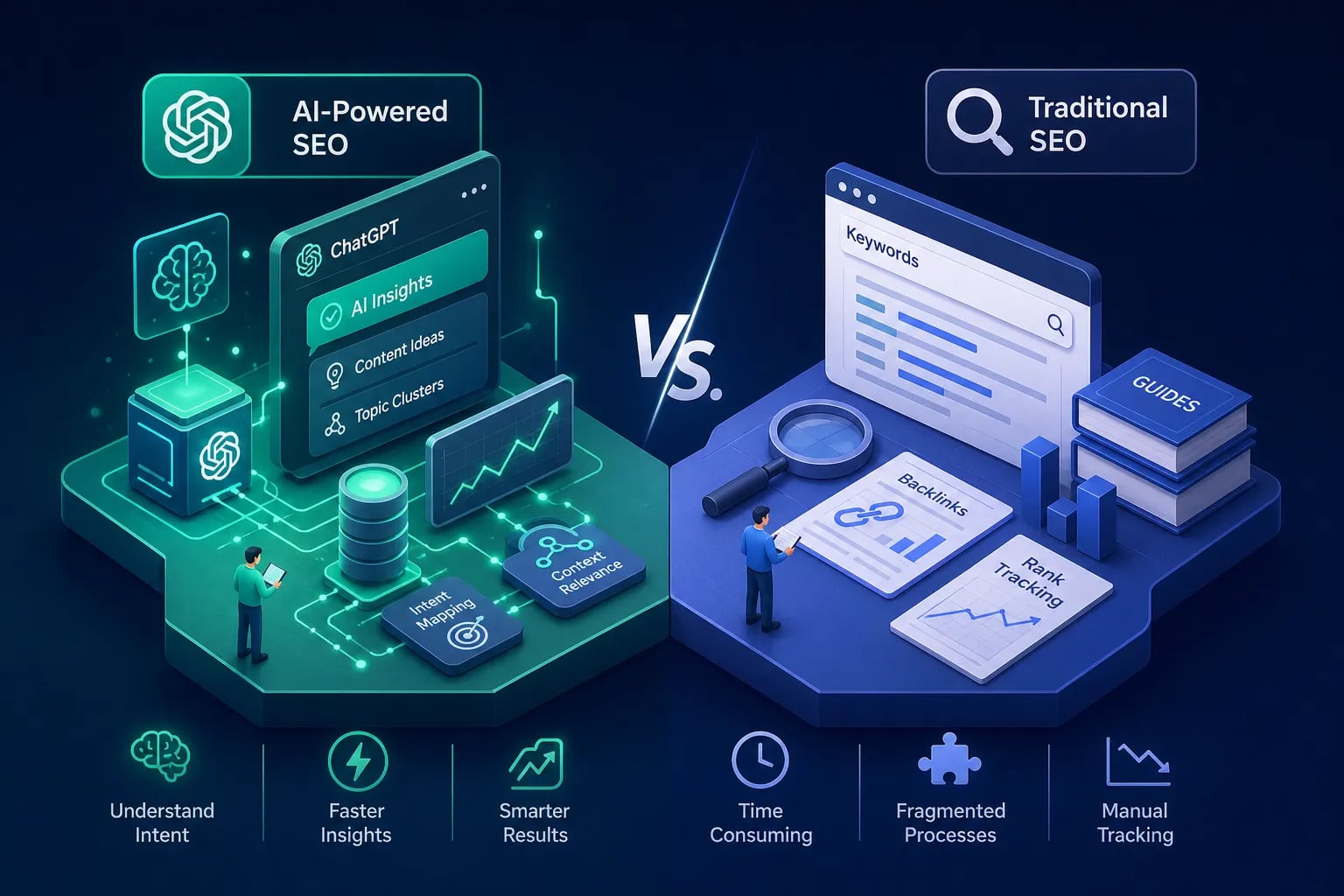
This scenario plays out constantly, and it exposes a real gap. Optimizing for Google rankings and optimizing for AI recommendation are not the same discipline. They reward different signals, follow different logic, and require different approaches. TW3 Marketing has already restructured its optimization framework to reflect this reality, helping professional firms close the gap before competitors do.
How ChatGPT SEO differs from traditional Google search
Google’s job is to rank a list of pages for a user to browse and evaluate. ChatGPT’s job is to synthesize a single answer and cite the sources that best support each claim inside that answer. One system puts you on a list; the other either includes your content in the answer or ignores you entirely. Understanding that distinction is the starting point for any effective AI SEO strategy.
Google ranks pages; ChatGPT extracts passages
When ChatGPT retrieves information, it scans candidate pages for relevant passages and selects only what directly supports the answer it’s building. Selection happens at the passage level, not the page level. A business that ranks third on Google but buries its core expertise under three paragraphs of marketing copy may never contribute a single cited sentence to an AI-generated response. Getting cited by ChatGPT depends far more on how clearly your content is structured than on where it ranks.
What this means for content structure
Traditional SEO rewards comprehensive, link-rich content. AI SEO rewards clear, extractable answers positioned near the top of the page. Answer-first structure, question-shaped headings, concise factual statements, and supporting evidence shift the optimization target entirely. A long-form resource that meanders before reaching its main point is a liability in AI retrieval, regardless of how well it ranks organically. The goal is to optimize content for AI answers, which means front-loading clarity, not burying it.
What signals ChatGPT uses to recommend a business
Based on observed citation behavior across ChatGPT, Perplexity, and Google AI Overviews, five factors consistently drive whether a business gets cited: query relevance, passage extractability, entity credibility, third-party corroboration, and content freshness. Understanding each one matters because the levers differ significantly from what traditional SEO work has targeted.
Entity credibility and third-party validation
ChatGPT doesn’t rely primarily on backlinks the way Google does. It evaluates whether a business is described consistently across independent sources: review platforms, industry directories, press mentions, comparison sites, and professional associations. A business that only controls its own website sends a weaker entity signal than one that appears authoritatively across multiple sources. Consistent name, specialization, credentials, and client outcomes across these platforms strengthen the recognition that AI engines use to validate a recommendation, and they’re central to any serious AI-generated content best practices checklist.
Answer-fit and content freshness
A page must directly and unambiguously answer the question the AI system is generating. Freshness matters too. For professional services where details change, credentials, specializations, service scope, outdated pages lose ground to current ones regardless of domain authority. An insurance agency that hasn’t updated its specialty pages in two years may be passed over for a competitor with a more current and specific description of its expertise.
How does ChatGPT SEO affect optimization steps for service businesses?
The goal is to make your expertise easy for AI systems to find, verify, and extract. That requires changes both on your website and across the platforms where your business is described by others.
Structure pages to answer specific client questions
Identify the 10 to 15 questions your ideal clients ask at each stage of the buying decision, then publish clear, answer-first content for each one. Headings framed as questions, concise lead paragraphs, and supporting evidence, client outcomes, credentials, case results, increase the chance that your content gets extracted and cited. Comparison tables and FAQ sections are particularly effective formats because each element is self-contained and easy to lift directly into an AI-generated response. Building a fixed ChatGPT prompts for SEO library using these same questions helps you test and refine your content over time.
Build consistent authority signals off your own website
Audit how your business appears across your Google Business Profile, professional directories, review platforms, and industry publications. Inconsistencies in your name, specialization, or service descriptions reduce AI confidence in recommending you. Genuine, detailed reviews that describe specific outcomes carry more weight than generic star ratings. Earning mentions in editorial roundups, professional associations, and credible third-party sources builds the independent corroboration that AI engines use to validate a business recommendation.
Why an AI-first diagnostic framework changes the outcome
Traditional SEO agencies track domain authority, keyword positions, and backlinks. Those metrics matter for Google rankings, but they don’t tell you whether your entity is credible to AI systems, whether your content is extractable, or whether your specialization is clear enough for an AI engine to confidently recommend you over a competitor.
TW3 Marketing’s Authority Framework evaluates positioning clarity, expert proof, third-party credibility, and content extractability, mapping directly onto what AI engines need to make a confident recommendation. A firm with strong rankings but vague expertise signals and weak entity presence will rank but won’t get recommended. The firms that get recommended have built all the signals, not just the traditional ones.
A consulting practice that completes an AI-first audit typically makes specific changes: clearer specialization language on every page, structured proof in the form of client outcomes and credentials, consistent entity presence across third-party platforms, and content that answers buying-stage questions directly. Those aren’t abstract improvements, they’re the concrete moves that shift a firm from invisible to cited.
How to measure whether AI engines are citing your business
Measurement starts with a fixed prompt library. Build 10 to 15 priority prompts that mirror the actual questions your prospects ask, service queries, comparison questions, and problem-solving questions. Run them weekly across ChatGPT, Perplexity, Gemini, and Google AI Overviews. Log three outcomes for each: cited with a link, mentioned without one, or absent entirely. Each outcome calls for a different response, and tracking the pattern over time reveals where your ChatGPT SEO efforts are gaining traction.
Why do these specific metrics matter? Because they connect AI visibility to actual business impact rather than vanity counts. Tools like Semrush AI Visibility, Ahrefs Brand Radar, and Otterly.ai track mention rate, citation rate, cited-page distribution, and share of voice against competitors. For each session, record which URLs are cited, whether competitor pages appear when yours don’t, and whether your brand is described accurately. Connect AI citation activity to GA4 referral sessions and branded search growth to understand business impact, not just visibility. A useful baseline dashboard shows mention rate, citation rate, top cited URLs, AI-referred sessions, and conversion rate by cited page.
The shift is already underway
Optimizing for AI recommendation is not a smarter version of Google SEO. It is a different system rewarding different signals. Service businesses that treat it as an extension of traditional optimization will remain invisible to a growing share of their prospects, specifically the ones who start their research in a chat window instead of a search bar.
The firms that adapt are the ones AI engines confidently recommend. They build clear expertise signals, consistent entity presence across independent sources, and answer-first content that AI systems can extract and cite. If you want a clear picture of where your business stands on these ChatGPT SEO signals, TW3 Marketing Authority Audit™ is a logical starting point. It identifies exactly the gaps that keep established firms out of AI-generated answers and delivers a prioritized roadmap for closing them.
