
Answer engine optimization for local service businesses in 2026 means structuring your content, entity data, and trust signals so AI systems like Google AI Overviews, ChatGPT, and Perplexity can identify, verify, and recommend your business in a direct answer. For searches like “best emergency plumber near me” or “HVAC company that installs heat pumps in [city],” AI-generated answers are increasingly appearing alongside, and sometimes instead of, traditional ranked link lists, particularly for transactional and service-based queries. Businesses cited in those AI answers are more likely to receive calls and zero-click conversions; businesses not mentioned may see fewer AI-driven leads.
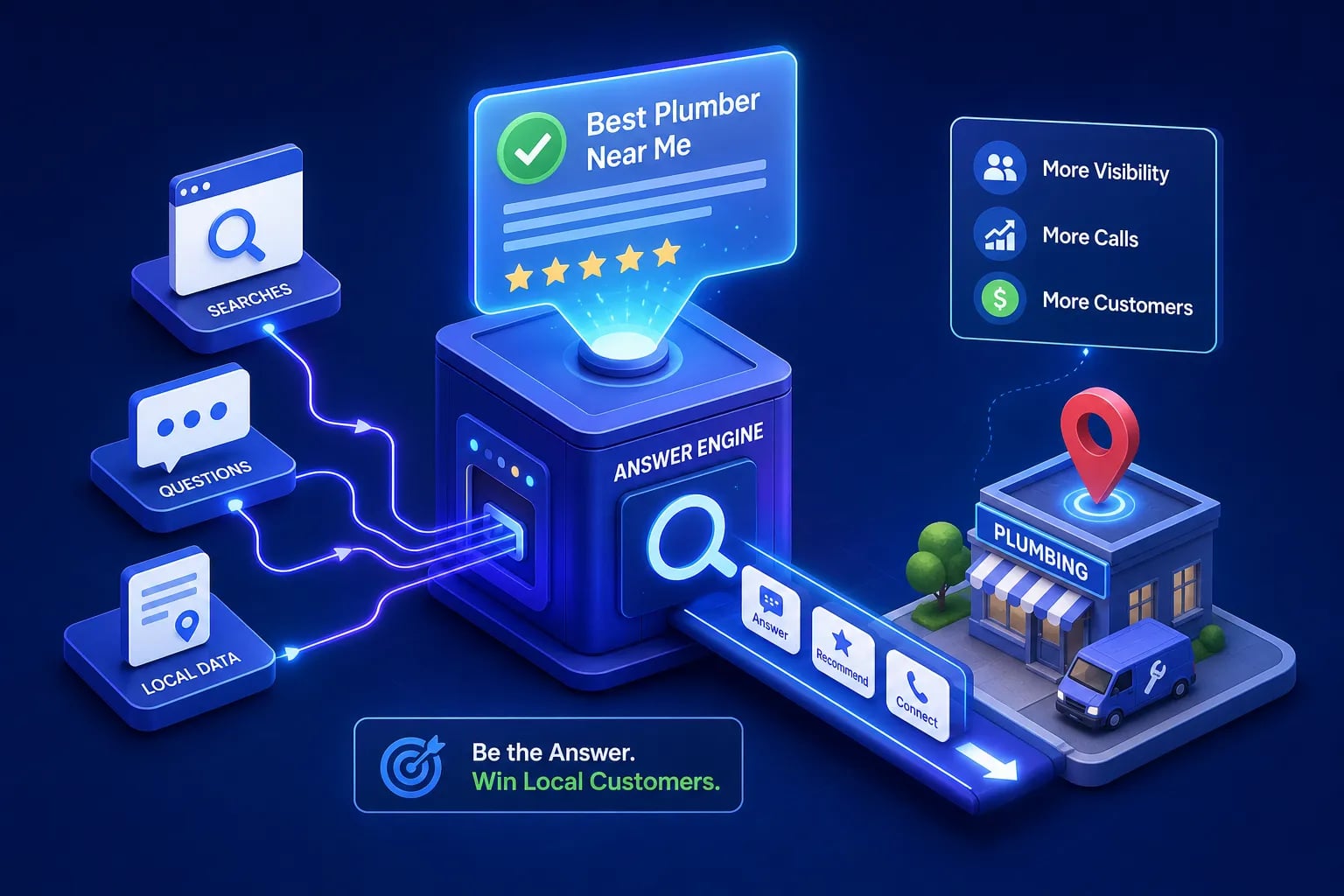
This guide covers the four implementation areas that determine whether your service business gets cited or skipped: content format, structured data, trust signals, and entity consistency. These four areas align with core elements of TW3 Marketing’s Authority Framework, and we’ll use that lens throughout to show you where the gaps typically are and how to close them.
Key takeaways
- AEO and local SEO are not the same: Local SEO competes for position and clicks; answer engine optimization for local service businesses competes for inclusion in the AI-generated answer itself. You need both strategies.
- Content format is the first lever: AI systems extract self-contained, answer-first passages. Question-based headings followed by concise 40–60 word answers perform consistently well.
- Specific schema beats generic schema: Use the most precise LocalBusiness subtype available (Plumber, HVACBusiness, RoofingContractor) and build one canonical entity on your homepage.
- Review text supplies evidence: A review mentioning “same-day water heater replacement in North Austin” reinforces both the service entity and geographic relevance for AI systems.
- Entity consistency reduces AI ambiguity: Inconsistent name, address, phone, hours, or service area data across your website, GBP, schema, and directories lowers AI confidence in recommending you.
- Measuring AEO performance does not require enterprise tools: A fixed set of 15–30 tracked prompts run monthly across ChatGPT, Perplexity, and Google AI Overviews gives you actionable trend data.
How AEO differs from local SEO for service businesses
Traditional local SEO competes for position: map-pack placement, proximity relevance, keyword rankings, and click-through from a results page. The primary signals are your Google Business Profile completeness, citations, backlinks, and review volume. It answers the question “is this business nearby and relevant?”
AEO competes for inclusion in the answer itself. An AI system needs to verify who your business is, what you specifically do, where you serve, and whether third-party sources corroborate those claims. The query shifts from “plumber near me” to “who is the best emergency plumber in Austin available on weekends?” and the answer engine decides which businesses to name. You need both strategies, but they’re not the same work.
| Area | Traditional local SEO | AEO in 2026 |
|---|---|---|
| Primary objective | Rank a webpage or map listing for location-based searches | Become the business cited or recommended in an AI-generated answer |
| Typical query | “Plumber near me” | “Who is the best emergency plumber in Austin for a weekend repair?” |
| Main platforms | Google local packs, maps, and blue-link results | AI Overviews, ChatGPT, Perplexity, Gemini, voice interfaces |
| Content emphasis | Local keywords, proximity, reviews, citations, backlinks | Direct answers, FAQs, clear entity data, consistent structured information |
| Key metrics | Map-pack visibility, rankings, calls, website visits | AI mentions, citation rate, answer accuracy, AI-referred leads |
What content formats AI actually pulls from
AI systems consistently surface self-contained, answer-first passages. The strongest format is a customer question as an H2 heading, followed immediately by a 40–60 word direct answer, then two or three supporting sentences with specifics. Vague paragraph text buried in long service-page copy rarely gets extracted. Your service pages need question-based headings that mirror how customers speak to voice assistants and AI search, this is the foundation of answer-ready content for local AEO strategies.
Each service page should include the following extractable elements:
- A short FAQ block covering cost, timing, service area, availability, and emergency access
- A cost callout with a concrete range and its qualifiers
- A local-availability statement naming specific cities and neighborhoods
- A how-to snippet for preparation or troubleshooting
These formats give AI systems answer-bounded passages tied to real service and location data, exactly the kind of structured content AI search optimization rewards.
Which schema types should service businesses implement first
Start with a specific LocalBusiness subtype rather than the generic type. HVAC companies should use HVACBusiness, plumbers should use Plumber, and roofing contractors should use RoofingContractor. Build one canonical entity on your homepage, then add a separate Service entity for each distinct offering, naming the service, stating the provider, listing the service area, and noting pricing where it genuinely appears on the page.
Complete the stack with FAQPage markup only for questions and answers visibly present on the page, plus Organization, BreadcrumbList, and AggregateRating only if you’re eligible and compliant. Schema defines your business entity for AI systems, but it doesn’t replace content quality or third-party corroboration. Keep your name, address, phone number, hours, and service areas identical across your website, GBP, schema markup, and major directories. Inconsistency creates ambiguity; ambiguity reduces AI confidence in recommending you. Structured data for local businesses only delivers full value when it reinforces what your content and citations already say.
How reviews, GBP, and citations affect AI recommendations
A fully complete and verified Google Business Profile gives AI systems a structured, trusted entity record: primary category, services, service area, hours, booking links, and attributes. For AEO, the profile needs to explicitly name each major service and keep service-area information current and specific. The profile directly supports zero-click optimization outcomes, calls, direction requests, and appointment bookings that resolve without a website visit.
Review text supplies natural-language evidence about services, locations, response times, and outcomes. A review mentioning “same-day water heater replacement in North Austin” reinforces both the service entity and geographic relevance in ways a five-star rating alone cannot. Citation accuracy across directories validates your business entity across the web. Consistent NAP data and authentic, specific, recent reviews signal to AI systems that your business is real, trustworthy, and worth recommending.
Answer engine optimization for local service businesses in 2026: closing your gaps before a competitor does
Most service businesses have done some local SEO work, but answer engine optimization for local service businesses requires deliberate content and entity-level decisions that basic SEO checklists don’t address. Before building new pages or adding schema, run a diagnostic pass. Check whether your service pages answer specific customer questions or only describe offerings. Confirm that your business entity data matches across your website, GBP, and major directories. Identify which services lack dedicated FAQ content and which citations contain outdated information.
Start with the highest-impact gaps first: answer-ready service pages with question headings, a specific LocalBusiness schema entity, a complete GBP with named services, and genuine reviews that describe what you actually did and where. For measurement, build a fixed set of 15–30 prompts covering your core services, locations, and urgency scenarios. Run them monthly across ChatGPT, Perplexity, and Google AI Overviews, then track whether your business appears, where it appears, and what sources get cited.
If you want a structured starting point, TW3 Marketing Authority Audit™ delivers a 100-point Authority Score and a prioritized roadmap across all six Authority Framework pillars, including the AEO gaps most service businesses don’t find until a competitor shows up in the answer instead of them. Reach out to our team to get started with answer engine optimization for local service businesses in 2026.
Frequently Asked Questions
How often should we run AEO performance checks for our service business?
You should run a fixed set of tracked prompts monthly. We recommend 15–30 prompts run across ChatGPT, Perplexity, and Google AI Overviews so you get actionable trend data about appearance, position, and cited sources.
How long should an answer-ready passage be for AI systems to extract it?
Aim for a direct answer of roughly 40–60 words immediately under a question heading. We also recommend adding two or three supporting sentences with specifics so the passage is self-contained and extractable.
Should we create more than one LocalBusiness schema entity for our website?
Create one canonical LocalBusiness entity on your homepage and add a separate Service entity for each distinct offering. We specify the service name, provider, service area, and pricing on each Service entity when that information appears on the page.
