
Consultant authority building comes down to four things: narrow positioning, visible proof, thought leadership content, and search and AI presence. That’s the system. Many consultants skip to step three, start publishing, and then wonder why the inquiries they get are still the wrong fit. The sequence matters as much as the effort.
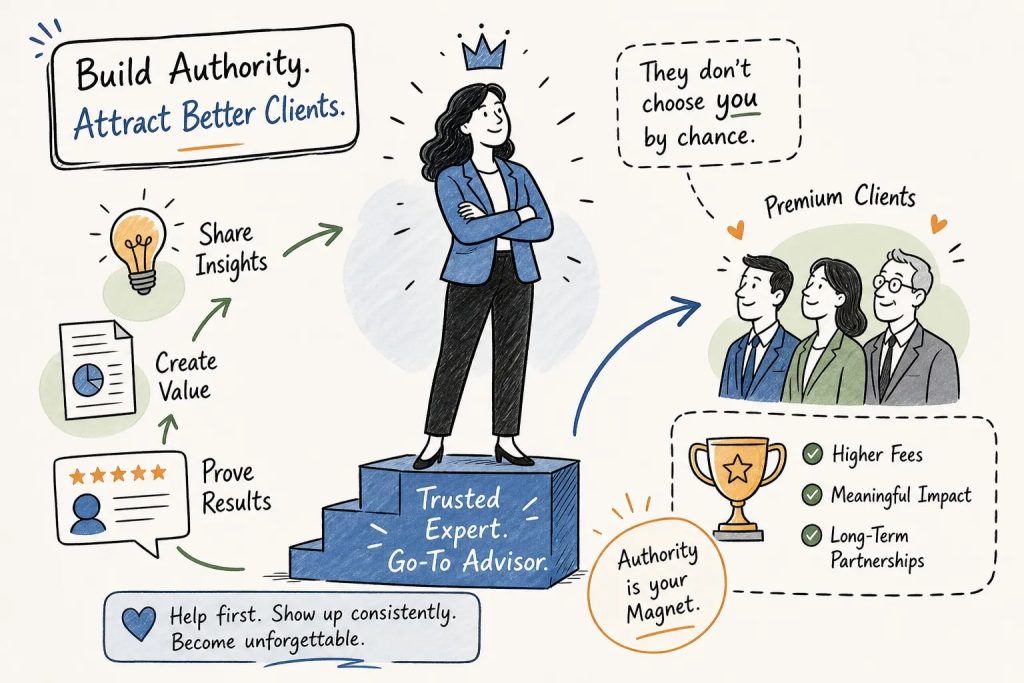
Each element depends on the ones before it. Content without positioning is noise. Positioning without proof is opinion. Proof without visibility stays undiscovered. Get the order right, and the system compounds. Reverse it, and you end up working significantly harder for far less return.
Key takeaways
- Sequence determines results: Position first, prove second, publish third, be discoverable fourth. Skipping steps creates effort without traction.
- Narrow beats broad: Specific expertise for a specific buyer makes you a clear choice, not a competitor on price.
- Case studies carry the most weight: B2B buyers consistently rank relevant case studies among the most influential content in purchase decisions, according to Redpoint Insights.
- Content quality over content volume: One well-placed byline or webinar outperforms months of generic social posts for consultant credibility.
- AI visibility is earned, not claimed: Structured, credible, consistent content across trusted sources is what makes a consultant findable by AI assistants.
What narrow positioning actually does for consultant authority building
Being credible across many domains is not the same as being the obvious choice for one valuable problem. Buyers with specific, expensive challenges look for specific expertise. When a consultant tries to appeal to everyone, they stop competing on fit and start competing on price.
A useful niche combines three things: a defined problem, a recognizable type of buyer, and a point of view about how that problem should be solved. “I help companies improve operations” is forgettable. “I help PE-backed manufacturers reduce post-acquisition revenue leakage in the first 100 days” is a reason to call. Narrow doesn’t mean small. It means clear enough that a referral partner knows exactly when to mention your name.
The highest-paid independent consultants also lead with the client’s expensive problem, not their own methodology. Outcome-led positioning makes relevance immediately obvious, which is what earns the first conversation with a premium buyer.
What proof buyers actually look for before hiring a consultant
According to a 2025 B2B buyer study from Redpoint Insights, customer case studies rank among the content most influential in purchase decisions. A persuasive case study includes the client’s starting situation, the consultant’s intervention, the timeline, and a quantified outcome. One detailed case study carries more weight than months of generic posting.
Testimonials work on a different level, but the same principle applies: specificity is what makes them credible. “Great to work with” is forgettable. A testimonial that names a role, describes a concrete result, and comes from someone with a comparable situation is evidence. Referrals work the same way, trust transfers before the first call. This is a system to build deliberately, not a byproduct of doing good work and hoping someone mentions you.
What thought leadership content actually moves the needle
Webinars, bylined articles in trade publications, original frameworks, and data-backed opinion pieces consistently outperform generic social posts for building consultant credibility. According to Firstpagesage’s 2025 B2B benchmarks, long-form thought leadership drives a 2.6% B2B conversion rate versus 1.7% for organic social. Webinars convert at approximately 20 to 40% on registration, according to Click Vision’s webinar conversion data, particularly when the presenter offers practical, specific expertise rather than broad inspiration.
One client result, used well, can become multiple authority assets: a detailed case study, a bylined article built around the lesson learned, a conference pitch, a newsletter issue, and a referral email to partners. This compounding model creates the repeated exposure that makes your name familiar before the sales conversation begins. That repetition is what turns visibility into recognition with the buyers who matter.
How search and AI fit into consultant authority building
AI assistants are increasingly an early filter some buyers use when looking for expert consultants. When a prospect asks an AI tool for a recommendation, the consultant who surfaces is the one with structured, specific, and credible content across multiple trusted sources. This isn’t a separate marketing task; it’s where the work from the first three pillars becomes searchable and recommendable.
Before executing any of this, you need to know which element is actually weakest. Positioning, proof, content, and visibility all interact, and fixing the wrong one first wastes effort and time. Understanding where your authority gaps sit is the logical starting point, which is exactly what an audit delivers. The TW3 Marketing Authority Audit™ scores a consultant’s authority across six dimensions and produces a prioritized roadmap rather than a generic action list. Start there before committing to a 90-day execution plan.
Authority is built in sequence, not in parallel
Position first. Prove second. Publish third. Be discoverable fourth. Consultants who reverse this order invest heavily in content without the positioning clarity to make it land or the proof to back it up. The result is activity without momentum.
Either way, the goal isn’t more content. It’s the right consultant authority building approach, clear positioning, backed by documented proof, distributed where your best buyers are already looking. The consultants who attract better clients aren’t the ones who post the most. They’re the ones who are clear about what they stand for and make it easy for the right buyers to find them. If you’re not sure where your gaps are, that’s the honest place to start.
Frequently Asked Questions
How do we know which of the four elements is weakest for our consulting practice?
You find the weakest element by conducting an authority audit, which identifies gaps across positioning, proof, content, and visibility. We score your authority across six dimensions and produce a prioritized roadmap so you fix the highest-impact gap first rather than guessing.
How specific should our niche be to attract premium clients?
Your niche should be specific enough to define a problem, a recognizable buyer, and a clear point of view about the solution. We emphasize outcome-led positioning that leads with the client’s expensive problem so referral partners and buyers immediately know when to call you.
What kind of content actually outperforms generic social posting for credibility?
Long-form thought leadership, webinars, bylined trade articles, original frameworks, and data-backed opinion pieces, outperforms generic social posts for building credibility. We note benchmarks showing long-form thought leadership drives a 2.6% B2B conversion rate versus 1.7% for organic social, and webinars can convert roughly 20 to 40% on registration when they deliver practical, specific expertise.
