
Google reviews are proof buyers check before they call. Before a prospect contacts your firm, books a consultation, or even reads your website carefully, they check what other clients said about working with you. That is not a theory; it is how buyers behave. Firms that treat reviews as an afterthought leave visible proof gaps that competitors with stronger profiles fill.
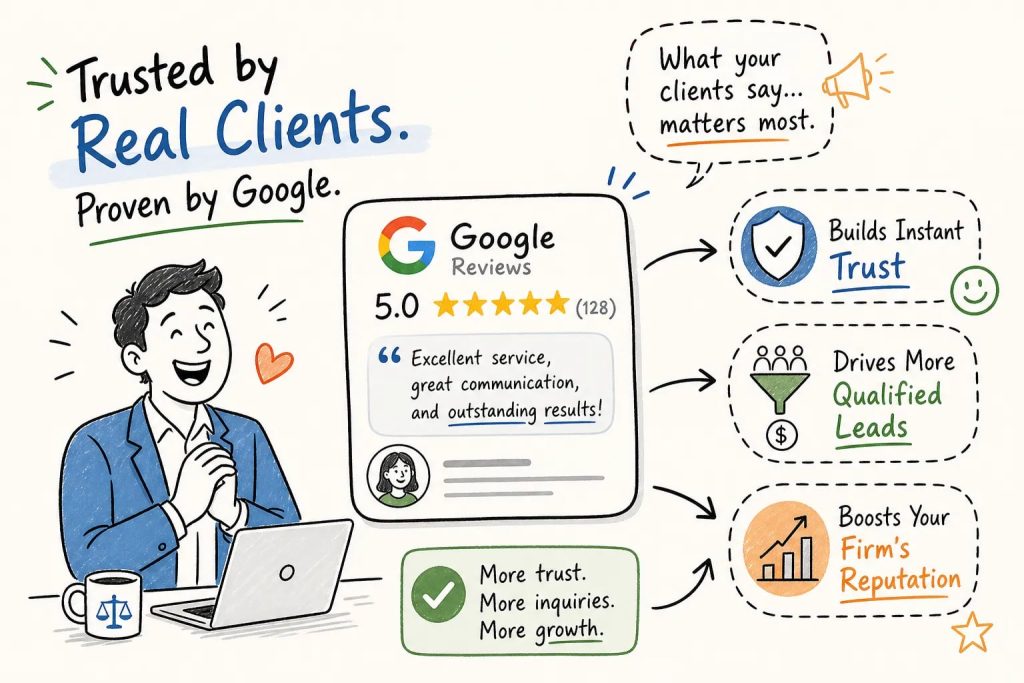
Professional firms earning strong reputations rarely have a marketing problem. They often have a proof visibility problem. The TW3 Marketing Authority Audit™ evaluates proof as one of six core dimensions of a firm’s authority, and reviews are among the most common places established firms fall short. What follows covers what reviews actually signal to buyers, how to generate them ethically, and how to manage them in a way that strengthens your firm’s standing, not just its star rating.
Key takeaways
- Proof over marketing: Reviews are what clients say about you, not what you say about yourself. Buyers treat them as a credibility checkpoint before first contact.
- Volume and recency matter: Thin, stale review profiles signal stagnation. Steady, recent reviews signal active delivery and healthy client relationships.
- Ethical generation is smarter: Google prohibits incentivized, gated, and fabricated reviews. Violations can remove your legitimate reviews, not just the problematic ones.
- Every response is public content: Prospective buyers read how you respond. Generic replies or a lack of responses can convey inattention to prospects who are still evaluating whether to contact you.
- Gaps reveal authority standing: A weak review profile is often a firm’s biggest authority gap, and it takes a structured diagnostic to see it clearly.
What do Google reviews actually signal to a prospective buyer?
Reviews as social proof at the moment of evaluation
Buyers use Google Business Profile reviews to verify claims a firm makes about itself. Volume, recency, and specificity carry more weight than the star average alone. A small number of reviews from two years ago signals stagnation; a substantially larger set of recent, detailed reviews signals active client relationships and genuine delivery. Local reviews and ratings on your Google Business Profile are often the first evidence a buyer consults before they ever visit your website.
What buyers read beyond the star rating
Buyers look for reviewer descriptions of outcomes, mentions of the professional by name, specificity of the engagement, and how the firm responded to criticism. These details let a prospect project their own experience before they ever make contact. Customer reviews on Google can function like mini case studies when they include specific outcomes or evidence, written by people with no incentive to oversell. Sophisticated buyers know the difference between a genuine account and a hollow five-star placeholder.
How do you ethically generate more Google My Business reviews without violating policy?
Asking at the right moment, in the right way
The legitimate ask is straightforward: request a review after a clear positive moment in the client relationship, not at the beginning or during an unresolved issue. The ask should be direct, low-friction, and use a shareable Google review link. Google Business Profile provides this link directly from the profile dashboard. Firms that make it a system, not a one-off request, build review volume consistently over time.
What Google’s review policy prohibits and why it matters
Google prohibits incentivized reviews, review gating, and fabricated reviews. Violations risk removal of your legitimate reviews, not just the problematic ones. Violations can also trigger profile restrictions, including temporarily blocking new reviews or displaying warnings to consumers. Beyond the risk, ethical generation is simply smarter practice: authentic, specific reviews carry more trust weight than generic five-star ratings, and buyers reading your profile can usually tell the difference. If you believe a review violates Google’s policies, you can flag it to request that Google remove the Google review in question, though removal is not guaranteed and is subject to Google’s own assessment.
How should a firm respond to Google Business Profile reviews strategically?
Responding to positive reviews is positioning, not just courtesy
A response to a five-star review is public-facing content. Other prospective buyers read it. A response that references a specific detail from the review, uses the client’s name, and reflects the firm’s voice reinforces character and service standard. Generic “Thanks for the kind words!” responses signal inattention, and that signal reaches every prospect who reads the thread.
Turning negative reviews into visible professionalism
Negative reviews handled well can build more trust than a stream of untouched five-star ratings. The core principle: acknowledge, do not argue, and offer a path to resolution offline. The goal is not to win the exchange with the reviewer; it is to demonstrate to every buyer reading the thread how the firm handles difficulty. The table below outlines a practical response standard based on review type.
| Review type | Target response time | Priority |
|---|---|---|
| Negative (1–2 stars) | Within 24 hours | Highest |
| Neutral (3 stars) | Within 48 hours | High |
| Positive (4–5 stars) | Within 72 hours | Routine but valuable |
Where do reviews fit in the professional buyer’s decision journey?
Reviews are proof, not marketing
Marketing is what a firm says about itself. Proof is what clients say. Buyers evaluating professional service firms, consultants, insurance professionals, or financial advisors are making high-stakes decisions. They move through a credibility filter before they engage. Reviews are one of the last checkpoints before they decide whether to contact you or scroll to the next result. One concrete example of this plays out on Google Maps reviews: a buyer who finds two comparable firms side by side will frequently choose the one with more recent, specific feedback over the one with an older, thinner profile.
Using your review profile beyond Google Maps
A strong review profile extends further than search results. Firms can embed reviews on their website, reference them in proposals, and, with reviewer consent, use them as case study context. This carries the credibility signal across the full buyer journey. A buyer who found your firm through a referral still checks Google before they call; a buyer reading your proposal checks it again before they sign.
What does a weak review profile reveal about your authority standing?
The gaps a sparse or stale review profile creates
A thin review profile does not look neutral to buyers; it looks uncertain. Firms with outdated, low-volume, or generic reviews create a credibility void that competitors with stronger visible proof fill. This is not about gaming a rating system. It is about matching the visible evidence of your reputation to the actual quality of your work.
How a structured authority assessment evaluates proof like this
The TW3 Marketing Authority Audit™ evaluates proof as one of six dimensions, alongside positioning, expertise, visibility, engagement, and experience. Reviews are assessed for volume, recency, specificity, and response quality. Many firms find their review profile is their biggest authority gap, not their pricing or their service delivery. Identifying it requires a structured diagnostic rather than a surface-level guess about where the problem might be.
Start with what buyers already see
Google reviews function as one of the clearest indicators of whether a professional firm delivers on what it promises. Buyers use them to verify credibility before the first conversation ever happens. If your review profile is thin, stale, or unresponded to, that is not a minor oversight; it is visible proof working against you at the moment buyers are making their decision.
A strong review profile requires a consistent, ethical ask process, responses that reflect your firm’s professionalism, and a clear read on where reviews fit in how buyers evaluate authority. All three are manageable once you can see the full picture of where you stand.
If you want to know exactly where your review profile stands relative to the other dimensions of your authority, the TW3 Marketing Authority Audit™ provides that assessment with a clear, prioritized roadmap. Reach out to our team and start with what buyers already see.
Frequently Asked Questions
How do I flag a Google review that looks fake or violates policy?
We recommend that you flag the review to request that Google remove it; Google assesses flagged reviews and removal is not guaranteed. We note that removal decisions are subject to Google’s own assessment, so flagging initiates their review rather than guaranteeing deletion.
Can we use Google reviews outside of Google search results and Maps?
Yes, you can embed Google reviews on your website, reference them in proposals, and, with reviewer consent, use them as case-study context. We point out that carrying those review signals across touchpoints reinforces credibility throughout the buyer journey.
If we have a few old five-star reviews, should we be concerned?
Yes, a thin or stale review profile signals stagnation to prospective buyers and can create a credibility gap. We explain that buyers value volume and recency, steady, recent, specific reviews signal active client relationships more than an old star average alone.
Can a well-handled negative review actually help our firm win business?
Yes, negative reviews handled professionally can build trust and demonstrate how your firm manages difficulty. We emphasize that acknowledging the issue, avoiding public argument, and offering a path to resolve the matter offline shows prospective buyers your commitment to client service.
