
Most small businesses pour money into ads and SEO while ignoring the one thing that determines whether a visitor actually calls: whether your website makes them feel safe trusting you. Trust signals for small business websites are the difference between a site that converts and one that leaks leads silently, and most businesses treat them as optional. In 2026, these signals don’t just influence human buyers. AI platforms like ChatGPT and Google AI use the same credibility markers to decide which businesses to recommend.
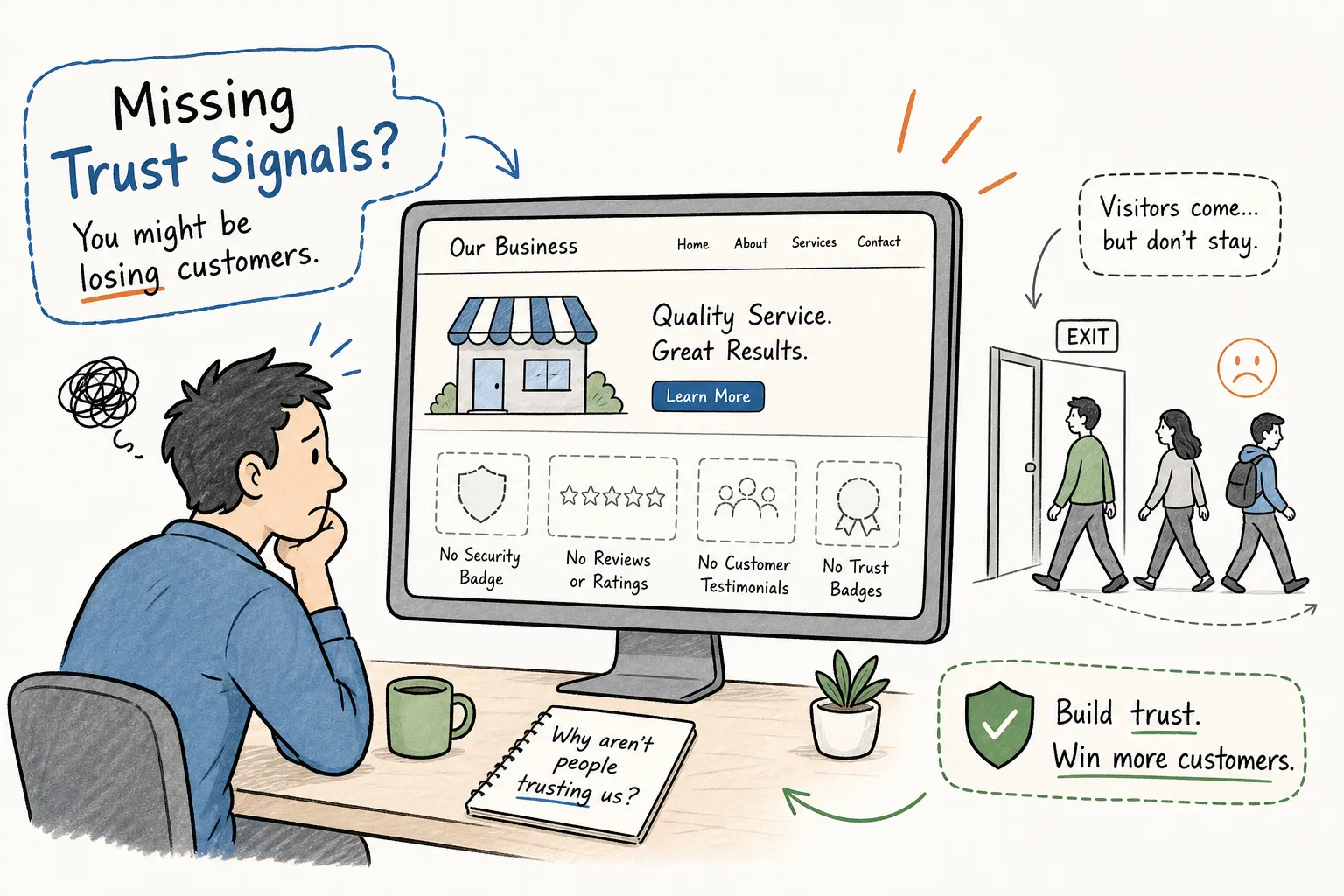
Some agencies now score businesses across credibility markers before recommending any marketing spend at all, because diagnosing trust gaps requires a structured lens, not guesswork. You can’t fix what you can’t see, and most business owners have no idea which signals they’re missing or which gaps are costing them the most.
This article covers the trust signals for small businesses that matter most, where to place them, and how to figure out which ones your site is currently missing.
Why trust signals now influence AI recommendations, not just human buyers
Platforms like ChatGPT, Google AI Overviews, and voice assistants don’t pick businesses randomly. They surface businesses with consistent, verifiable credibility signals across the web. Trust signals, reviews, consistent contact data, certifications, and expert content, feed directly into the authority layer AI systems use to determine who gets recommended. Based on current industry analysis of how AI recommendation engines evaluate local businesses, this behavior appears consistent across major platforms, even without an officially published checklist from any of them.
Most businesses are still optimizing for clicks, thinking about keywords and rankings, while the real game has shifted to credibility. A homeowner who asks ChatGPT for a plumber in their city gets a recommendation based on authority signals, not just a keyword match. A business with strong reviews, verified contact data, and industry credentials gets surfaced. One without those signals gets ignored, even if their actual work is excellent.
The shift from “how do I rank?” to “how do I get recommended?” is the defining trend of search in 2026. NAP inconsistencies, mismatched Name, Address, and Phone data across directories, confuse AI recommendation algorithms. If your business name or address appears differently across platforms, that inconsistency registers as a credibility gap. AI systems trying to verify your identity across sources treat conflicting data as uncertainty, and uncertain businesses don’t get recommended.
Trust signals for small business: the review signals that carry the most weight
A generic four-star review with no name, no detail, and no context is substantially less persuasive than a specific one. Specificity is the credibility multiplier. The reviews that move people include full names, specific outcomes, relevant context (service type, location), and recency. “Great service” tells a prospect nothing. “They fixed my furnace on a Saturday morning and had it running before noon” tells them everything they need to know.
In split tests, adding detailed, attributed testimonials has moved conversion rates from 2.1% to 3.8%. Placing testimonials near primary CTAs has produced conversion lifts around 34% in documented CRO experiments. These aren’t small numbers for a service business running on margin.
Collect reviews at the right moment: after delivery, after the first result, after a positive interaction, not weeks later through a cold email. A text message with a direct link often outperforms a newsletter buried in other content. Ask all customers, not just the happy ones. Selective asks undermine credibility when prospects notice a pattern of suspiciously perfect ratings.
Where you place reviews matters as much as the reviews themselves. Put them near the primary CTA on service pages, not buried in a testimonials tab no one visits. On the homepage, a short, specific testimonial above the fold outperforms a vague five-star badge. The rule: place the review closest to the moment of highest hesitation. That’s usually near your phone number, contact form, or pricing.
Identity signals that prove your business is real
A business with a visible phone number, physical address, and consistent NAP data across Google, Yelp, and relevant directories signals legitimacy to both buyers and AI systems. Research has found that visible phone numbers increase leads by as much as 54%, and that’s not really about the phone number itself. It’s about what the visibility signals: a real business with real accountability and real people on the other end.
A real About page with a founder photo and brief origin story closes the anonymity gap that generic service sites leave wide open. Authentic photography consistently outperforms stock images in trust perception. Real team photos, real job site photos, real before-and-after work, these convert. Stock images of people in hard hats who have never touched a tool in their lives do the opposite.
Don’t overthink the About page. For small service businesses, one honest paragraph about who you are and why you do this work tends to outperform three paragraphs of polished marketing copy. Prospects aren’t looking for a corporate story. They’re looking for a person they can trust with their home, their business, or their money.
Badges, seals, and certifications worth actually earning
Not all badges carry equal weight. According to consumer trust research including studies from Baymard Institute and CXL, Norton Secured, PayPal Verified, and Google Customer Reviews badges rank among the highest-trusted in U.S. markets. Payment logos like Visa and Mastercard are expected at checkout but don’t differentiate a service business the way a BBB accreditation or industry certification does.
The easiest high-trust signals to obtain are SSL/HTTPS, major payment logos, and Google Customer Reviews badges. BBB accreditation takes more effort but lands well with U.S. consumers in service industries. For service businesses, industry-specific certifications carry more trust weight than generic trust seals. Certifications from recognized trade organizations, state licensing information, and manufacturer certifications tell a prospect something concrete. A generic “trusted by thousands” badge tells them nothing they can verify.
Placement matters more than most businesses realize. Put credentials near the specific service claim they support, not just in the footer where no one reads them. If you’re a licensed HVAC contractor with manufacturer certification, that credential belongs on your HVAC service page next to your primary CTA, not buried at the bottom of your homepage.
Where to place trust signals for small business websites
On your homepage, one strong credibility cue above the fold is a solid starting point. A star rating with a review count, a recognizable logo row, or a one-line outcome-based testimonial. Add a trust bar directly below the hero CTA so the first screen already answers the question: “Why should I trust this business?” Keep it compact. A cluttered trust section reads as desperation. One clear signal beats five competing badges.
On service pages, place proof blocks near each major claim, not just once at the bottom. Every promise on a service page should have supporting evidence adjacent to it. Near the contact form or call button, include a short testimonial, a visible phone number, a guarantee statement, and a one-line risk-reducer like “No obligation estimate. We’ll call you within two hours.”
Microcopy is underrated and underused. “We never share your information” next to a form field does real conversion work. “Rated 4.8/5 by 2,300 customers” is stronger than “Trusted by thousands” because it’s specific and verifiable. Use reassurance copy near every decision point: near the CTA, next to the form, and adjacent to your pricing if you show it. Commitment-reducers work best before the decision, not after.
How to find which trust signals you’re actually missing
Walk your site once as a skeptical stranger before you spend another dollar on ads. Ask yourself: “What here tells me this business is real, capable, and safe to contact?” Check each page for visible contact info, real photos, reviews near CTAs, security indicators, and credentials relevant to the page’s offer. Most business owners can’t do this honestly because they know too much about their own business, they see trust signals that aren’t actually there.
Check your NAP consistency across your Google Business Profile, Yelp, BBB listing, and any industry directories. Inconsistencies are trust leaks most businesses never find on their own. One address listed as “Suite 100” on one platform and “Ste. 100” on another isn’t a disaster in isolation, but patterns of inconsistency fragment your authority signals in ways that compound over time.
A self-audit catches the obvious gaps. It rarely catches the subtle ones: weak review recency, missing schema markup, thin social proof on high-traffic pages, or credentials that exist but aren’t structured in a way AI systems can read. A structured diagnostic, like the 100-point Authority Audit™ TW3 Marketing uses, measures businesses across the exact signals that influence both customer conversions and AI recommendation eligibility. The value isn’t just knowing what’s missing. It’s knowing which gaps to fix first for the fastest measurable lift. In practice, businesses tend to have more trust signal gaps than they realize, and the ones they’re aware of are rarely the most damaging.
Start simple, then build
Audit your site’s trust signals today to stop leaking leads. The core trust signals for small business websites aren’t complicated: reviews, real contact information, relevant certifications, security indicators, and honest design. What trips most businesses up isn’t understanding what trust signals are, it’s not knowing which ones they’re missing or where to put them.
Check your review placement, your contact visibility, your NAP consistency across directories, and your service page credibility gaps. If you want a faster answer, a structured audit gives you a prioritized list instead of a guessing game.
Fix the biggest gaps first. Measure what changes. Then keep building. Trust compounds. The social proof for small businesses that you establish today makes tomorrow’s visitors easier to convert, and makes AI systems more likely to recommend you when a customer asks who to call.
Want to go deeper on this? The AI Authority Paradox explains why AI makes it easy for almost any business to look credible, and why real, verifiable authority now matters more than ever.
Frequently Asked Questions: Website Trust Signals
What are trust signals on a website?
Trust signals are the pieces of proof that show a visitor your business is real and dependable. They include reviews, licenses, certifications, years in business, case studies, real photos, named team members, and clear contact and location details.
Why do trust signals matter for small business websites?
Most small business sites make claims but show little proof. Customers, and now AI systems, decide based on evidence, not adjectives. Strong trust signals remove doubt and make it easier for someone to choose you over a competitor that looks the same.
Which trust signals matter most?
The ones a customer can verify. Recent reviews, a professional license, real credentials, completed work, and consistent business information carry more weight than words like “trusted” or “best.” Proof that a stranger can confirm is what actually builds confidence.
How do trust signals affect AI search?
AI systems recommend businesses they can understand and verify. When your reviews, credentials, and business details are clear and consistent online, an AI system has the evidence it needs to include you. Missing trust signals leave you invisible to both people and AI.
