
If you’re wondering how HVAC companies get more leads from Google and AI search, the answer comes down to a dual-track approach, and most businesses are only running one track, if that. Homeowners now search in two places at once: traditional Google and AI platforms like ChatGPT and Google AI Overviews. The typical HVAC business is optimized for one of those channels at best, or neither. That split means you’re bleeding leads at every stage of the funnel without realizing it.
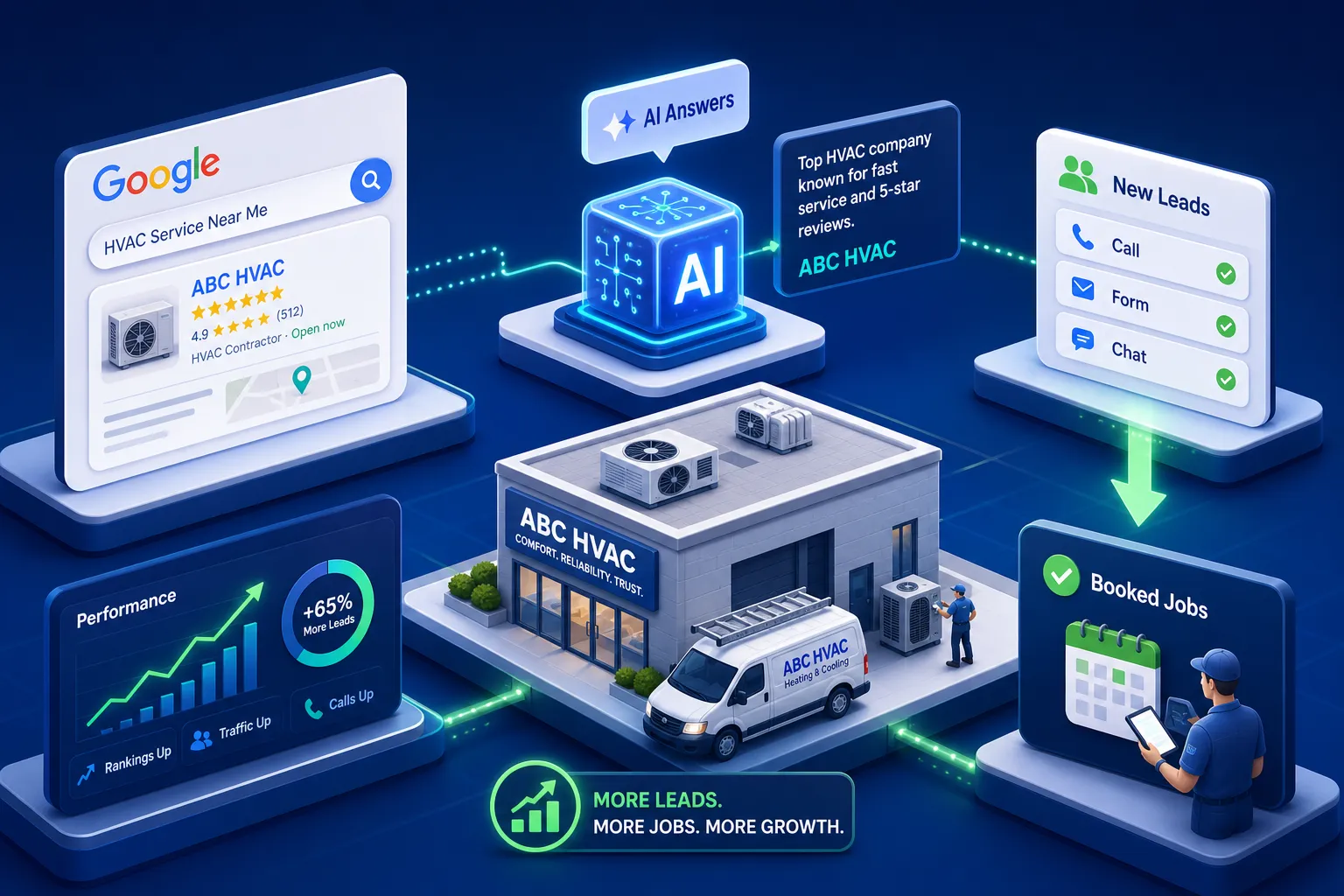
The fix isn’t doing more of the same. It’s building a system that covers both the traditional Google signals (Maps, LSA, reviews, local SEO) and the emerging AI authority signals that determine whether ChatGPT recommends your company or a competitor across town. At TW3 Marketing, we call this the authority optimization framework, and it organizes every tactic in this guide.
By the end of this article, you’ll know which eight tactics to prioritize, what order to implement them in, and which KPIs to track so you can see measurable lead growth within 30 to 90 days.
1. Start here: the local search foundation that drives map calls
Before you touch paid ads or AI optimization, your Google Maps presence needs to be solid. The Google Maps 3-Pack remains the highest-volume organic lead channel for most HVAC companies, and most businesses have fixable gaps holding them back.
Optimize your Google Business Profile for HVAC, not just home services
The single biggest mistake HVAC companies make on their GBP is using the generic “Home Services” category instead of “HVAC Contractor.” That distinction matters because Google uses category data as a relevance signal. Beyond the category, fill out your services list completely, upload seasonal photos, list your service areas explicitly, and post regularly, biweekly is a manageable target for most operators. These moves tell Google your profile is active and service-specific, not just a placeholder listing collecting dust. Initial ranking gains from a freshly optimized GBP can show up in as little as two to four weeks, with meaningful movement in the 60 to 90-day range for most markets.
Build a review engine that runs after every job
There’s a big difference between “asking for reviews occasionally” and having a system. Review recency and velocity are separate ranking signals from total review count, which means a steady stream of new reviews outperforms a one-time push every quarter. The most effective approach: send a text-based review request within two hours of job completion with a direct link to your GBP review page. Keep the message short, make it easy, and make it automatic. Consistency beats intensity every time.
NAP consistency and citations: the unglamorous fix that stabilizes rankings
NAP stands for name, address, and phone number. If those three details aren’t identical across Yelp, Angi, BBB, HomeAdvisor, Houzz, and your chamber listing, Google sees conflicting signals and discounts your local relevance. Run a citation audit, clean up the mismatches, and move on. This won’t rocket you to the top of the Map Pack on its own, but it removes a drag that’s quietly undermining everything else you’re doing.
2. Paid lead channels: LSA vs. Google Ads for HVAC
Once your GBP foundation is in place, paid channels are your fastest path to lead volume. The key is knowing which one to launch first and why the order matters.
Why Local Services Ads deliver cheaper HVAC leads with higher booking rates
LSA works differently than traditional PPC: you pay per lead, not per click, and your listing appears above everything else in the search results with a Google Guaranteed badge attached. For urgent HVAC service queries, that badge removes trust friction fast. Based on current HVAC industry benchmarks, LSA averages around $51 per lead with a 44% book rate. Compare that to blended Google Ads at roughly $104 per lead, and the math is hard to ignore. LSA should be your first paid investment, not an afterthought.
When to layer in Google Search Ads, and what to avoid
Google Search Ads have a role, but it’s as a complement to LSA, not a replacement. Branded campaigns (people searching your company name) can run as low as $34 per lead and are worth running once you have budget. Non-branded campaigns for terms like “AC repair near me” can push $149 per lead in competitive markets, so treat those as a scaling play after your LSA account is dialed in. The common mistake is launching broad non-branded Google Ads before fixing the GBP foundation, which means paying premium CPLs for clicks that don’t convert because the trust signals aren’t there yet.
3. How HVAC companies get more leads from Google and AI search: understanding the shift
This isn’t a future trend. It’s happening now in 2026, and HVAC companies are already feeling it in their traffic numbers. Understanding what’s changed, and why, is the first step toward doing something about it.
The zero-click problem and what it means for your organic traffic
According to recent industry analysis, AI Overviews appear in roughly 16% of local HVAC service queries and on 63% of broader HVAC searches. For informational queries like “why is my AC blowing warm air,” users increasingly get the answer directly from the AI summary without clicking anything. That suppresses click-through rates on standard organic listings for those informational terms. The good news: high-intent local queries like “emergency AC repair near me” still drive calls through the Map Pack and LSA placements, so those channels hold their value. The risk is treating organic rankings as a proxy for actual lead flow when the relationship is becoming less direct.
ChatGPT and voice search as new HVAC referral channels
A growing segment of homeowners now asks ChatGPT or a voice assistant who to call before ever opening a Google search tab. When that happens, AI systems look for businesses with consistent, credible authority signals across multiple sources: your website, your GBP, reviews, directories, and third-party mentions. If those signals are thin or contradictory, AI has nothing credible to cite and your competitor gets the recommendation instead. The question every HVAC owner should be asking right now is: what does ChatGPT find when it looks your company up?
4. AEO: how to get your HVAC business cited in AI answers
Understanding the shift is step one. Doing something about it is step two, and that means building the content and authority signals that AI platforms actually use when forming recommendations.
The content signals AI platforms use to recommend local businesses
ChatGPT and Google AI Overviews pull from authoritative, well-structured content. For HVAC companies, that means dedicated service pages (not one generic “services” page), FAQ content that directly answers common homeowner questions in plain language, and clear positioning signals throughout your site: who you serve, where, and what makes you credible. These aren’t just SEO pages, they’re the evidence AI systems cite when making a recommendation. Generic content that could apply to any HVAC company in any city gives AI nothing specific to work with.
Schema, FAQ pages, and entity signals that reinforce AI visibility
LocalBusiness schema with areaServed and service details is foundational. FAQ schema is the highest-correlation format for AI Overview inclusion and functions as a direct pipeline into featured snippets. Beyond schema, entity reinforcement matters: consistent mention of your business name, location, specialization, and credentials across multiple credible sources creates the authority footprint AI systems trust. This is exactly what TW3 Marketing’s Authority Score Check evaluates, it shows where your HVAC company currently stands in AI recommendations, including how you appear in Google and ChatGPT results, delivered within 48 hours. It’s the diagnostic step that tells you which gaps to close before spending more on any channel.
5. HVAC chatbots that turn website visitors into booked jobs
More traffic is useless if your website isn’t converting it. A well-built chatbot is one of the highest-leverage fixes available because it works around the clock without adding headcount.
The conversation structure that qualifies and books in under 5 questions
Based on HVAC industry benchmarks, phone leads convert at around 46% to booked jobs. Chat converts at 5 to 12%. The goal of your chatbot is to move the conversation off chat and onto a phone call or booked appointment as fast as possible. The structure that works: greet and detect urgency, classify the request (repair, maintenance, install, or quote), collect minimum intake details (name, callback number, service address), offer a next action (first available slot or a text booking link), then confirm and hand off. Keep the whole flow under five questions for most job types. The bot should feel fast, not like a form with a personality.
Emergency triage, pricing language, and what to never promise in a chatbot
Any mention of a gas smell, no heat in cold weather, or a safety concern should trigger immediate human escalation, not continued qualification. Don’t let the bot keep asking questions when someone’s furnace is out in January. On pricing, use “typical price range” language and never commit to a firm number before an onsite inspection. Connect the bot to your CRM and calendar so leads flow in automatically, validate service areas before booking to avoid wasted appointments, and review chat transcripts weekly to catch abandonment patterns early. The transcript review habit alone consistently surfaces easy fixes most operators miss.
6. How to get more HVAC leads from Google and AI: sequencing and measuring your tactics
The sequencing matters as much as the tactics themselves. Doing these out of order wastes budget on channels that can’t convert without the foundation underneath them.
The right order: quick wins first, then compounding investments
Start with GBP optimization: it’s the fastest ROI available and costs nothing but time. Launch LSA next, since it’s the fastest paid channel with the lowest CPL for urgent service queries. Deploy the chatbot within the first one to three weeks so you’re not losing visitors who bounce before filling out a form. Then build your AEO content and review generation systems in parallel; both take three to six months to compound but start paying off steadily once they’re in motion. Running paid ads before fixing the GBP foundation is the most common sequencing mistake: you end up paying to drive clicks to a profile that doesn’t convert because the trust signals aren’t there yet.
KPIs by channel and the one diagnostic that reveals hidden gaps
Track these metrics by channel so you know what’s actually working:
- GBP: profile views, call clicks, direction requests
- LSA: cost per lead, book rate (industry benchmark: ~$51 CPL, ~44% book rate)
- Chatbot: chat-to-lead rate, abandonment rate
- AEO and organic: Search Console clicks, GBP views from AI referrals
Before investing more in any of these channels, run TW3 Marketing’s Authority Score Check. It’s a 48-hour diagnostic that shows exactly how your business currently appears in Google and ChatGPT, which authority signals are strong, and which gaps are costing you AI recommendations right now. It replaces guessing with a prioritized action list so your next dollar of marketing spend goes where it will actually move the needle.
Stop guessing and start fixing what’s actually costing you leads
HVAC lead generation in 2026 runs on two parallel tracks. The first is traditional Google signals: GBP, LSA, reviews, and local SEO. The second is AI authority signals: AEO content, entity footprint, schema, and E-E-A-T. Many HVAC companies are underperforming on at least one of these tracks without knowing which one or why.
The sequencing laid out in this guide gives you a clear path from quick wins to compounding growth without burning budget on channels that can’t perform yet. Fix the foundation first, add paid volume fast, then build the AI authority layer that determines whether you get recommended when the next homeowner asks ChatGPT who to call instead of opening a search tab.
Now you know how HVAC companies get more leads from Google and AI search, and you have a concrete eight-tactic framework to act on. The fastest way to know exactly where you stand is to run the TW3 Marketing Authority Score Check. In 48 hours, you’ll see how your business appears across Google and AI platforms, where your authority gaps are, and what to fix first. Stop allocating budget based on assumptions and start making decisions backed by a real diagnostic.
Frequently Asked Questions: HVAC Leads from Google and AI
How do HVAC companies get more leads from Google in 2026?
A complete and accurate Google Business Profile, consistent business information across the web, steady recent reviews, and service pages that clearly explain each job you do. Google rewards HVAC contractors that are easy to understand and easy to trust, not just the ones that spend the most on ads.
How does AI search change HVAC lead generation?
AI tools like ChatGPT and Google AI Overviews now answer questions like “who is the best HVAC company near me” directly. To be the one they name, your business needs enough public proof, reviews, credentials, and clear service information for an AI system to recommend you with confidence.
Do HVAC companies still need Google Ads to get leads?
Ads can help in the short term, but they stop the moment you stop paying. Reviews, local SEO, authority content, and a strong Google Business Profile build owned assets that keep producing leads over time. Most HVAC companies get the best results by combining both.
What is the fastest way for an HVAC company to improve its lead flow?
Start with what customers and AI systems already see. Fix your Google Business Profile, ask recent customers for reviews, make sure your name, address, and phone number match everywhere, and spell out your services clearly. These moves usually move the needle faster than a new website.
