
A homeowner’s furnace dies on a Thursday night. She opens ChatGPT and types: “Which HVAC company should I call in [her city]?” Three businesses come back by name. She calls the first one. The business that ranked #1 in Google for “HVAC repair [city]” is not on the list. It doesn’t even come up. That scenario plays out frequently across every local service category, and it’s exactly why answer engine optimization matters for businesses that depend on local customers finding them first.
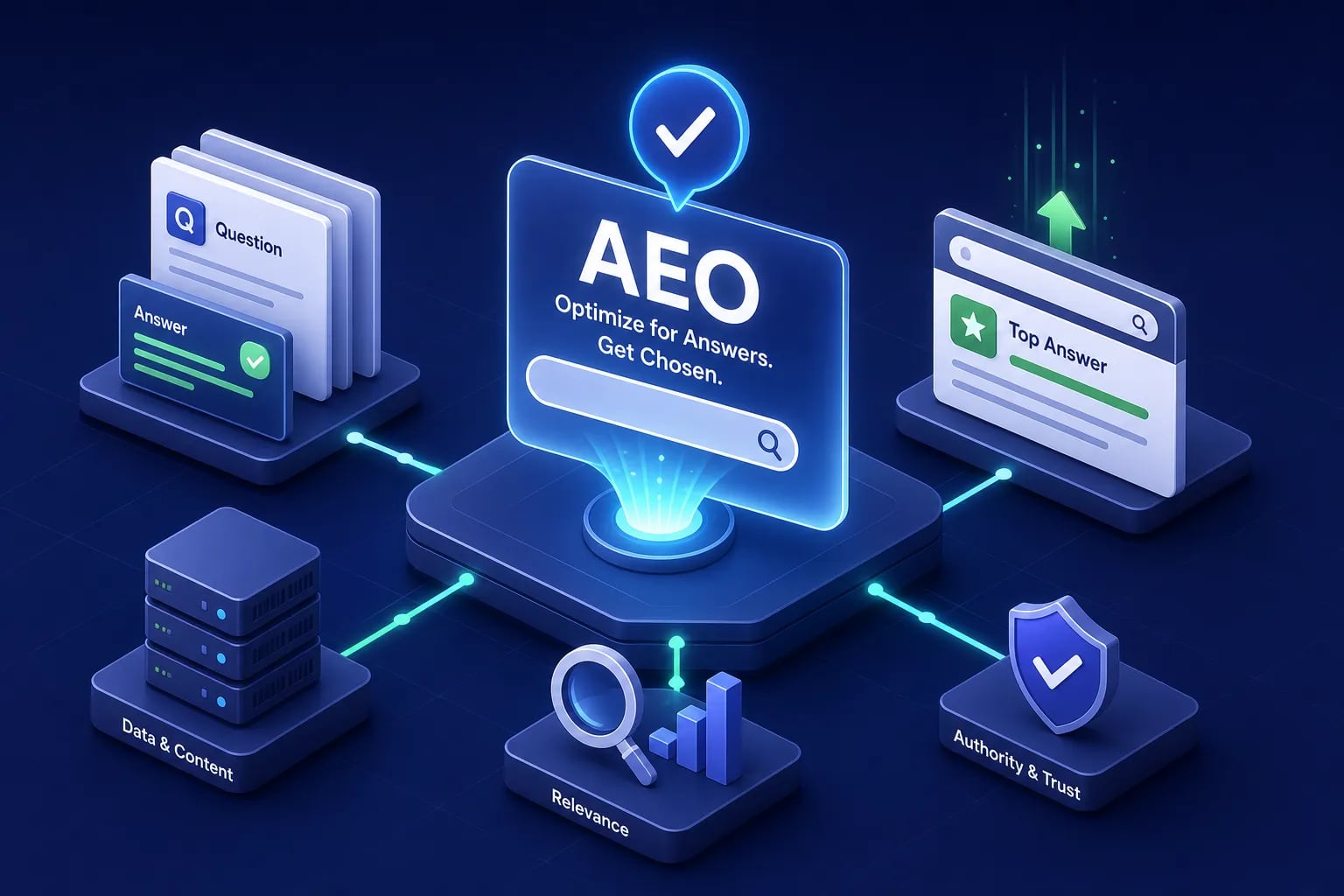
Industry surveys suggest that close to half of U.S. consumers have used AI tools like ChatGPT or Google AI to get local business recommendations in the past year, with a meaningful share doing it weekly. The businesses getting named in those responses aren’t necessarily the ones with the biggest ad budgets. They’re the ones whose digital presence is structured to be understood, trusted, and cited by AI systems, a finding consistent with how AI citation signals actually work.
That’s the core of what answer engine optimization (AEO) actually is: the practice of structuring your content, authority signals, and digital presence so that AI-powered answer engines choose your business as a source when customers ask relevant questions. At TW3 Marketing, this topic comes up constantly in our work with service businesses, because the gap between traditional SEO performance and AI citation visibility is wider than most business owners realize. This article breaks down what AEO is, how it differs from traditional SEO, which signals matter most, and what you can do right now to improve your standing.
What answer engine optimization actually means
Traditional SEO is about earning a position in a ranked list of results. Answer engine optimization is about being the response. AI systems like ChatGPT, Google AI Overviews, and Perplexity generate synthesized answers and cite a handful of sources rather than surfacing ten blue links, though the exact interface varies by platform and query type. Getting cited means being chosen as trustworthy, relevant, and extractable. Not getting cited means being invisible, even if you rank well in traditional search.
The selection criteria AI answer engines use are specific: semantic relevance, domain authority, content freshness, structural clarity, and cross-source corroboration. AI systems favor pages where factual claims are clear, easily attributable, and confirmed by multiple reputable sources. Stale content, vague commentary, or pages that are difficult to parse lose out regardless of how many backlinks they’ve earned. High-ranking SEO pages are not automatically cited if they’re hard to extract or weakly supported.
AEO isn’t an extension of SEO, it’s a different optimization target entirely. SEO optimizes for a crawler’s ability to rank content by relevance to a query. AEO optimizes for an AI model’s ability to extract, trust, and cite a specific passage as a direct answer. Both matter, but confusing the two leads to misallocated effort. Running traditional SEO tactics and expecting them to improve your AI citation rate is like optimizing a radio ad and expecting better TV results. This is the distinction that separates generative AI SEO from the search optimization most service businesses have practiced for the past decade.
How AEO and traditional SEO differ at their core
Traditional SEO is built around the Google ten-blue-links model: earn authority through backlinks, target keywords, satisfy search intent well enough to rank on page one. The goal is to get someone to click through to your site. The metrics are rankings, impressions, and organic traffic. That model still works and still matters, but it’s no longer the complete picture of how customers find service businesses.
Answer engine optimization shifts the goal from “get the click” to “be the answer.” The metrics are citation rate, mention share, and AI-referred sessions. The optimization levers are different too: content extractability, entity clarity, schema markup, and the kind of verifiable, specific information that AI systems can quote with confidence. A business can rank #3 on Google and consistently miss AI-generated responses. The reverse can also happen: a business with modest traditional rankings can show up regularly in AI recommendations when its content is structured correctly, because the ranking signals and the citation signals are not the same thing.
Consider a plumbing company’s “water heater replacement” page. The traditional SEO version is written to rank for a keyword and drive clicks: it’s long, it covers the topic broadly, and it earns backlinks. The AEO-optimized version opens with a direct 40-word answer to “How much does water heater replacement cost?”, uses question-based heading structure, includes FAQ schema markup, and cites specific cost ranges with local context. The second version gets cited in AI answers. The first often doesn’t, even when it outranks the second in traditional search, which illustrates precisely why conversational search optimization requires its own strategy.
Why service businesses carry the most risk right now
Consumers are increasingly bypassing the search results page entirely. They ask ChatGPT, Google AI, or a voice assistant: “Who’s the best HVAC company near me?” or “Which solar installer should I call in [city]?” The AI answers directly, without a results page in between. For service businesses that rely on local reputation and referrals, this shift is significant. The businesses that appear in those AI responses aren’t always the ones with the largest ad budgets or the most reviews, they’re the ones whose digital presence is structured to be understood and cited.
AI answer engines are doing what a diligent customer would do with unlimited research time: checking credentials, cross-referencing reviews, looking for proof of expertise, and evaluating whether a business’s claims are verifiable. If your digital presence has gaps, thin content, missing schema, inconsistent directory listings, absent author credentials, AI systems won’t cite you. This is the trust gap, and for most service businesses, it’s larger than they realize. It doesn’t show up in your Google Search Console data, which is exactly why so many businesses don’t know it exists.
The signals that determine if AI cites your business
AI systems look for three overlapping qualities before citing a source. Semantic relevance means the page directly and clearly answers the question being asked. Authority means the source has demonstrable credibility on the topic, backed by expert authorship, consistent entity information, and a verifiable track record. Corroboration means the facts on your page appear across multiple reputable sources, not just your own site. Generic, hedged content that doesn’t commit to specific claims gets passed over. Specific numbers, named credentials, dated information, and primary-source language improve citation likelihood across AI platforms, a practice sometimes called answer citation optimization.
Two signals that often get overlooked are structural parsability and content freshness. Clean heading hierarchies, short answer paragraphs, and question-style subheadings give AI systems clearly bounded, quotable passages. Freshness matters especially in fast-moving categories. An HVAC company’s service page that hasn’t been updated in three years signals lower reliability to an AI engine prioritizing current information.
TW3 Marketing’s Authority Audit™ maps directly to these citation signals. The Audit scores a business across six authority dimensions: positioning, proof, expertise, visibility, engagement, and experience. Positioning and expertise cover semantic relevance and E-E-A-T-style authority. Proof and engagement cover corroboration and social trust. Visibility and experience cover structure, freshness, and discoverability. The Audit was built to address the signals that determine AI recommendation likelihood alongside traditional SEO metrics, a useful distinction as many agencies’ audit frameworks predate the rise of AI answer engines.
Answer engine optimization tactics: content and technical moves that improve your standing
One of the most consistently recommended structural changes in AEO is writing answers before explanations. Every section of an AEO-optimized page should open with a direct, 40-60 word response to the question implied by the heading, then expand with supporting detail. This approach is widely cited in AI search optimization research as the format most likely to produce extractable content. Pair it with question-style H2 and H3 headings that mirror how customers actually ask questions in AI search: “How much does [service] cost?”, “What does [problem] mean for my [system]?”, “How long does [service] take?” This structure maps directly to how AI systems retrieve and cite content.
Which schema types matter most for AEO
For schema markup, three types carry the most weight for service businesses. FAQPage schema consistently shows strong citation performance in available benchmark studies, because it matches the Q&A format AI systems extract directly. HowTo schema improves citation likelihood for procedural queries. Article schema with full author, publisher, datePublished, and dateModified metadata contributes to the E-E-A-T-style trust signals AI engines weight heavily in source selection. Use Google Rich Results Test to validate your implementation before publishing.
How to write FAQ blocks that AI systems actually cite
Keep each question-answer pair self-contained: the answer should make sense without the question above it. Write answers at the 40-60 word target and avoid answers that redirect the reader to another page. For service businesses, the highest-value FAQ topics are:
- Pricing, specific ranges with local context, not vague estimates
- Process, what happens from first call to job completion
- Timeline, realistic timeframes customers can plan around
- Credentials, licenses, certifications, years in business
- Service area, specific cities, counties, or zip codes served
Those are exactly the questions customers ask AI assistants before making a call, and the questions where featured-answer optimization pays off most directly for local service businesses.
Testing and tracking your AEO performance
The most accurate way to check your AEO performance is still manual. Run the exact questions your customers would ask in ChatGPT, Perplexity, Google AI Mode, and Gemini, then check whether your business or content appears in the response. Document which questions return citations, which return competitors, and which return no local results at all. This gives you an answer-gap list: the highest-value prompts where you need to improve your standing. Start with 10-15 buyer-intent questions specific to your service and geography.
Once you have your core prompt list, move it into a monitoring tool so you can track trends over time. Tools worth testing include Profound, LLM Pulse, Peec AI, and AIclicks, all of which are designed to track citation rate, mention share, and visibility changes across AI engines. Note that independent accuracy testing of these tools is still limited, and the market is evolving quickly, combine any tracker with regular manual prompt checks. These tools aren’t replacements for manual testing; they’re what make your performance trendable so you can see whether content changes are actually moving the needle.
Connect your monitoring data to GA4 so you can see whether citation gains translate to direct visits and conversions. AI-referred sessions are trackable in GA4 as referral traffic from sources like ChatGPT.com and Perplexity.ai. Early results from businesses that have implemented focused AEO strategies suggest meaningful increases in AI-referred traffic, though outcomes vary significantly by industry, geography, and how systematically the changes are applied. Set your GA4 baseline before you start making content changes so you have a clean before-and-after comparison.
Where to go from here
Answer engine optimization is not a future consideration for service businesses. Customers are already asking AI which contractor, HVAC company, or insurance agent to trust. The businesses that get cited are the ones with clear authority signals, structured content, and verifiable proof. The ones that don’t are invisible in a channel that’s growing every month.
The practical starting point is diagnosis. Identify your answer gaps by running your top 10-15 buyer-intent questions across major AI engines. Audit your content for extractability: are you leading with direct answers, using question-based headings, and including FAQ schema? Check your structured data, your content freshness, and whether your entity information is consistent across your website, Google Business Profile, and key directories. Fix those signals before spending more on ads or traditional SEO.
TW3 Marketing’s Authority Audit™ is one structured way to get that baseline. It scores your business across the six authority dimensions that directly map to AI citation signals and shows you exactly where the gaps are. Whether you use the Audit or build your own process, the principle is the same: know your gaps, fix the signals, and get your business into the answers where your customers are already looking.
