
Something quiet happened to the way homeowners find a plumber or an HVAC contractor. It didn’t make headlines, and there wasn’t a single update that changed everything overnight. But the shift is real: for local service businesses, SEO vs. answer engine optimization is no longer a theoretical debate, it’s the practical difference between showing up in a list of blue links and getting recommended by name when someone asks an AI assistant who to call. An increasing share of those high-intent moments now end without a single click, and most local service businesses aren’t visible in that channel at all.
At TW3 Marketing, we’ve worked with local contractors across the U.S., and we keep seeing the same pattern: solid Google rankings, zero presence in AI-generated answers. The business shows up on page one for “HVAC repair in Dallas.” But when someone asks ChatGPT who to call, the business doesn’t exist. That’s not a traffic problem. That’s a structural one.
This article breaks down what actually separates traditional SEO from answer engine optimization, where each one earns its value for local service businesses, and what to fix first if you want to show up in both channels.
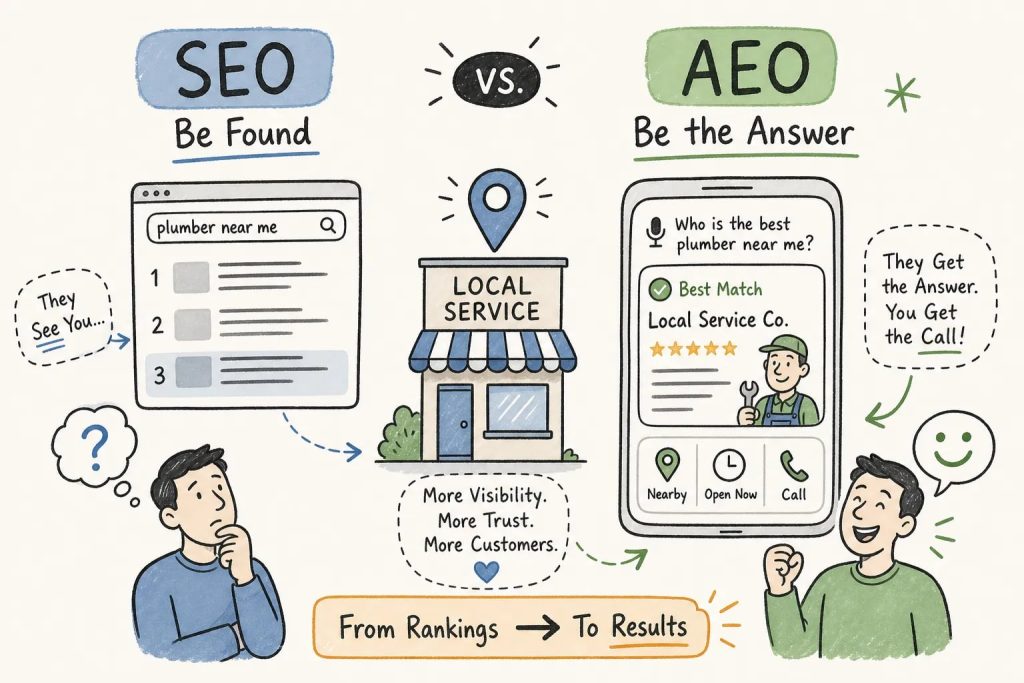
SEO vs. Answer Engine Optimization (AEO) for Local Service Businesses: What Actually Changes
Traditional SEO is built around one objective: get your web pages ranked in a list of search results. Answer engine optimization (AEO) has a different objective entirely, become the answer that an AI system surfaces when someone asks a direct question. One targets the click; the other targets the citation. Both serve real demand, but they operate through different logic.
The content unit changes between them, too. SEO optimizes whole pages for keyword relevance, depth, and internal links. AEO optimizes self-contained answer chunks: short, direct, entity-rich passages that an AI can extract and present without any surrounding context. A service page built only to rank rarely formats information in a way that AI systems can pull from reliably, FAQs are absent, service details are buried, and there’s no schema markup for answers to latch onto.
The success signals are different as well. SEO success shows up in rankings, clicks, and organic traffic. AEO success shows up as citations inside AI-generated responses, direct business mentions, and leads that arrive saying “ChatGPT recommended you.” A contractor optimizing only for the first set of metrics has no visibility into how they’re performing on the second. Most don’t even know to look.
How AI Assistants Decide Which Contractor to Recommend
When someone asks “best HVAC company near me,” an AI system doesn’t guess. It pulls from structured, consistent, verifiable data. Google Business Profile completeness comes first. NAP consistency across directories comes second. After that come review quality and recency, service-page content that directly answers local questions, and third-party citations. A contractor with an outdated GBP profile and mismatched directory listings is effectively invisible to this process.
Your Google Business Profile is no longer just a listing. It’s one of the primary factual sources that powers Google’s AI answers. The primary category you’ve selected, your service descriptions, your hours, your business description, your photo count, and even the language patterns in your reviews all feed into how Google’s AI interprets and presents your business. Businesses with complete, current, and specific GBP data are the ones appearing in AI Overviews and conversational search results. Businesses with half-filled profiles aren’t.
Reviews do more than build trust with humans. They build trust with AI systems. Review language that consistently mentions specific services, service areas, and quality markers gets reflected in how AI systems describe your business to prospective customers. Third-party citations from directories, local news outlets, and trade sites function as corroboration signals, they tell the AI that information about your business has been confirmed elsewhere. That consistency is what converts a business from one that AI might mention to one that AI recommends first.
Where Traditional SEO Still Earns Its Keep (and Where It Falls Short)
SEO isn’t going anywhere for local service businesses. Comparison searches, pricing research, and branded searches still produce traditional results pages where ranking matters. Homeowners looking to shortlist contractors often browse multiple sites before calling. For those moments, a fast website, strong local pack visibility, and credible page rankings still convert. Contractors who abandon SEO entirely in favor of AEO alone are leaving a real traffic channel behind.
But direct-intent queries are shifting. Research on AI Overviews suggests they appear on roughly 12, 18% of local and home-service queries, with an estimated 10, 15% resulting in zero-click AI-driven outcomes. Queries like “HVAC repair cost in Phoenix,” “plumber open now near me,” and “best roofer in [city]” are increasingly resolved without a single click. Traditional SEO tactics alone, keyword density, internal links, meta descriptions, don’t help here. They address a different problem entirely.
The honest framing is this: SEO is your foundation. AEO is the layer on top that determines whether you appear when AI systems take over the answer. You need both. Most local service businesses have spent years building the first layer without knowing the second one existed.
AEO Tactics That Move the Needle for Local Contractors
When it comes to SEO vs. answer engine optimization for local service businesses, structured data is the clearest dividing line. The most effective schema stack for a local contractor combines LocalBusiness schema (using a specific subtype like Plumber or HVACBusiness) with Service schema for each individual offering, FAQPage schema for question-and-answer sections, and AggregateRating pulled from verified reviews. This combination makes your business identity, services, location, and reputation parseable by AI in a way that generic page content cannot replicate. Generic sites get skipped. Structured sites get cited.
Here’s a simplified example of how a LocalBusiness + FAQPage schema stack might look in JSON-LD:
<code>{
  "@context": "https://schema.org",
  "@type": "HVACBusiness",
  "name": "Your Business Name",
  "address": { "@type": "PostalAddress", "addressLocality": "Phoenix", "addressRegion": "AZ" },
  "aggregateRating": { "@type": "AggregateRating", "ratingValue": "4.9", "reviewCount": "214" },
  "hasOfferCatalog": {
    "@type": "OfferCatalog",
    "name": "HVAC Services",
    "itemListElement": [{ "@type": "Offer", "itemOffered": { "@type": "Service", "name": "AC Repair" } }]
  }
}</code>
Content structure matters just as much as schema markup for answers. Service pages built around one service each, with a dedicated FAQ section using question-led H2 or H3 headings followed by two-to-five sentence direct answers, tend to perform better for AEO than keyword-optimized long-form pages. The questions need to mirror exactly how customers ask: “How much does a new HVAC unit cost in [city]?” “Do you serve [neighborhood]?” “Are you available for same-day repairs?” Self-contained answers that make sense without the surrounding page are what AI systems quote.
The results from this approach are measurable. One HVAC company that restructured its service pages for AEO and resolved GBP completeness gaps moved from zero ChatGPT citations to a 75% citation rate, generating 38 AI-sourced leads per month and a 112% increase in qualified leads within six months (agency-reported results, internal TW3 Marketing case study). A roofing contractor in Portland saw a 35% increase in organic impressions from AI-generated listings after implementing local AEO optimization. These results reflect what happens when a business stops optimizing only for blue links and starts structuring for answerability.
How to Audit Your Authority Gaps Before Spending Another Dollar
Many local contractors have at least one of these six authority signals broken. Identifying which ones is where a real audit starts:
- Positioning clarity: Does your site clearly state what you do, where you do it, and for whom?
- Proof signals: Verified reviews, before-and-after evidence, documented case studies.
- Expertise demonstration: Educational content that signals you actually know the trade.
- Visibility consistency: Matching NAP data across directories, a complete GBP, broad directory presence.
- Engagement quality: Content that generates real return visits and interaction.
- Experience signals: How fast, clear, and credible your site feels to a first-time visitor.
AI systems weigh all six. Most audits only check keywords and backlinks.
A basic self-audit starts with one simple action: search your business name in ChatGPT and Google AI. Does your business appear? What does it say? Check your GBP for missing fields, outdated hours, and uncategorized services. Run a NAP consistency check across major directories. Review your service pages for FAQ-format content and schema implementation. This process surfaces obvious gaps, but it doesn’t score the depth of each signal or tell you what to fix first.
TW3 Marketing’s Authority Audit™ uses a 100-point scoring system across all six authority signals to show exactly where a local service business stands on both traditional SEO and AEO readiness, ranked by their impact on AI recommendation likelihood. For a roofing company that can’t figure out why their ads aren’t converting, that diagnostic often reveals the real problem: the authority signals feeding the AI recommendation layer are broken, not the ad spend. For businesses investing in leads without seeing the return they expected, that’s usually where the answer lives.
Stop Choosing Between SEO and AEO, Layer Them
Understanding SEO vs. answer engine optimization for local service businesses comes down to this: it’s not a choice between two strategies. It’s a sequencing problem. A solid SEO foundation makes AI-driven search optimization possible. AEO on top of that foundation makes you visible in the channel that is growing fastest. Most local service businesses have years of solid SEO work behind them and zero AEO structure. The gap between where they rank and where they get recommended is exactly the size of that missing layer.
Auditing where you actually stand is the next step. Start with your GBP: fill every field, update your services, respond to reviews. Then look at your service pages and ask whether the content answers real customer questions in a format an AI could quote. Check your schema implementation next. Then measure where AI systems see you today versus where a competitor is showing up.
Before you spend another dollar on ads, find out whether your authority signals are strong enough to earn the recommendation in the first place. That’s the question most local contractors have never been asked, and it’s the one that changes everything.
