
When a homeowner types “who should I call for HVAC repair near me” into Google, an AI-generated answer often appears above the organic results. That answer names specific businesses, summarizes their services, and frequently includes star ratings. Your Google AI business visibility, how consistently your company surfaces in those answers, determines whether you get the call or your competitor does. If you’re not in that answer, you’re missing a key opportunity at the exact moment someone is ready to hire. This is already happening across a large volume of local service queries every day, and the volume is growing.
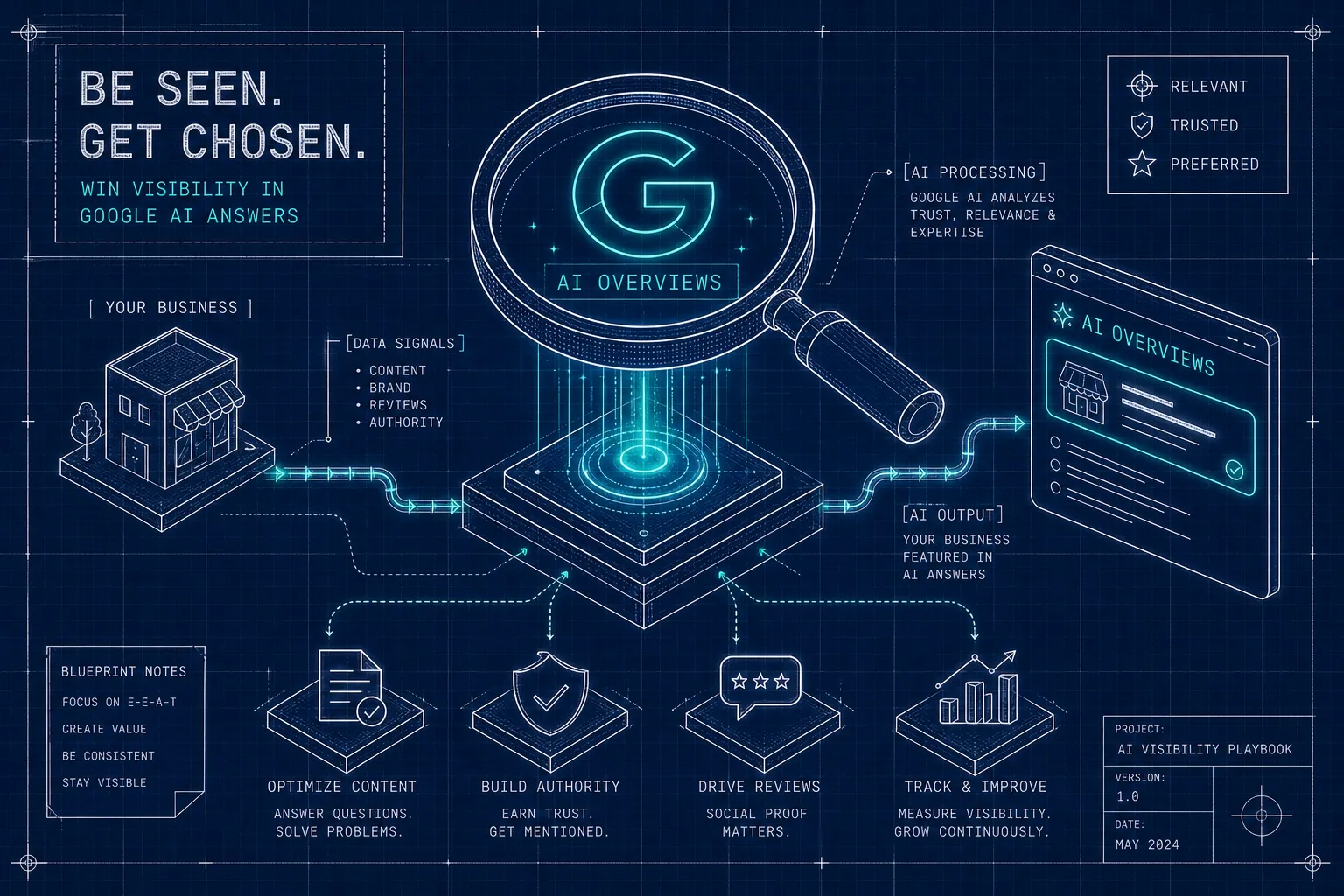
Google’s AI doesn’t browse the web randomly to build those answers. It pulls from specific, structured signals it can verify and cross-reference across multiple sources. Businesses that feed those signals clearly get surfaced. Businesses with inconsistent, incomplete, or thin data get skipped. Based on internal audits of local service businesses, a consistent pattern emerges: most are missing the same handful of fixable signals that block AI visibility, not massive technical problems requiring months of work.
This article walks through which signals matter most, how to optimize each one, and how to measure whether your changes are actually working inside Google’s generative AI search features. If you run an HVAC company, contracting business, or local service operation, these are the levers worth pulling first.
How Google AI Overviews decide which businesses to surface
Google hasn’t published a definitive algorithm for AI Overviews, but its Search Central documentation and observed citation patterns reveal a consistent picture. AI Overviews combine entity signals from the Knowledge Graph with retrieval signals from the live organic index. In plain terms, Google runs two parallel checks: is this a real, well-defined business entity, and does the web corroborate it?
The entity and index signals behind AI selection
The primary data sources Google AI draws from for local service businesses include your Google Business Profile (category, services, description, hours, and reviews), your business website, Knowledge Graph entity grounding, and structured data markup. Google is essentially asking: “Is this business a clearly defined entity with consistent, verifiable facts across multiple sources?” Businesses that answer that question confidently get surfaced. Those with conflicting data, thin descriptions, or no structured markup get skipped.
Research from Whitespark’s 2026 local search report shows that approximately 68% of local business queries in the United States now trigger an AI Overview. Some home-service categories show similar or higher rates, window cleaning, for example, comes in around 65%. That means AI Overviews aren’t an emerging feature to prepare for later; they’re the primary search result format your potential customers are already seeing. Platforms like Gemini Enterprise visibility and other AI-driven interfaces compound this further for businesses operating across multiple service lines.
Why conflicting data gets your business skipped
Corroboration is how Google’s AI builds confidence. When it sees the same business name, address, phone number, service descriptions, and service area repeated consistently across your GBP, your website, Yelp, BBB, Angi, and industry directories, its confidence in your entity increases. When those facts conflict, different phone numbers, inconsistent service area descriptions, outdated hours, the AI treats the business as ambiguous and skips it in favor of a cleaner entity. Consistency isn’t a nice-to-have; it’s the foundation every other optimization sits on.
Optimizing your Google Business Profile for Google AI business visibility
GBP optimization is the highest-leverage starting point for AI-driven business visibility on Google because GBP data feeds directly into AI-generated answers. But “optimized” here means more than filled in. It means written for how AI reads and synthesizes information to answer conversational queries.
The GBP fields that directly feed AI-generated answers
The fields with the clearest impact are your primary category (be as specific as possible, not just “contractor” but “HVAC contractor” or “roofing contractor”), service descriptions written in natural question-and-answer language, and a business description that clearly states who you serve and where. Attributes like payment methods, service options, and accessibility signals help AI match your business to intent-based queries. Product and service listings with pricing ranges give AI concrete decision-making data to include in answers.
When you write a service description, write it the way a customer would ask the question. “We provide emergency AC repair in [City] with same-day availability” maps directly to the queries that trigger AI Overviews. Generic descriptions like “HVAC services available” give AI nothing useful to work with.
Reviews, Q&A, and posts as AI content sources
Several GBP signals consistently get underused by local businesses. Review response quality is one: detailed replies that mention specific service types, locations, and technician names give AI more content to extract when building answers. A one-line “Thanks for your review!” contributes nothing. The Q&A section is another, it functions as a prompt-and-answer database sitting inside your GBP, so seed it with the exact questions your customers ask, paired with complete, location-specific answers. Fresh Google Posts signal ongoing activity and keep your profile current in generative AI search features, which favor active, well-maintained entities over dormant ones. Per Google’s own GBP guidance, regularly updated profiles are more likely to surface in local results across all formats.
Structured data and site content that AI reads and cites
Your GBP handles the entity layer. Your website handles the retrieval layer. AI Overviews cite pages from Google’s organic index, so your site must be structured for machine comprehension, not just human readers. The two aren’t mutually exclusive, but the structured data has to be intentional.
Schema types that matter most for local service businesses
For HVAC, contracting, and other home service businesses, the schema types with the clearest impact are LocalBusiness (or HVACBusiness for HVAC specifically), which provides address, hours, service area, and review data; FAQPage, which maps directly to conversational AI queries; HowTo for process-driven content like “how to prepare for a furnace inspection”; and Organization for brand entity grounding. Article and BlogPosting schema with authorship and publication dates strengthen your expertise signals over time.
One rule applies across all of them: only implement schema that accurately reflects what’s visible on the page. Mismatched markup doesn’t help and can actively harm your credibility with Google’s systems.
Page-level facts that help AI verify expertise
Beyond schema, AI evaluates page-level facts to assess credibility, author identity, publication and update dates, specific entity details (service types, locations, certifications), and concrete decision-making data like pricing ranges, service guarantees, and response times. A service page that states “emergency furnace repair with 2-hour response time in [City], starting at $89 diagnostic fee” gives AI exactly the kind of verifiable facts it uses to construct confident answers. A page that just says “we offer furnace repair” does not.
Trust signals and third-party citations that strengthen AI recommendations
A well-optimized GBP and website still won’t consistently appear in AI Overviews if the broader web doesn’t corroborate your claims. AI systems are more confident recommending businesses when multiple independent, authoritative sources tell the same story about the same entity.
Where to build the corroboration that AI relies on
For local service businesses, the third-party sources Google AI pulls from most consistently include Yelp, BBB, Angi, HomeAdvisor, Facebook Business, and industry-specific directories. For home services, that means platforms like Houzz and niche contractor directories. Reddit threads and YouTube content have been observed as sources in local AI Overviews for high-intent queries, more often than most business owners expect. Citation building in this context isn’t just about SEO link equity; it’s about entity verification at scale. Every consistent, accurate mention of your business across a trusted platform is another signal of confidence that Google’s AI can count.
How TW3 Marketing’s Authority Framework closes the trust gap
This is the exact problem that TW3 Marketing built its proprietary Authority Audit™ to address. The 100-point diagnostic scoring system measures six specific signals AI platforms use to recommend businesses: positioning, proof, expertise, visibility, engagement, and experience. HVAC companies, contractors, and insurance agencies that go through the framework regularly find the same pattern: their operational credibility is strong, but their digital authority signals are too weak and inconsistent for AI to confidently recommend them. The Authority Score™ Check is a 48-hour diagnostic that gives you a clear picture of where you stand in Google AI results, so you’re making decisions based on data, not assumptions. If you’re not showing up in AI Overviews for your core service queries, that’s the right place to start.
Measuring your Google AI business visibility and tracking changes
Traditional rank tracking doesn’t capture AI visibility. A business can rank #3 organically for a query and never appear in the AI Overview for that same query. These are separate systems with separate signals, and they require separate measurement approaches.
Tools built for AI visibility tracking
Several platforms now track whether your brand is mentioned or cited in AI-generated answers. Semrush, SE Ranking, AI Rank Lab, LLM Pulse, and Keyword.com all track brand presence inside AI Mode responses. Google Search Console provides a Generative AI performance report, but it delivers aggregate data rather than prompt-level brand tracking. For a clear picture of which queries are surfacing your business, and which are surfacing competitors, the dedicated AI visibility tools give you the granularity you need.
The metrics that actually matter: presence, citation rate, and share of voice
Four reporting metrics are worth tracking consistently:
- Mention rate, how often your brand name appears in AI answers across your tracked queries
- Citation rate, how often a page from your domain is linked as a source
- Citation position, where your URL appears in the citation list
- Share of AI voice, your citation share compared to competitors across the same set of prompts
Benchmarks vary by industry and market; treat any published ranges as directional rather than definitive until you’ve built your own baseline. Audit these metrics quarterly at minimum, monthly if you’re actively making changes.
A prioritized action plan to improve your AI visibility right now
Start with the actions that take the least time and deliver the most immediate signal improvement, then layer in the longer-term work that compounds over time.
Quick wins to execute this week
Run through your GBP and complete every field, with specific attention to services, business description, Q&A, and attributes. Then check your NAP consistency across your top five directory listings, Google, Yelp, BBB, Angi, and Facebook. Any discrepancy in your business name, phone number, or address needs to be corrected. Add FAQPage schema to your top three service pages, written to match the actual questions your customers ask. Finally, seed two or three Q&A responses on your GBP with specific service-and-location language. For a single-location business, these steps can often be completed in a few hours and directly feed the signals AI Overviews pull from.
Long-term authority building for sustained AI recommendation
The businesses that consistently dominate AI Overviews treat visibility as a program, not a project. They run systematic review generation processes that produce a steady stream of fresh, detailed reviews rather than occasional bursts. Content goes out on a regular schedule with clear authorship and updated dates. Citations get built across industry directories as a structured process, not an afterthought, and AI visibility metrics get audited quarterly to track what’s working and where gaps are reopening. Businesses that operate this way consistently outperform those chasing one-time fixes, because the signals AI relies on are cumulative, not static.
What this all comes down to
Google AI business visibility follows a clear pattern: entity verification, content clarity, cross-platform corroboration, and ongoing trust signal maintenance. Businesses that structure their GBP, website, and third-party presence around these signals give Google’s AI exactly what it needs to recommend them confidently. The signals are knowable, and the tools to measure progress now exist, so there’s no reason to optimize blindly.
If you want to know exactly where you stand before making changes, TW3 Marketing’s Authority Audit™ is the diagnostic built for this. It measures all six authority signals across your digital presence and gives HVAC, contracting, and insurance businesses a clear picture of what’s blocking AI recommendation and what to fix first. You don’t have to guess which gaps are costing you the most visibility.
Start with the audit, then fix what the data shows. That’s how you get recommended.
