
AI assistants like ChatGPT and Google AI Overviews don’t show ten blue links anymore. They pick one or two sources, generate a direct answer, and move on. If your site isn’t one of those sources, you don’t exist for that query. Not low-ranked. Not on page two. Gone.
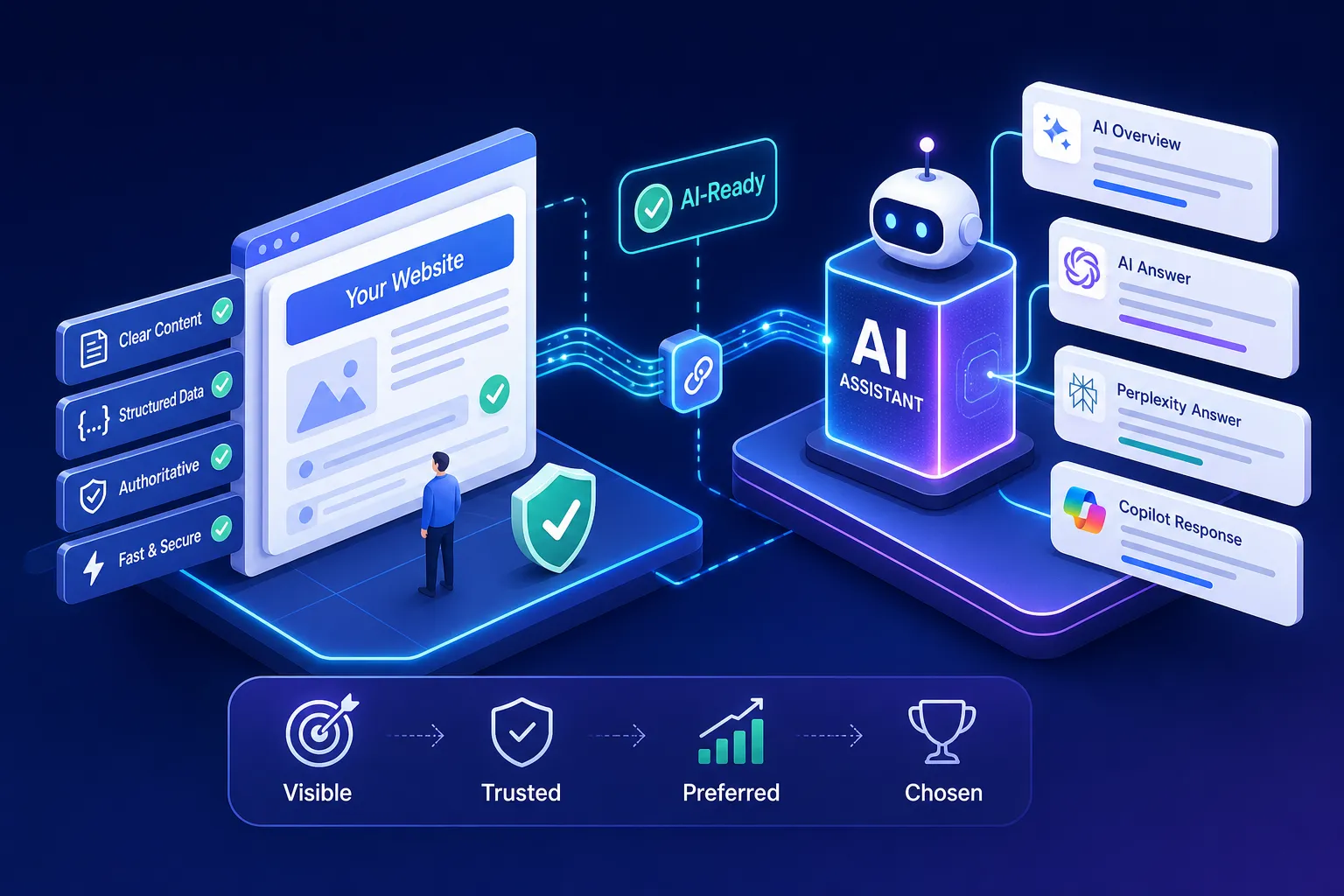
So what does your website need to show up in AI assistant answers? The short answer: structural clarity, verified credibility signals, and clean crawl access. This isn’t about gaming an algorithm. It’s about giving AI systems what they actually need to trust your site, extract from it, and cite it. These are the same elements we evaluate in every authority diagnostic we run for clients at TW3 Marketing, and most sites are missing at least three of them. The fix isn’t complicated, but it does require working through the right areas in the right order.
This article covers six areas: how AI assistants select which pages to cite, structured data markup, content format and expertise signals, technical crawl access, trust indicators and NAP consistency, and how to test what you’re actually getting in AI-generated answers right now.
What does my website need to show up in AI assistant answers?
What AI answer engines look for (and what they skip)
AI assistants evaluate pages across multiple dimensions at once: whether a crawler can reach the page, whether the content is extractable in a clean format, whether the entity behind the page is clearly defined, and whether the source appears trustworthy. A page that fails on any one of these dimensions gets passed over. AI systems aren’t choosing the best of ten results; they’re selecting a single source they can quote with confidence.
Why traditional SEO alone doesn’t get you into AI answers
A page can rank number one in Google search and still never appear in an AI-generated answer. Traditional ranking signals like keyword density, domain authority, and backlink counts don’t directly map to what AI systems use when constructing a response. The difference is structural clarity, not popularity. AI systems need to understand what a page is about, who wrote it, and whether that information is trustworthy enough to hand to a user as a direct answer. That’s the gap between traditional SEO and AI assistant search visibility.
Structured data markup: what AI reads before humans do
The Schema.org types that appear most in AI-cited pages
The schema types most commonly found on pages cited in ChatGPT and Google AI Overview answers are FAQPage, Organization, Article or BlogPosting, HowTo, and LocalBusiness. FAQPage performs especially well because question-and-answer pairs are directly extractable. An AI system can lift a question and its accepted answer and drop it into a response without any transformation required. Organization schema establishes the entity behind the content, which is how AI systems confirm that a business is real and disambiguate it from similar names.
For most service businesses, the starting combination is FAQPage plus Organization. FAQPage captures the service-specific questions your customers are asking. Organization anchors your business as a trusted entity behind the answers. Everything else builds from there.
How to implement markup without overcomplicating it
JSON-LD is the recommended format. Place it in the page head and keep it accurate. Here’s a minimal FAQPage example you can adapt:
{
  "@context": "https://schema.org",
  "@type": "FAQPage",
  "mainEntity": [{
    "@type": "Question",
    "name": "What does my website need to show up in AI assistant answers?",
    "acceptedAnswer": {
      "@type": "Answer",
      "text": "Your site needs clean crawl access, structured data markup, answer-first content, named author signals, consistent NAP data, and verified trust indicators."
    }
  }]
}
The properties AI systems extract most from FAQPage are Question.name and acceptedAnswer.text. For Article schema, the key fields are author, datePublished, and dateModified. For Organization, focus on name, url, sameAs, and contactPoint. One rule that matters: markup must accurately reflect what’s visible on the page. Schema that contradicts the actual content is ignored or penalized.
One schema type most service businesses skip
LocalBusiness schema with geo, areaServed, and aggregateRating properties is consistently underused. This markup tells AI systems exactly where you operate, what you do, and what customers think of you. Businesses with this in place have a clear entity-clarity advantage over competitors running generic page markup. For any service business competing in a local market, this is not optional.
Content format and expertise signals that earn citations
Answer-first structure and question-based headings
AI assistants pull from pages that answer directly, not from pages that build slowly toward a conclusion. The structure that works is simple: lead with the core answer in the first 40 to 60 words of a section, then support it with detail. Don’t save the point for the end of the paragraph, lead with it. H2 and H3 headings phrased as questions (for example, “What does an HVAC company need to appear in Google AI?”) map directly to how users query AI assistants, which makes those headings easier for AI systems to match against incoming queries. This is one of the fastest wins for AI answer attribution.
Expertise signals AI systems can actually verify
Named author bylines with credentials, consistent author profiles linked to external publications, specific data points with cited sources, and content depth that goes beyond surface-level summaries are all signals AI systems use to assess credibility. These are the same markers Google’s E-E-A-T evaluation rewards: experience, expertise, authoritativeness, and trustworthiness. A page written by an unnamed author with no credentials and no supporting data looks, to AI systems, like content produced by anyone, anywhere, for any reason. Give AI systems something to verify.
Technical crawl access: the foundation everything else depends on
Robots.txt, sitemaps, and page speed basics
If an AI crawler can’t reach your page, nothing else matters. Check your robots.txt file and confirm that AI crawlers including GPTBot, Google-Extended, and OAI-SearchBot are not blocked. Verify your XML sitemap is current and submitted. Core Web Vitals compliance also matters here: slow pages and render-blocked pages are less likely to be successfully fetched for real-time answer retrieval. These aren’t advanced technical tasks. They’re the minimum access requirements that a surprising number of sites still fail.
What llms.txt is and how much it matters right now
The llms.txt spec is a markdown file placed at your site root. A minimal example looks like this:
# Your Business Name
> A brief description of what your business does and who it serves.

## Key Pages
- [Services](https://yourdomain.com/services)
- [About](https://yourdomain.com/about)
- [Contact](https://yourdomain.com/contact)
It requires an H1 with your site name, a blockquote summary, and optional H2 sections linking to key pages. The idea is to give AI systems a clean index of your most important content. Here’s the honest reality: Google’s John Mueller has publicly stated that no AI systems are currently using llms.txt, and OpenAI has not confirmed production adoption. It takes about 20 minutes to implement and costs nothing, so add it. But don’t treat it as a fix. It’s a signal of intent, not a ranking mechanism. The technical fundamentals covered above matter far more.
Trust indicators and NAP consistency AI systems verify
The trust signals that separate cited sources from ignored ones
AI systems cross-reference several credibility signals before deciding whether to cite a source: aggregate review ratings with sufficient quantity and recency, HTTPS, a clear About page, author pages, a privacy policy, and terms of service. These aren’t advanced tactics. They’re table stakes that many service business websites still skip. A site without an About page or without any visible review ratings looks thin to an AI system evaluating whether it’s a trustworthy source to hand to a user.
Why NAP consistency is a credibility signal, not just an SEO checkbox
AI systems pulling data from multiple sources including Google Business Profile, Yelp, LinkedIn, and Bing Places cross-reference your business name, address, and phone number to verify you’re a real, stable entity. Conflicting NAP data introduces ambiguity. An AI assistant won’t confidently cite a business it can’t clearly identify. The audit should cover directory listings, your website footer, your structured data, and social profiles. Exact matches across all of these tell AI systems the same consistent story about who you are and where you operate. This is a core component of AI search provenance, the chain of evidence AI systems use to confirm your business is what it claims to be.
How to test your AI visibility and know what to fix first
Practical ways to check if AI assistants are citing your site
Query ChatGPT and Perplexity directly with the phrases your customers would use: “best HVAC company in [city],” “who do you recommend for [service] in [area],” “what’s the top-rated [service] contractor near [location].” Check Google AI Overviews for your core target queries as well. Then run a business-specific prompt: “What do you know about [your business name]?” Document what comes back. Thin responses or no mention at all tell you exactly where your authority signals are weak.
Repeat the same prompts multiple times across different sessions, because AI answers vary between runs. Save screenshots. Track which competitors are being cited instead of you. That shows you whose authority signals AI systems are treating as more credible for those queries right now.
Getting a full diagnostic without spending weeks on it
The prioritization order is straightforward: fix crawl access first, then structured data, then content structure, then trust signals. Work through these in sequence and don’t skip ahead. A perfectly formatted FAQ schema block does nothing if GPTBot is blocked from reaching the page.
For business owners who want a complete picture without running this manually, TW3 Marketing’s Authority Audit™ is a 100-point diagnostic built specifically around the six authority signals AI platforms use when recommending businesses. It covers positioning, proof, expertise, visibility, engagement, and experience, and it delivers a full prioritized report within 48 hours.
Start with what AI systems need, not what you assume they want
The question isn’t just “why isn’t my site ranking?” It’s “what does my website need to show up in AI assistant answers?” The six areas covered here give you a direct answer: AI assistants select sources based on crawl access, structured data markup, content format and expertise signals, trust indicators, and NAP consistency. Work through them in order. The businesses showing up in AI-generated answers aren’t lucky. They’ve made their sites readable, credible, and extractable to AI systems, and that’s a repeatable process.
You don’t need to fix everything at once. Start with crawl access and structured data, because those two areas determine whether AI systems can reach and interpret your pages at all. Then work through content structure and trust signals. Small, specific fixes in the right order produce visible results faster than a broad overhaul with no clear sequence.
If you want a clear starting point with no guesswork, the TW3 Marketing Authority Audit™ gives you a scored baseline across all six authority areas and a clear sequence to follow. Request your Authority Score™ Check today and see exactly how your business currently appears in Google and ChatGPT within 48 hours.
