
If you’re wondering how can a service business get leads without running ads, the short answer is: build organic channels that compound over time. Most service businesses assume they need to spend money to get clients. Run more ads. Increase the budget. Repeat. The problem with that logic is simple: when the ad spend stops, so do the leads. That’s not a marketing strategy; it’s renting an audience you’ll never own.
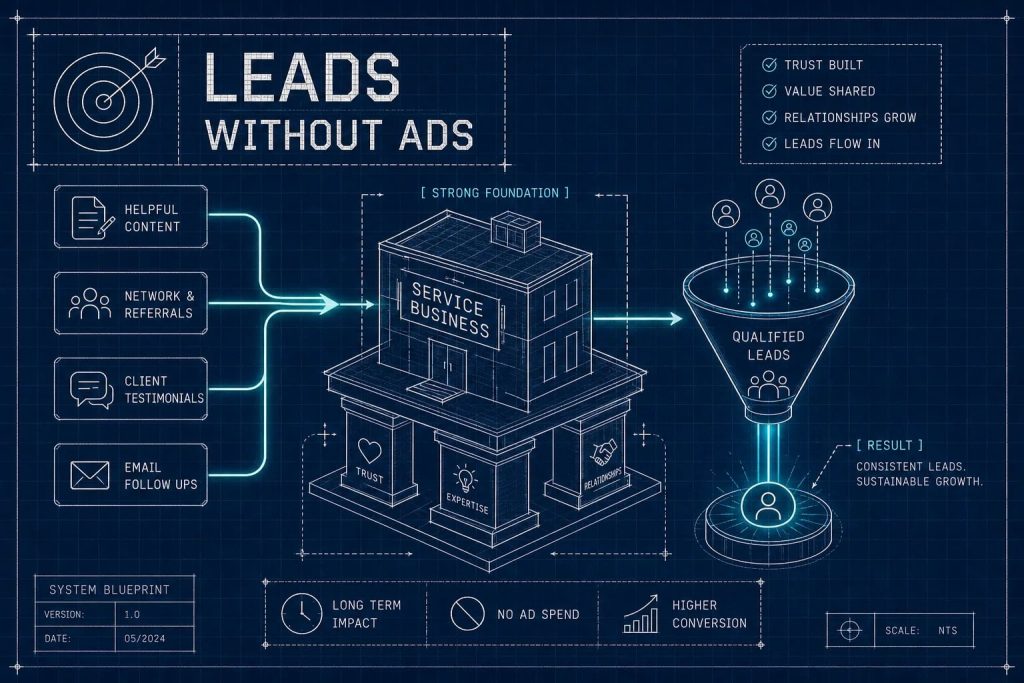
The businesses that build real pipelines do it differently. They invest in channels that compound over time, channels that work while you’re on the job, not just while you’re paying. Referrals convert at 3, 5x the rate of cold paid leads. Organic search closes at 14.6% in home services. Phone calls from organic local inquiries convert at 46%. The opportunity is sitting there for almost every service business. Most just haven’t built the systems to capture it.
What follows is a prioritized, practical playbook: the organic lead channels that actually work for service businesses, ranked by impact, with real numbers behind each one and a clear action plan for the next seven days.
Why Organic Leads Outperform Paid Ones, and How a Service Business Can Get Leads Without Running Ads
Paid advertising has one fatal flaw: it resets to zero. Every dollar you spend buys a temporary slot in front of a buyer. The moment you pull back, visibility disappears. Organic channels don’t work that way. A well-optimized Google Business Profile keeps generating calls. A referral system keeps producing introductions. Content keeps attracting search traffic. The effort stacks rather than evaporates.
The conversion data makes the case plainly. Referrals close at 3, 5x the rate of cold leads because trust is already baked in. Organic search closes at 14.6% in home services, significantly higher than typical cold outreach, which tends to run in the low single digits depending on the channel and list quality. Google Business Profile calls convert to booked jobs at roughly 42%, comparable to the best-performing paid channels. If you’re ignoring organic, you’re likely leaving your highest-quality leads on the table and paying to replace them with costlier, lower-intent ones.
Your Google Business Profile Is Your Single Highest-Leverage Free Asset
Most service businesses claim their Google Business Profile and walk away. That’s like opening a store, unlocking the door once, and never stocking the shelves. GBP is where high-intent buyers find service businesses, through “near me” searches, Google’s AI Overviews, and local pack results. It drives roughly 50, 60% of inbound leads for local service businesses. There is no faster or higher-return investment in your organic pipeline.
The GBP Optimization Checklist
The priorities that actually move the needle for local SEO for service businesses are:
- Set the correct primary category that reflects your core revenue service
- Make sure your name, address, and phone number are identical across every directory and your website
- Upload real photos of your team and completed work
- Build a steady flow of recent reviews (the last 90 days carry the most weight)
- Respond to every review within 24, 48 hours
GBP edits and review activity can shift local rankings within 2, 4 weeks, while broader organic authority signals typically take 3, 6 months to move. This is your fastest lever, pull it first.
Staying Visible After Setup
After the initial setup, consistency is what separates businesses that stay visible from those that drift. Weekly, post an update, respond to messages, and request new reviews. Monthly, add fresh photos, verify your hours are accurate, and check your profile performance metrics. Google interprets consistent activity as a signal that the business is real, current, and trustworthy. That signal directly affects where you appear in results.
Building a Referral System That Generates Leads on Autopilot
Most service businesses get referrals passively. A happy client mentions them to a neighbor. That’s not a system; that’s luck. Some businesses do a little better by remembering to ask occasionally. That’s still not a system. A real referral system for service companies has a trigger, a reward structure, and a follow-up sequence. Without all three, you’re relying on client memory and goodwill to do work that infrastructure should be doing.
Referral Marketing Numbers Worth Knowing
The numbers behind referral marketing for service companies are hard to ignore. Referred leads close at 15, 35%, significantly higher than typical cold leads, which tend to convert in the low single digits across most outbound channels. Dual-sided rewards, where both the referrer and the new client receive something, consistently outperform one-sided offers. For home services, common incentive structures include cash per booked job, service discounts, or account credits. Programs with automated follow-up average around $65 per converted referral in home services, with incentive spending typically running 3, 5% of referral-attributed revenue. For higher-ticket jobs like roofing or HVAC replacement, payouts often range from $100, $200 per conversion.
The best moments to introduce the referral ask are after job completion, right after a client leaves a positive review, and at invoice delivery. These are peak satisfaction moments. Keep the ask human and simple: no corporate program language, no long enrollment forms. Then automate the follow-up so the system works without depending on anyone’s memory. That’s the difference between a referral program and a referral habit.
Lead Magnets and Content That Get Leads Without Running Ads
Static content, generic blog posts, and FAQ pages rarely convert on their own for service businesses. The formats that actually perform are the ones that mirror the experience of hiring you. An estimate tool, a diagnostic checklist, a scoped audit: these feel like the first step of starting a project, which is exactly what a high-intent buyer is looking for.
Conversion rates break down clearly by format. Interactive quizzes and assessments convert at 35, 50% in service contexts. Cost estimators and ROI calculators run 20, 35% for local service businesses. Free audits and strategy calls come in at 5, 23%, depending on execution and traffic quality. A case study tied to a specific client outcome works well for buyers already in evaluation mode, not for cold traffic. The pattern is consistent: the more the lead magnet resembles the beginning of your actual service, the better it converts.
Between the data-heavy formats, it’s worth noting what doesn’t work: generic downloads, vague guides, and anything that requires a buyer to self-educate before they can see value. Those formats stall in inboxes. The high-converting ones put value in the buyer’s hands immediately.
For most service businesses, a scoped estimate tool or a short diagnostic checklist beats a long eBook every time. Pick one format, build it properly, and put it on the highest-traffic page of your site before adding more. Pair it with your GBP and local service pages targeting specific problems and locations. That combination creates a compounding effect: search traffic lands on a page designed to capture and convert, not just inform.
How AI Visibility Is Becoming a Lead Channel You Can’t Ignore
When someone asks ChatGPT or Google AI who to call for HVAC repair, roof replacement, or insurance quotes, those platforms return recommendations. This is happening right now, and it’s changing how service businesses get found. The businesses showing up in those responses aren’t the ones spending the most on ads. They’re the ones with the strongest authority signals: consistent NAP data across the web, recent reviews with real sentiment, structured website content that clearly states services and location, and third-party mentions in directories and local publications.
Across the more than 4,500 clients Bobby Christy and his partner Terry Wilson III of TW3 have served since 2008, and in TW3 Marketing’s Authority Audit™, the same gap shows up repeatedly: businesses with decent website traffic but weak trust signals get passed over by AI platforms and searchers in favor of competitors with stronger authority footprints. Based on that audit experience, and consistent with how AI recommendation systems evaluate sources, six signals drive AI recommendation likelihood: positioning, proof, expertise, visibility, engagement, and experience. Closing gaps in those six areas is what moves a business from invisible to recommended, without touching ad spend.
If you don’t know how your business currently appears in ChatGPT and Google AI responses, you’re optimizing blind. TW3 Marketing’s Authority Score™ Check gives you a clear snapshot of where you stand across these signals. It’s the diagnostic step that tells you which organic channels to prioritize before you invest more time in any of them. You can request yours at TW3 Marketing.
Your 7-Day Action Plan and the Metrics That Matter
Three moves in the next seven days will get every one of these systems started:
- Days 1, 2: Audit your Google Business Profile against the checklist above. Fix your primary category, update photos, and verify your hours and NAP consistency across directories.
- Days 3, 4: Identify your top 10 recent clients and write a simple, human referral ask into your post-job follow-up sequence.
- Days 5, 7: Go to the highest-traffic page on your website and add onehigh-converting lead magnet, either an estimate tool, an audit offer, or a diagnostic checklist.
Once those are in place, track the right metrics so you know what’s working:
- GBP: Profile views, call clicks, direction requests, and review velocity
- Referrals: Number of referrals per month and your referral-to-booked ratio (benchmark: 15, 35%)
- Content and lead magnets: Opt-in conversion rate and lead-to-call rate
- AI visibility: Ask ChatGPT directly who they’d recommend for your service category in your city. If your business doesn’t appear, that’s diagnostic information you need to act on.
The Real Answer to How a Service Business Gets Leads Without Running Ads
If you want to know how can a service business get leads without running ads, the answer isn’t a single tactic, it’s a set of compounding systems. Organic lead generation for service businesses doesn’t require a bigger budget. It requires better infrastructure. The businesses building authority, referral systems, and AI visibility right now won’t be dependent on ad spend a year from now. Start with one channel. Build it completely. Then layer the next. That’s how pipelines get built, and how they stay full.
