
An HVAC contractor in Phoenix grinds for three years to hit the top spot on Google for “AC repair Phoenix.” They get there. Organic traffic is up, the phone rings steadily, and the rankings hold. Then a homeowner walks inside from 108-degree heat, skips Google entirely, and asks ChatGPT who to call. A different contractor’s name comes up. The Phoenix contractor doesn’t exist in that conversation.
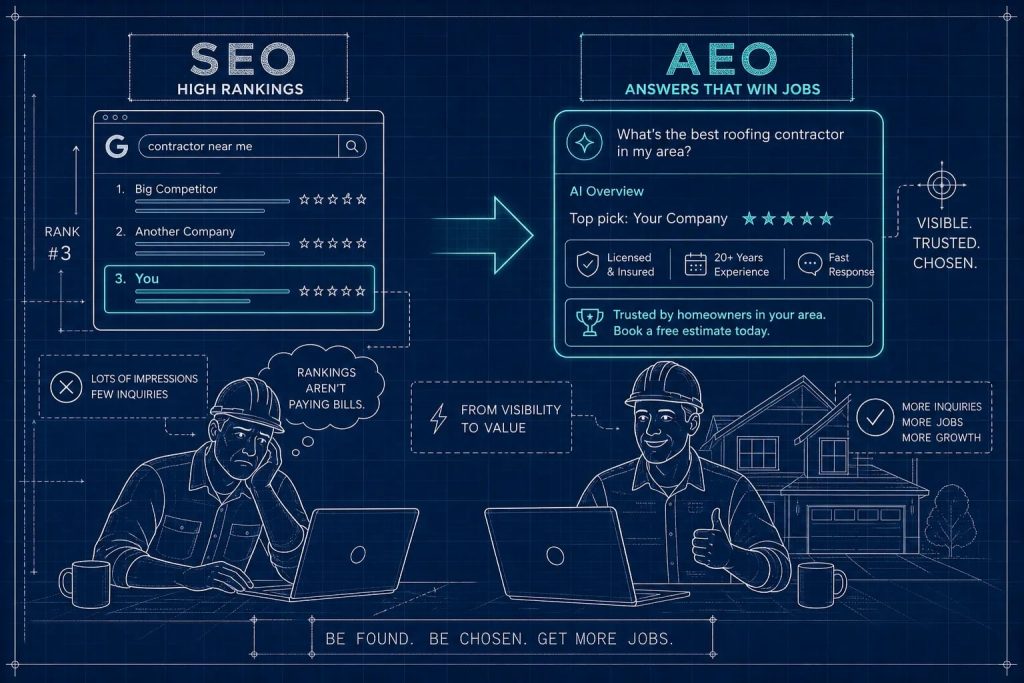
This scenario captures the core tension in contractor SEO vs AEO, two optimization systems that now run in parallel, producing separate outcomes. Answer engine optimization (AEO) determines whether your business gets cited when AI platforms answer homeowner questions directly, while traditional SEO still governs whether you rank when someone clicks through to a search results page. For home service trades where trust drives the hiring decision and urgency compresses the research window, the gap between those two outcomes has a direct dollar value. This article explains exactly what separates the two systems, where contractors are losing ground, and what to do about it.
Why ranking #1 on Google no longer guarantees the lead
The click behavior shift AI search created
Google AI Overviews, ChatGPT, and voice assistants now intercept a growing share of queries before a user ever sees a list of blue links. When someone asks “who’s the best plumber near me,” they increasingly get a direct name, not ten pages to browse. According to BrightLocal’s 2026 Local Consumer Review Survey, 45% of consumers used AI to find a local business in the past year, and 27% did so in the past week. A 2025 Semrush analysis found that 17.7% of home service queries triggered Google AI Overviews, with that rate dropping to around 12% when local modifiers like city names were added.
For contractors, this matters more than for almost any other business category. Broken AC units, burst pipes, and missing shingles are high-urgency, high-trust decisions made fast. That’s exactly the query profile where AI-first behavior is strongest. The user doesn’t want to compare ten plumber websites. They want a name they can trust, and AI gives them one.
What “zero-click” actually means for home service businesses
Zero-click search isn’t new, but AI-generated answers have expanded it far beyond the old featured snippet game. Here’s the structural problem: a contractor ranked #3 on Google with strong structured data, clear entity signals, and an active Google Business Profile may get cited by ChatGPT, while a contractor ranked #1 with none of those signals gets passed over entirely. SEO rank and AI recommendation are now two separate outcomes. Optimizing for one doesn’t automatically produce the other, and most contractor sites are only optimized for one.
Contractor SEO vs AEO: What each system is actually optimizing for
How traditional SEO works for contractor sites
SEO optimizes for ranking. It uses backlinks, on-page keyword relevance, domain authority, and technical crawlability to earn positions in Google’s organic results. For local contractors, this has traditionally meant service pages, location pages, Google Business Profile signals, and review counts all working together. The outcome metrics are rankings and organic traffic, both of which assume the user opens a browser, types a query, and clicks a link.
This system has worked well for over a decade, and it still matters. The problem isn’t that SEO stopped working. It’s that a second system now runs parallel to it, using different inputs to produce different outputs.
How answer engine optimization (AEO) works differently
AEO optimizes for citation. It structures content so AI systems can extract, trust, and repeat the business’s answer to a user’s question. The signals AI answer engines weight most heavily are entity clarity (is it unambiguous who this business is and what they do?), structured data markup, question-and-answer content formats, and third-party mentions that validate the business’s expertise and location. Generative engine optimization (GEO) describes the same goal applied specifically to generative AI platforms like ChatGPT and Gemini.
The clearest way to hold the distinction is this: SEO says “find my page”; AEO says “use my answer.” In SEO, strong backlinks can carry a page even when the structure is rough. In AEO, structural clarity and entity precision matter more, because the system needs to extract a reliable answer fragment and attribute it to a real, verifiable business.
How the contractor SEO vs AEO gap plays out for HVAC, roofing, and plumbing
The HVAC contractor example: visibility without presence
Picture an HVAC company that ranks solidly for “AC tune-up [city].” Their service pages are keyword-optimized, their site loads fast, and they have a decent backlink profile. But their service pages have no FAQ schema, no structured service descriptions, and no Q&A content written the way a homeowner would phrase a question. When a homeowner asks ChatGPT “who does AC maintenance in [city],” the AI pulls from content it can parse and cite. This contractor’s site gives it nothing usable, so it gets skipped entirely.
Meanwhile, a competitor with half the backlinks but a well-structured service page, FAQPage schema, keyword-rich Google reviews, and a complete Business Profile gets cited instead. The winning contractor didn’t necessarily outwork the losing one on SEO. They built pages that AI systems could actually read and trust.
Roofing and plumbing: where trust signals determine the AI pick
For roofing, a high-cost, high-stakes decision, some homeowners now consult ChatGPT for a recommendation before they open Google at all. That makes AEO the first impression, not a secondary channel. It’s worth noting that Google AI Overviews and ChatGPT operate differently: Overviews are integrated directly into search results and draw on Google’s index, while ChatGPT recommendations are shaped by model training and, where enabled, real-time browsing. Both reward the same underlying signals, but the pathways differ. For plumbing, emergency-intent queries like “emergency plumber near me at 2am” are increasingly answered by voice assistants, where exactly one business name gets spoken. There’s no second place in a voice answer.
The contractors consistently winning AI citations share a common set of traits: clear entity signals on every page, service-specific schema, review volume with recent activity and keyword-rich text, and content that directly answers the questions homeowners actually ask. None of that is accidental, and none of it comes from traditional SEO alone.
The tactical changes that improve AI visibility for contractor sites
Local SEO signals that AI systems still rely on heavily
Google Business Profile optimization remains the foundation, and it feeds both Google AI Overviews and the broader web presence that ChatGPT draws from indirectly. Primary category precision matters more than most contractors realize: it tells Google exactly what the business is and whether it’s eligible for a given query. Beyond category, a complete services list, defined service area, recent photos, and consistent review velocity are the signals AI systems cross-reference to validate relevance and trust.
NAP consistency across directories, name, address, and phone number matching everywhere it appears, is unglamorous work, but it’s the foundation that makes a contractor’s entity unambiguous to AI systems. Review text that mentions specific services and job types gives AI extractable context far beyond what a star rating alone provides. A review that says “fixed our AC compressor the same afternoon we called” is citable. A review that says “great service” is not.
Structured data and schema for contractor service pages
FAQPage schema on every service page is one of the highest-leverage AEO tactics available to contractors right now. It mirrors exactly how AI systems answer questions and presents extractable Q&A pairs that are purpose-built for citation. Organization and LocalBusiness schema establish entity clarity: who you are, where you serve, what you do, and how to reach you.
For contractors, the specific schema subtypes matter: HVACBusiness, RoofingContractor, Plumber. These signal relevance at the category level, not just the page level. HowTo schema works well for process-oriented content like what to expect during an HVAC tune-up or how a roof inspection is conducted. Service schema on individual service pages maps each offering directly to the contractor entity. The most important technical rule: only use schema for what is actually visible on the page. Structured data that describes content the user can’t see is a trust signal that fires backwards.
Answer-first content structure on service pages
Rewrite your service page openings so they lead with a direct answer to the most common homeowner question about that service. Not a keyword-stuffed headline. Not a generic company intro. Lead with a real answer. Add a dedicated FAQ section to every service page with four to six questions written the way a homeowner would phrase them to ChatGPT, not the way a contractor would write a headline. Use clear headings, short paragraphs, and self-contained answer passages. AI systems extract fragments, so every passage should be able to stand alone as a useful, citable answer.
How to find out if your digital presence is ready for AI search
Why guessing your AEO readiness is a losing strategy
Most contractors assume that strong Google rankings mean they’re visible everywhere. The research shows that’s not accurate, and the gap is widening as AI search adoption grows. Running a structured diagnostic before implementing tactics ensures you’re fixing actual gaps, not just adding schema to pages with bigger structural problems underneath. Without a baseline, there’s no way to measure whether AEO efforts are moving the needle or just adding complexity.
What TW3 Marketing’s Authority Audit™ reveals about AI readiness
TW3 Marketing developed their 100-point Authority Audit™ to evaluate the signals AI platforms use to recommend businesses, not just traditional SEO metrics. The audit scores a contractor’s digital presence across six authority signals: positioning, proof, expertise, visibility, engagement, and experience. These map directly to the factors that determine whether AI systems like ChatGPT and Google AI surface a business when a homeowner asks for a recommendation.
Contractors who complete the Authority Audit™ receive a detailed breakdown of where their digital presence falls short for AI recommendation engines, along with a prioritized roadmap for closing those gaps before investing more in ads or content creation. It’s the diagnostic step that removes the guesswork from every tactic that follows.
The KPIs that tell you if your AEO efforts are actually working
Tracking AEO performance alongside traditional SEO metrics
Traditional SEO KPIs, rankings, organic traffic, and click-through rate, still matter and should still be tracked. AEO doesn’t replace them; it adds a second measurement layer. Add these AEO-specific KPIs to your reporting:
- AI citation frequency: How often does your business appear when you test relevant queries in ChatGPT or Google AI?
- Featured snippet capture rate: Are your structured pages earning the position-zero placement?
- People Also Ask impression volume: Tracked via Google Search Console.
- Voice search result inclusion: Manual testing of common local queries via voice assistant.
Set a monthly testing cadence: query 10 to 15 variations of your core services, record which contractors appear, and note what content from those sites is being cited.
Leading indicators that AEO is taking hold
One early signal to watch is FAQ schema activity in Google Search Console. Rich result reports will often show FAQ impressions before broader citation changes become visible. Increases in branded searches and direct visits often correlate with AI recommendation exposure driving name recognition in channels that don’t show up in traditional attribution. Review velocity and Google Business Profile interaction spikes can indicate that more people are finding and evaluating the business from non-traditional search paths.
Consider a 90-day review cycle for AEO KPIs as a practical starting heuristic. AI recommendation patterns may evolve on a different cadence than Google’s organic rankings, so evaluating over a 60- to 90-day window gives you a more accurate picture than week-over-week comparisons. The trajectory over a quarter tells a more accurate story than any single week’s data.
Contractor SEO vs AEO: Start with where you actually stand
Contractor SEO and AEO aren’t competing strategies. They’re sequential layers of the same system. The local SEO and technical foundations still matter; AEO tactics build on top of them, not instead of them. Trying to skip the foundation to get to AEO faster produces fragile results. Ignoring AEO because Google rankings look good means leaving an increasingly large share of AI-driven leads on the table.
The contractors who start building AEO-ready digital presence now will have a compounding advantage as AI search adoption continues to grow. Every AI citation reinforces the contractor’s authority. Every month a competitor earns citations and you don’t is a month harder to recover. According to a case study published by a national home services franchise, running AEO tactics across thousands of locations produced 458% AI visibility growth over the measurement period, an agency-reported figure, but one that reflects the scale of the opportunity even when discounted for promotional framing. That’s not a small edge.
The practical first step is knowing exactly where your digital presence stands today. Before adding more content, more ads, or more schema, get the diagnostic that shows you what’s actually broken. When you’re ready to understand how your business performs across the signals that drive SEO and AEO for contractors, TW3 Marketing’s Authority Audit™ scores your digital presence across the six authority factors AI systems use to recommend local businesses, and tells you what to fix first. Reach out to TW3 Marketing to request your Authority Score™ Check and get a clear picture of where your business stands in both Google and AI search.
