
Most service business websites look perfectly fine to the person who built them. The problem is that a first-time visitor isn’t you. They land on your site without context, without a referral, and with zero reason to trust you yet. If they can’t quickly answer three questions, Is this business real? Are they qualified? Have other people used them?, they leave without calling, without filling out the form, and without ever becoming a client. So how do you build trust signals for your service business website in a way that actually stops that from happening?
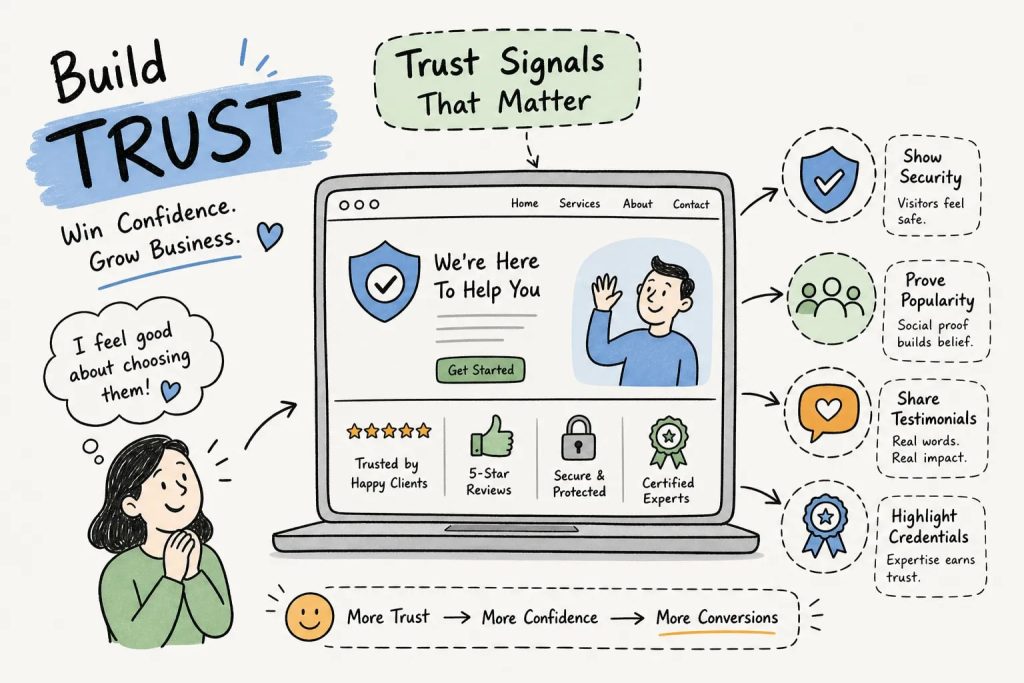
The stakes are higher now than they were even a few years ago. Your website doesn’t just need to convince human visitors. AI search systems like Google AI Overviews and ChatGPT evaluate similar credibility signals, structured data, review consistency, contact clarity, and demonstrated expertise, when deciding which businesses to surface in their recommendations. A site that looks uncertain to a visitor looks uncertain to an algorithm too. That’s the trust gap, and it’s costing service businesses leads from both directions.
This article walks through the trust signals that matter most for service websites: where to put them, why they work, and the technical steps to make them readable to both people and machines. If you want to know exactly where your gaps are before you start, TW3 Marketing’s Authority Score™ Check gives you a clear picture of how your business currently appears in Google and ChatGPT, typically delivered within 48 hours.
Why trust signals affect both your visitors and AI search engines
When a visitor lands on your site, they don’t read it top to bottom. They scan. Within the first few seconds, they’re running a mental checklist: Does this look professional? Is there social proof? Can I easily reach someone? Missing signals at any of those checkpoints create doubt, and doubt kills conversions. Service businesses that feature client testimonials prominently report substantially higher conversion rates than those that don’t, some studies suggest the lift can reach 34%. That number reflects a simple human truth: people reduce risk by looking for evidence that others have already made the same decision safely.
AI systems work differently but arrive at a similar conclusion. ChatGPT and Google AI Overviews don’t just crawl your pages for keywords. They evaluate authority signals: structured data, review consistency, contact detail clarity, and the depth of expertise demonstrated across your content. A site that lacks these signals isn’t just harder for humans to trust, it’s less likely to be recommended by AI, regardless of how much you spend on ads. Many competitors still under-invest in machine-readable trust signals, which makes this one of the more practical advantages available to service businesses right now.
Reviews and testimonials: the trust signal with the biggest conversion impact
Placement matters more than most businesses realize. A Google review widget displayed above the fold, visible without scrolling, can increase form submissions by 15 to 25%, according to conversion rate studies. That’s not a subtle effect. It happens because you’re addressing the visitor’s uncertainty at the exact moment they’re deciding whether to stay on the page. Generic testimonials pages, buried in the navigation, don’t produce that kind of result because relevance and proximity to the decision point drive conversions, not review volume in isolation.
Where to place reviews for maximum impact
The three highest-impact placements for a service website are the homepage, individual service pages, and the contact or booking page. Each placement should feature reviews relevant to the specific service or action being considered on that page. A roofing company’s storm damage page should show reviews about storm damage repairs, not general praise. Professional case studies with specific metrics outperform general testimonials as conversion tools, some research puts the gap at 30 to 50%, because specificity is what creates credibility.
Format matters too. Real names, real photos, and outcome-specific language are what separate a credible review from generic praise. “They fixed our HVAC before noon and the price matched the quote exactly” is far more persuasive than “Great service, highly recommend.” Short excerpts with a full name and role work best on service pages. Longer stories and detailed case studies belong on a dedicated results page for visitors who want deeper proof before committing.
Credentials, team bios, and visible proof of expertise
Industry certifications, BBB accreditation, and platform-verified badges function as website credibility indicators. They work because they shift the trust burden off you and onto a recognized third party. Trust badges placed near the conversion point, next to your CTA button or above your contact form, have been associated with conversion increases of 10 to 30% in testing. BBB accreditation is especially recognized by U.S. consumers as a signal of business legitimacy, which makes it more than just a logo to stick in a footer.
The key word there is “relevant.” A certification badge that matches the service being offered on that page works. A cluster of unrelated logos stacked at the bottom of your homepage doesn’t. Security seals from recognized providers are best placed near contact forms and booking pages, where security concerns are highest. Don’t bury credentials where no one will see them at the moment they’re making a decision.
Why real team photos and bios matter more than you think
Real team photos and named bios are one of the most underused trust signals in service marketing. Replacing stock photos with real professional headshots can meaningfully improve conversions, figures from various studies range from 12 to 20%. For service businesses, bios should be functional, not decorative: list credentials, years of experience, and a direct connection to the service the person delivers. This matters to human visitors who want to know who they’re inviting into their home or business, and it matters to AI systems that evaluate expertise depth when deciding whether a page is authoritative enough to recommend.
Contact information, NAP consistency, and local credibility
Visible contact information is a trust signal that’s easy to overlook because it feels obvious. It shouldn’t be. Research indicates that visible phone numbers can significantly increase leads, some studies point to lifts around 54%. The mechanism is straightforward: a phone number signals that the business is reachable, accountable, and not hiding behind a form. Display your primary phone number in both your header and footer. Put your full NAP (Name, Address, Phone) in plain text on your contact page and in the footer of every page. Use text, not images, so search engines can read it and users can copy it.
NAP consistency across your website and every directory listing is foundational for local SEO. When your business details match across Google Business Profile, Yelp, Angi, and your own site, search engines can confidently connect reviews, links, and mentions to a single verified entity. Inconsistent NAP creates conflicting data that weakens your local authority signals and, in practice, reduces your visibility in local search results.
The same logic applies to AI systems. Google AI and ChatGPT cross-reference business information across multiple sources. Consistent, crawlable contact details reinforce your local authority and increase the likelihood of appearing in AI-generated local recommendations. Add a response-time statement near your contact form, something like “We respond within one business day”, to address the uncertainty visitors feel before they submit their information.
The technical trust layer: SSL, security badges, and schema markup
HTTPS is non-negotiable. A site without SSL shows a “Not Secure” warning in the browser, which is enough to end the session for many visitors before they’ve read a single word. Beyond the browser indicator, HTTPS is a confirmed ranking signal that affects how your site is evaluated and how securely Google indexes it. It’s the baseline, not a differentiator, but missing it quietly undermines every other trust metric you’ve built.
Security seals from recognized providers placed near contact forms and booking pages can drive meaningful improvements in form completion rates; ecommerce research has documented gains in the 18 to 42% range, and similar dynamics apply when service site visitors face the same moment of commitment before submitting personal information. Place seals adjacent to the form itself, not in the header or footer where they’re contextually disconnected from the action being taken.
Schema markup: making trust signals machine-readable
Schema markup is the technical layer that makes your trust signals readable to search engines and AI systems. Three types matter most for service businesses:
- LocalBusiness schema communicates your NAP and aggregate ratings in a structured format search engines can parse.
- Service schemamarks up individual service offerings and associated content in a machine-readable format.
- Review with AggregateRating makes your review data machine-readable and can make it eligible for rich result display, though Google’s eligibility rules for review rich results are specific, so consult Google’s review snippet guidelines and test your implementation carefully.
Use JSON-LD format; it’s the most maintainable approach and the one Google explicitly recommends. One critical policy rule: only mark up reviews that are visibly displayed on the page. Marking up reviews that aren’t visible violates search engine guidelines and can result in manual actions against your site.
How a structured authority audit reveals the trust gaps costing you clients
Most service businesses have some trust signals in place. The problem isn’t a complete absence of credibility indicators, it’s that gaps in the wrong places suppress conversions in ways that are hard to see without a structured diagnostic. Businesses might have great reviews but display them only on a testimonials page no one visits. They might have legitimate credentials listed only in the footer. They might have inconsistent NAP across dozens of directories without realizing it. Each gap quietly kills the effect of the signals that are working.
A proper trust signal audit maps the full picture: review volume, recency, and placement; credentials displayed and linked; contact detail clarity and NAP consistency; SSL and schema implementation; and content depth across bios and service pages. Without that diagnostic, businesses make fixes based on guesses rather than prioritizing the changes with the highest conversion impact.
TW3 Marketing’s proprietary 100-point Authority Audit™ was built specifically to score service businesses across six trust and authority dimensions: positioning, proof, expertise, visibility, engagement, and experience. Rather than recommending tactics upfront, the audit starts with diagnosis, identifying which gaps are suppressing both human conversions and AI discoverability. For HVAC companies, contractors, insurance agencies, and similar service businesses, the result is a prioritized fix list built around your specific situation, not a generic checklist of things to eventually try.
Where to start and what to do next
Building trust signals into a service website isn’t a one-time task. It’s a system: social proof, credentials, contact clarity, technical signals, and structured data working together to reduce visitor uncertainty at every decision point. The question of how to build trust signals for your service business website ultimately comes down to layering the right proof in the right places, so both a human visitor and an AI search system choose you over a competitor whose site still looks uncertain.
Don’t try to fix everything at once. Start with the highest-impact changes: reviews displayed above the fold on your homepage and service pages, your phone number visible in the header and footer, and HTTPS confirmed site-wide. From there, layer in schema markup, real team bios, and relevant credential badges near your CTAs. That sequence produces measurable results before you’ve touched every element on the list.
If you’re asking how do I build trust signals for my service business website without guessing where to start, TW3 Marketing’s Authority Score™ Check gives you a clear, prioritized picture of how your business currently appears to both Google and ChatGPT, so you know exactly what to fix first before spending time or money on changes that may not move the needle.
