
You’re running ads. You’re publishing content. Traffic is coming in. And yet the phone isn’t ringing at the level your spend should be producing. That frustration is exactly what drives most service business owners to consider a proper marketing audit for service business owners, and it’s the right instinct. But the problem almost never lives where most audits look first.
A genuine marketing diagnostic for a service business has to go deeper than campaign metrics. It needs to examine the trust signals, positioning clarity, and proof structures that determine whether a prospect picks up the phone or clicks away. Together, Bobby Christy and his partner Terry Wilson III of TW3 have served more than 4,500 clients across 70 industries since 2008, and the same patterns keep surfacing regardless of industry or market size. Those patterns are the foundation of what follows.
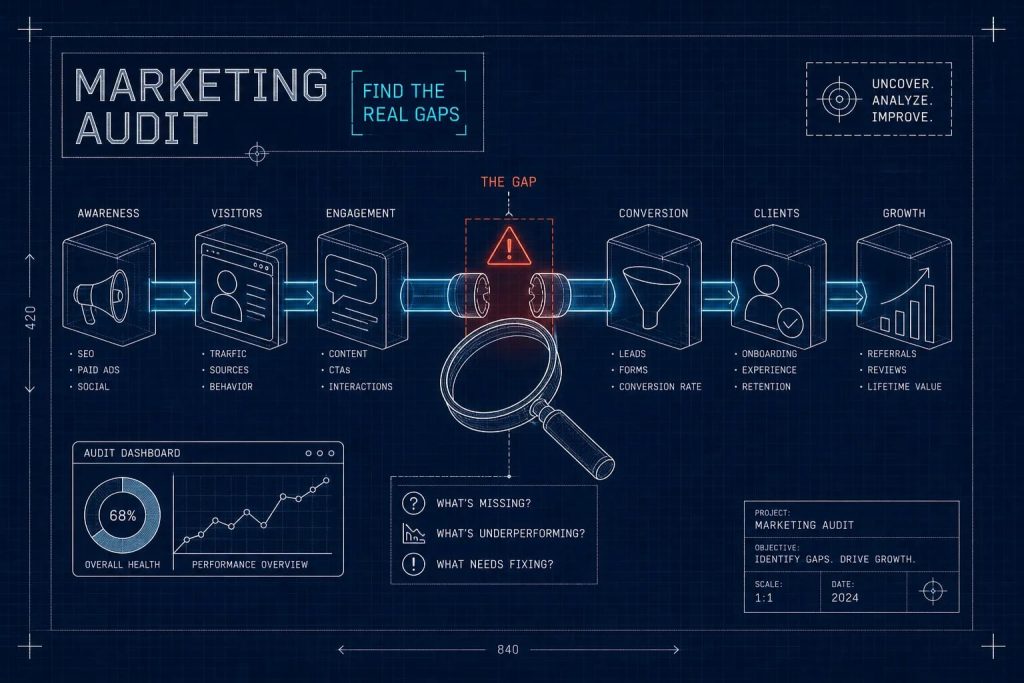
Why most service business audits look at the wrong things
The channel-first trap that wastes audit time
Most audits start with what’s easy to measure: traffic, impressions, click-through rates. Those numbers feel productive to analyze because they’re right there in the dashboard. The problem is that channels are delivery mechanisms. If the message they’re delivering isn’t clear, differentiated, or credible, improving channel performance just sends more people to a broken experience.
Service businesses consistently lose leads not because traffic is too low, but because the business doesn’t appear trustworthy enough to act on. Optimizing your Google Ads CTR while your homepage fails to answer basic buyer questions is like increasing water pressure through a cracked pipe. The audit needs to start at the strategy layer before it touches the channel layer.
Where service businesses actually lose leads
The drop-off typically happens at the positioning and proof stages, not the traffic stage. The average service business website converts roughly 3% of visitors to leads, and for many firms that number is lower. Most professional service firms have broad messaging written for internal insiders, inconsistent branding, and social proof that’s either thin or buried. All of that kills conversion before a call to action (CTA) ever gets seen. The audit areas below are sequenced to reflect where value is actually leaking, strategy first, channels second, because fixing the wrong layer in the wrong order wastes both time and budget.
How to run a marketing audit for service business owners: the five diagnostic areas
Digital positioning and message clarity
Start with the homepage and service pages. Ask three questions directly: Does this page communicate who the business serves? Does it name the specific problem it solves? Does it give a clear reason to choose this firm over any other? If the answers require more than five seconds to find, the messaging is failing.
The most common failure mode here is copy that reads like a brochure rather than an answer. Service pages written around internal process descriptions instead of buyer outcomes are one of the most reliable conversion killers. A prospect who can’t quickly understand what you do for someone like them won’t stick around to find out.
Proof signals and credibility markers
This is where most service businesses have their largest gap and their fastest potential wins. Audit the social proof layer across four dimensions: volume and recency of reviews, depth of case studies, specificity of testimonials, and placement of credentials at the right moments in the buyer journey. Generic five-star reviews don’t do the job. A testimonial that says “Great service!” tells a prospective client nothing actionable.
Specificity and placement matter more than quantity. A case study with concrete outcomes placed on the relevant service page will outperform a wall of anonymous testimonials on a dedicated reviews page. Missing contact information, anonymous team pages, and stale blog dates compound the problem. They signal to visitors that the business is either inactive or evasive. Every proof signal gap is a point where a prospect is choosing to trust a competitor instead.
Expertise visibility and customer engagement paths
These two areas are deeply linked. Ask whether your content demonstrates genuine competence or simply exists for visibility’s sake. A blog that publishes generic industry summaries signals the same level of expertise as no blog at all. Buyers don’t need more content; they need content that answers the specific questions they’re already asking before they contact anyone.
At the same time, audit the inquiry path itself. Is the contact form accessible on mobile without scrolling? What happens after someone submits a form? Lead-to-client conversion rates for home services typically benchmark around 55 to 70%. If your rate falls below that range, the issue is often in lead handling, response time, or follow-up process, not in the marketing campaign that generated the lead. A slow or confusing inquiry path destroys the trust the rest of your marketing worked to build.
The AI optimization check your marketing audit for service business is probably skipping
How AI platforms decide who to recommend
In 2026, a growing share of high-intent service leads starts with a query to ChatGPT, Google AI, or a voice assistant. These platforms don’t recommend the business with the most ads or the most impressions. They recommend the business whose digital presence most clearly signals expertise, authority, and trustworthiness in a way their systems can parse and verify.
ChatGPT and Google AI both evaluate authority by cross-checking multiple external signals: third-party mentions in authoritative sources, review quality and specificity, consistent business information across directories, structured schema data, and content that clearly matches the user’s service query. Self-published claims carry far less weight than corroborated evidence from outside sources. Most service businesses have never checked what their presence looks like to an AI system, and that’s exactly where a growing portion of future clients are now searching.
What your digital presence looks like to an AI search engine
Work through three questions during this part of the audit. First: does your website clearly communicate what you do and who you serve in language an AI system can extract and reference? Second: is your proof content structured and findable, with reviews, case studies, and credentials that appear across multiple corroborated sources? Third: does your business appear consistently across authoritative directories with matching name, address, phone, and service area?
If the answer to any of those is no or unclear, your AI visibility has gaps. A comprehensive digital marketing audit for service firms now requires this step. Skipping it means your audit is already out of date.
KPIs that actually matter during a marketing audit for service business owners
The metrics worth tracking at each stage of the funnel
Build your measurement stack by funnel stage. At the top: lead volume, cost per lead by channel, and traffic-to-inquiry rate. At the mid-funnel: appointment or consultation booking rate, speed-to-lead, and lead qualification rate. At the bottom: lead-to-client conversion rate, customer acquisition cost, and average deal value. For retention: customer lifetime value, repeat business rate, and referral rate.
Which stage you prioritize depends on where the audit reveals the biggest gap. If traffic is strong but inquiry rate is low, the issue is on-site. If inquiry rate is strong but close rate is low, the issue is in lead handling or sales process. Don’t let a dashboard full of metrics obscure that simple diagnostic logic.
The one ratio that exposes a broken marketing engine
Customer acquisition cost versus client lifetime value is the single most revealing ratio in a professional services marketing audit. If what it costs to acquire a client is rising faster than what that client is worth, you have a structural problem, not a channel problem. The general benchmark is to keep CAC below 20 to 30% of customer lifetime value. Above that range, you’re burning capital on growth that can’t sustain itself.
Calculate this from your existing data before making any decisions about budget changes. The number tells you immediately whether the fix belongs in marketing, pricing, retention, or all three.
How to turn audit findings into a 90-day action plan
Separating quick wins from structural gaps
After a thorough diagnostic, findings split into two buckets. Quick wins are things that can be fixed in days: adding a specific testimonial to a service page, tightening a CTA, fixing a broken contact form, updating an outdated team page. Structural gaps take longer, repositioning, rebuilding a content program around genuine buyer intent, or building the authority signals needed for AI visibility.
Start with quick wins not because they’re the most important but because they build momentum. A realistic 90-day roadmap looks like this: Weeks 1, 2 cover diagnosis and data validation; Week 3 delivers prioritized findings; Week 4 produces an owner-assigned action plan with deadlines. Weeks 5 and 6 extend into deeper channel analysis if needed. Quick wins go live during the structural work, not after it.
When a structured framework beats a DIY checklist
There’s real value in a self-directed audit, and this article is built for exactly that purpose. But be honest about when outside diagnosis adds more value: when findings are unclear, when the business has been stuck for more than two quarters despite marketing activity, or when a clear roadmap is needed before committing more budget.
TW3 Marketing’s Authority Audit™ is a structured diagnostic framework built around the six authority signals that both AI platforms and prospective clients use to evaluate a service business: positioning, proof, expertise, visibility, engagement, and experience. The 100-point scoring system produces a clear, prioritized roadmap rather than a list of observations with no sequence. For service business owners who want certainty before spending more, it’s the logical next step after working through the self-audit above.
Start with your three biggest gaps
A marketing audit for service business owners is most valuable when it diagnoses trust signals and conversion architecture, not just channel metrics. The five diagnostic areas covered here, positioning clarity, proof signals, expertise visibility, engagement paths, and AI visibility, address where service businesses actually lose leads.
AI visibility is no longer an advanced tactic. It’s where a growing portion of high-intent service leads start their search, and if your business can’t be parsed and verified by those systems, you’re invisible to that audience. Run the marketing audit checklist from this article and identify your top three gaps. For those who want a scored, structured assessment with a clear action plan attached, the TW3 Marketing Authority Audit™ delivers exactly that. Reach out to schedule your Authority Audit™ and get a scored, actionable roadmap within days.
