
A homeowner needs a new furnace. She grabs her phone, opens ChatGPT, and types: “Who’s the best HVAC company near me in Phoenix?” A name comes back, it’s not yours. She calls that company, books the job, and you never knew the opportunity existed. If you want to get found in ChatGPT before that happens to you, you need to understand exactly how these recommendations work. That scenario plays out thousands of times a day across every service category, and most local business owners have no idea it’s costing them jobs.
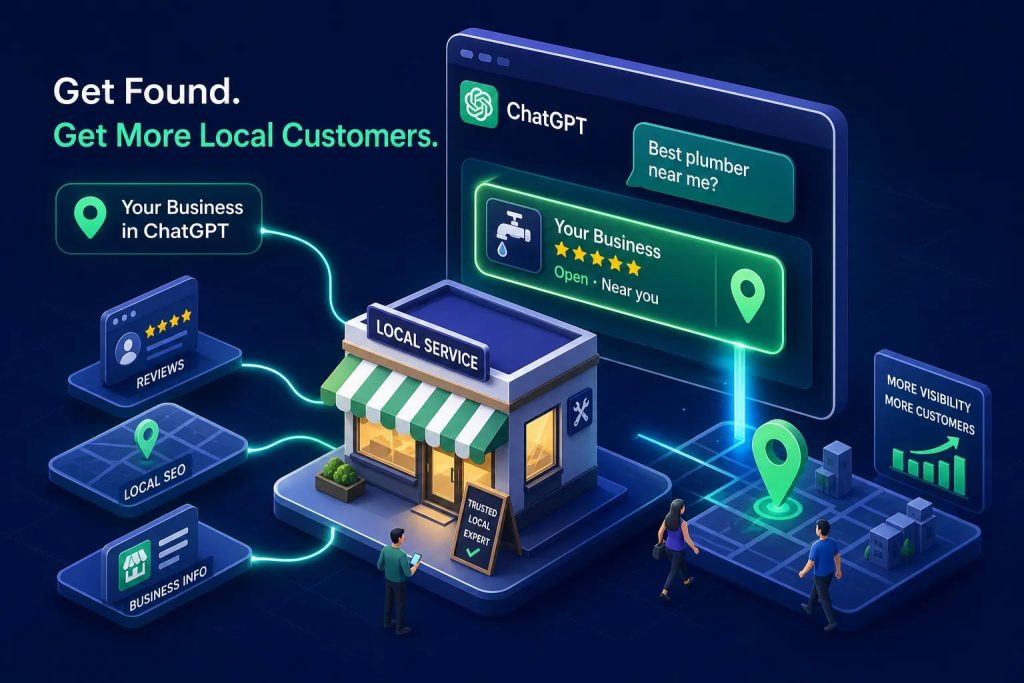
Getting recommended by ChatGPT isn’t random, and it’s not reserved for big brands with enormous marketing budgets. It comes down to specific, buildable signals that AI systems use to evaluate which businesses are credible enough to recommend. This article covers exactly what those signals are and how to build them: authority signals, structured data, expert content, and consistent business citations. Work through all four, and you give yourself a real shot at appearing in the answers your future customers are already reading.
Why ChatGPT recommends some local businesses and ignores others
ChatGPT doesn’t publish a ranking algorithm the way Google does with its developer documentation. What it does use is a combination of real-time web search and training data to surface businesses that demonstrate credibility. OpenAI has confirmed that any website can appear in ChatGPT Search, but appearing and being recommended are two completely different things. ChatGPT synthesizes answers from sources it can understand and trust, which means a business with weak digital authority, inconsistent information, or no structured data simply doesn’t register as a reliable answer.
The model scans retrievable web pages, cross-references what it finds against corroborating sources, and constructs a response that draws from whatever it can confidently cite. A business that exists only on its own homepage, with no external citations, no schema markup, and no expert content, gives the AI nothing to validate against. It’s not that ChatGPT dislikes your business. It’s that your digital presence doesn’t give it enough signal to work with.
The difference between being indexed and being recommended
Being indexed by search engines is the baseline requirement, the minimum table stakes for existing online. Being recommended by an AI assistant is a higher bar entirely. It requires consistent authority signals that cross-reference and reinforce each other across multiple platforms. Think of it this way: a human researcher fact-checking a recommendation would look for the same cross-referenced, verifiable signals. If your business only shows up in one place, saying one thing, with no external verification, a careful researcher wouldn’t recommend you either. AI systems work the same way.
The authority signals ChatGPT uses to evaluate your business
AI systems like ChatGPT evaluate businesses across several overlapping signals. Positioning clarity and proof, reviews, case results, credentials, and verifiable outcomes, form the first two layers. Topical expertise signals whether a site demonstrates genuine knowledge in its field, not just keyword-stuffed service pages. Digital visibility then asks whether the business is mentioned and verified across multiple trusted platforms. These aren’t theoretical frameworks. They’re the signals that determine whether a business gets cited or skipped entirely in a ChatGPT SEO context, and they’re the same signals that govern whether you show up in ChatGPT at all.
What a weak authority profile looks like in practice
Consider a plumbing company with 12 Google reviews, a homepage that says “trusted and reliable,” no published content, and inconsistent NAP data spread across directories. That business is functionally invisible to AI recommendation engines, not because the plumber does bad work, but because the digital signals communicate nothing trustworthy. The website claims reliability without proving it. There are no external sources confirming the claim. There’s nothing for ChatGPT to cite with confidence.
Where to start: getting a clear authority baseline
Before fixing individual signals, you need to know which ones are actually broken. That’s exactly where TW3 Marketing’s Authority Audit™ earns its place. It’s a 100-point diagnostic that scores your business across the specific authority factors AI platforms evaluate. A prioritized roadmap is delivered within 48 hours. Rather than guessing which signals need attention, you get a scored picture of where you stand and what to fix first. For businesses tired of throwing money at tactics without knowing why they’re not working, it’s a practical first step.
Structured data your website needs to get found in ChatGPT
Structured data is how you communicate directly to machines. Both search engines and AI systems depend on it to understand what a page is about, who published it, and what questions it answers. Without structured data, your content is readable to humans but essentially opaque to AI assistants. The recommended implementation format is JSON-LD: it’s clean, widely supported, and doesn’t require embedding code directly into your visible page content.
The schema types that matter most for local service businesses
For local service businesses, this is the priority stack to implement:
- LocalBusiness + Organization: establishes your entity, location, and service category. Use the most specific subtype available, HVACBusiness, Plumber, Electrician, rather than the generic parent type.
- FAQPage: creates extractable question-and-answer pairs that ChatGPT can pull directly into responses. This is one of the most consistently recommended schema types for AI citation.
- HowTo: signals procedural expertise on process-based service pages, useful for content like “how to prepare your HVAC system for winter.”
- Person: ties expert authorship to content and strengthens the E-E-A-T signals that AI systems use to evaluate source credibility.
- Article/BlogPosting: marks up written content with author, publish date, and topic, making it easier for AI systems to attribute and cite correctly.
One critical rule: schema only works when it matches visible on-page content. If your FAQPage markup contains questions that don’t appear anywhere on the page, it won’t help you, and may actively hurt your credibility with search systems.
How to implement schema without a developer
The “I need a developer” barrier stops a lot of small business owners from implementing structured data, and it doesn’t have to. Google’s Structured Data Markup Helper walks you through building schema by pointing and clicking on page elements. Rank Math’s schema builder handles this inside WordPress without touching code. Most modern CMS platforms have built-in schema plugins that cover the basics. Start with LocalBusiness schema using Rank Math, it takes under 20 minutes and immediately improves how AI assistants read your site.
How to create content that gets found in ChatGPT
Content architecture matters as much as writing quality here. ChatGPT cites sources that answer questions directly, clearly, and with specificity. Vague service pages with generic copy don’t get cited. Pages that answer specific questions a homeowner or buyer would actually ask, written in plain language, structured logically, and authored by someone with visible credentials, are the ones that get pulled into AI-generated answers.
Writing answer-style content that AI can extract and cite
The format that works is straightforward: lead each page or section with a clear, direct answer to the target question. Follow that answer with supporting context and specifics. Use headers that mirror natural question phrasing, the same way your customers would actually ask the question. This mirrors how ChatGPT formats its own responses, making it easier for the model to extract and cite your content. Pair this with FAQPage schema and you’ve created two reinforcing layers pointing to the same answer.
Building topical authority through consistent expert content
Publishing one great article isn’t enough. ChatGPT tends to cite sources that demonstrate consistent, deep expertise across a topic area, not single-page depth. A local HVAC company that has published 15 specific, helpful articles about heating system maintenance, efficiency ratings, and seasonal preparation signals topical authority in a way that a single “About Us” page never could. Consistency and specificity together build the kind of topical footprint AI systems recognize as reliable. Pick your core service topics, cover them thoroughly over time, and your site starts to look like a credible source rather than a marketing brochure.
NAP citations and business listings that build AI trust
Consistent Name, Address, and Phone number data across the web functions as a verification signal for AI systems. When ChatGPT cross-references a local business, inconsistent citations create noise: a different phone number on an old directory, a business name variation across platforms, an outdated address still live on Yelp. That noise reduces the AI’s confidence in recommending you. Consistent citations, on the other hand, build confidence by confirming that the information about your business is stable and verifiable, a key factor in whether you appear in ChatGPT for local service queries.
Which directories and platforms carry the most weight
For local service businesses in the United States, prioritize this citation stack:
- Tier 1: Google Business Profile (the single most critical citation for local AI visibility), Bing Places, Apple Business Connect, Yelp, and Facebook Business Page.
- Tier 2: BBB, Yellow Pages, Foursquare, Nextdoor, and chamber of commerce directories. For contractors and home services, add Angi, HomeAdvisor, and Houzz.
- Tier 3: Industry-specific associations and regional directories relevant to your category.
How to audit and clean up inconsistent citation data
Start with a simple manual check: search your business name plus your phone number on Google and review what comes back. Tools like BrightLocal or Whitespark automate this process, surfacing every citation across the web and flagging mismatches. Once you have the full picture, systematically correct the inconsistencies, starting with Tier 1 listings first. This isn’t a one-time task. Data drifts, new directories emerge, and old listings get corrupted over time. Build a quarterly citation review into your routine.
How to test whether your business shows up in ChatGPT
Most businesses do the work and never verify whether it’s having an effect. That’s a mistake. You need a repeatable process for testing your AI visibility so you know what’s working and where the gaps remain. Start with a simple manual test right now: open ChatGPT and search for the top service you offer in your city. If a competitor’s name appears and yours doesn’t, you have a clear baseline to work from.
Running prompt research to get found in ChatGPT for the right questions
The methodology for prompt research starts with real customer language pulled from sales calls, reviews, support tickets, and Google’s People Also Ask section. Convert that language into the kinds of questions your customers are typing into ChatGPT, then test those prompts directly. Tools like Semrush’s Prompt Research feature, Profound, or OtterlyAI can automate discovery and track prompt volumes at scale. The goal is identifying which specific questions your target customers are asking AI assistants, then building content and schema around those exact prompts.
Measuring AI visibility over time
Platforms like SE Ranking’s AI Visibility Tracker, Profound, or Peec AI let you monitor whether your business is mentioned or recommended across a set of tracked prompts, compare your visibility against local competitors, and track whether changes to your content and citations are having an effect. Set a baseline before you start optimizing. Re-test monthly. What gets tracked gets improved, and without a baseline, you’re optimizing blind.
The simplest way to start
Getting found in ChatGPT isn’t about gaming a new algorithm. It’s about building the kind of credible, consistent, well-documented digital presence that any intelligent system, human or AI, would recognize as trustworthy. The businesses showing up in AI answers aren’t doing anything exotic. They’ve done the fundamentals well: clear positioning, strong proof signals, expert content, consistent citations, and structured data that makes their expertise machine-readable.
Build your authority signals. Implement structured data. Publish answer-style expert content. Clean up your citation consistency. Then run a prompt test for your business name and your top service category in ChatGPT right now. If you don’t appear in ChatGPT, those four pillars tell you exactly where to start.
If you’d rather skip the guesswork entirely, TW3 Marketing’s Authority Audit™ gives you a scored, prioritized breakdown of where your authority signals stand and what to fix first, based on the same signals AI platforms use to evaluate which businesses deserve a recommendation. It’s a structured starting point for businesses serious about showing up where their customers are already looking. Start now.
